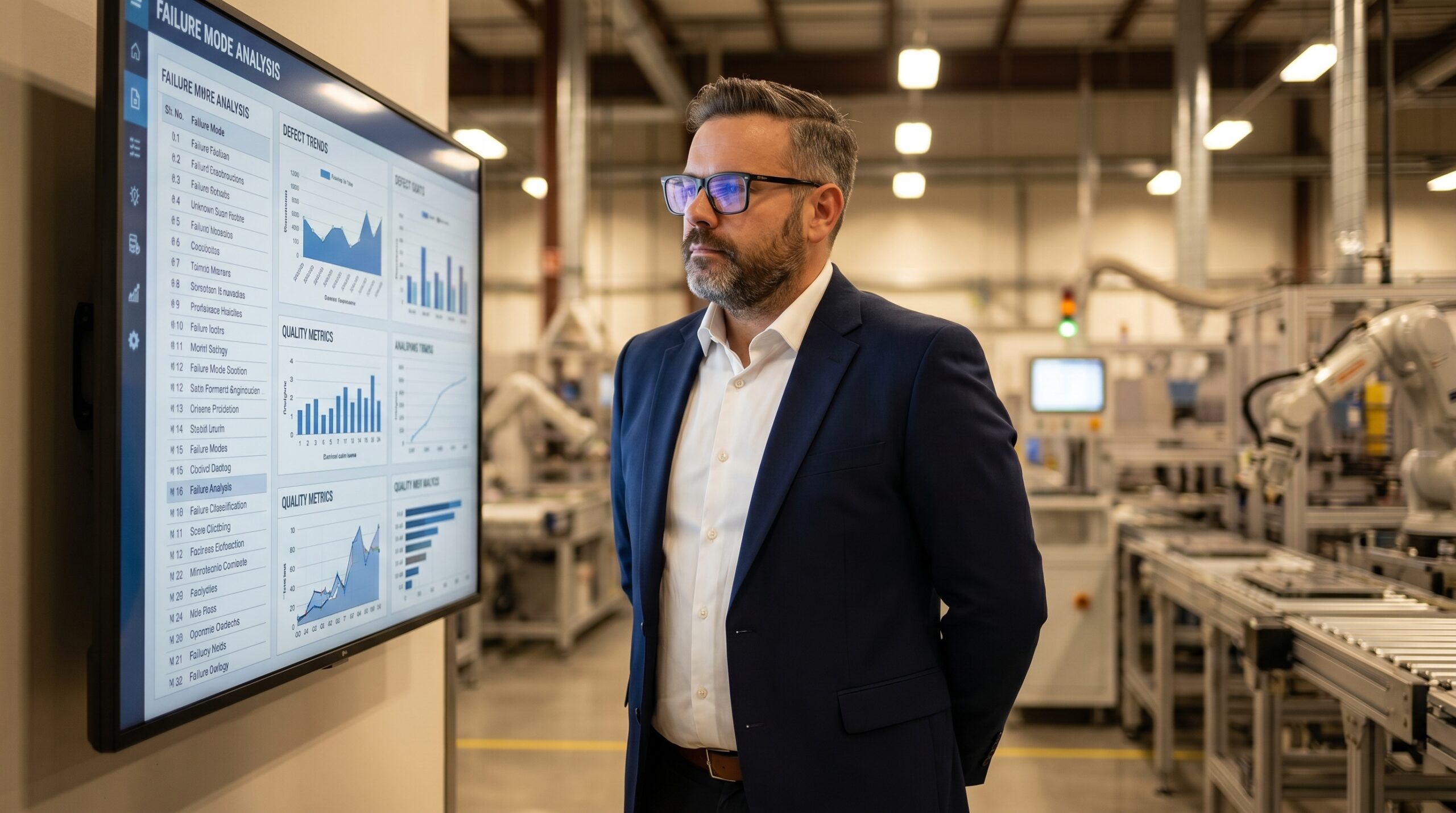
Organisations repeatedly solve the same quality problems because they have no institutional memory for failure. When a defect occurs, a team forms, runs an 8D investigation, finds the root cause, and implements a corrective action. The report is filed by date and part number, then forgotten. Three years later, a different engineer on a different line discovers the exact same failure mode and starts the investigation from scratch.
I have audited plants where experienced engineers left overnight, taking decades of unwritten failure knowledge with them. The standard response is to demand better documentation, but the structural problem is taxonomy. Completed 8D reports and customer complaint records are indexed transactionally, not by failure mechanism. When an engineer searches for similar precedents, the search terms do not match the titles.
A Failure Mode Catalog solves this by capturing the full lifecycle of every significant failure in a structured, cross-referenced knowledge base. It indexes defects by their physics and mechanisms rather than by complaint number. This makes historical data instantly accessible, transforming isolated 8D reports into a predictive quality asset.
The Structural Disconnect in Quality Data
The 8D process is excellent at solving isolated problems but terrible at preserving institutional knowledge. Most organisations bury completed reports in document management systems where they are indexed by date, product, or customer. There is no mechanism to search by failure mechanism or root cause category. The data exists, but it is functionally invisible.
Simultaneously, Process FMEAs are strictly forward-looking prediction tools. They ask what could go wrong, but they rarely incorporate lessons from actual failures. The feedback loop is broken. PFMEA lives in its own file, 8D reports live in another, and the two never interact. This guarantees that risk assessments miss failure modes the organisation has already paid to discover.
Cross-plant learning suffers the same fate. In multi-site operations, Plant A and Plant B often run identical equipment and materials. When Plant A solves a chronic defect through a costly investigation, that solution rarely reaches Plant B. Each site remains an island, proudly developing unique fixes for problems solved years earlier elsewhere.
Quality Data: Isolated Tools vs Integrated Catalog
What teams do now
- 8D reports indexed by customer complaint number
- FMEAs based on brainstorming, disconnected from actual failures
- Plants independently solving identical defects
- Knowledge trapped in the heads of senior staff
What a catalog does
- Failures indexed by physical mechanism and root cause
- FMEAs actively populated using historical failures
- Investigations and solutions shared instantly across sites
- Institutional knowledge captured in a searchable database
Defining the Failure Mode Description
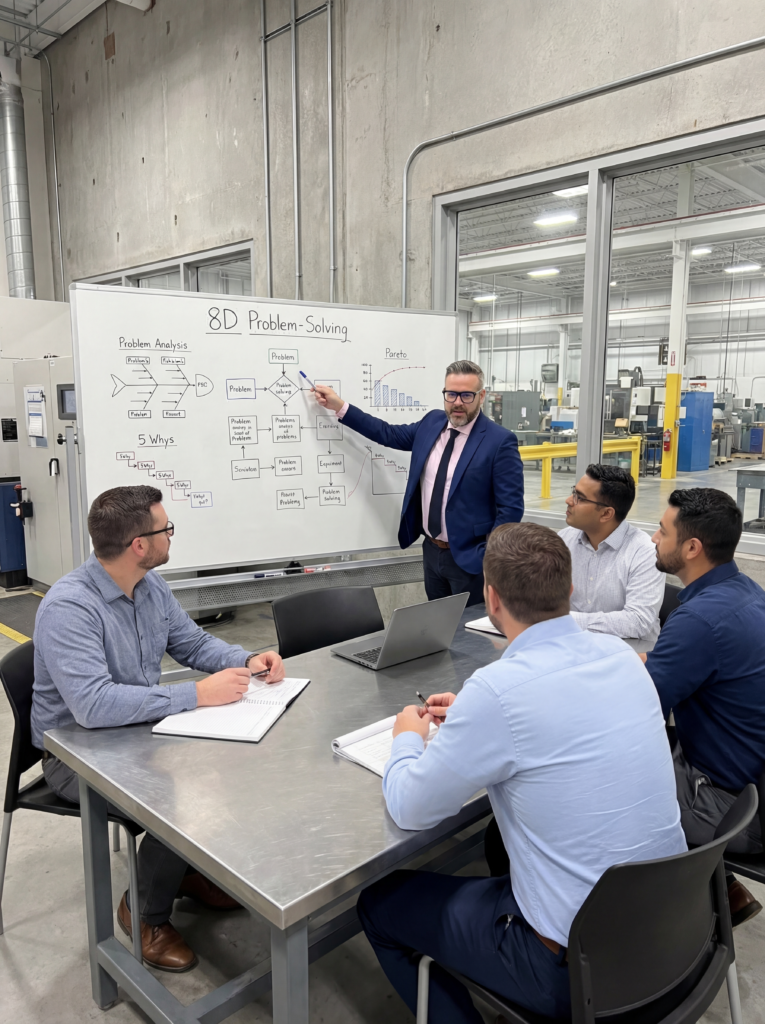
The core of the catalog is the failure mode description, written in standardized, process-agnostic language. It must describe the physics, chemistry, or mechanism of the failure, not the symptom. A description like customer complaint 4721 or scrap event on line 6 is useless to future searches. The catalog demands precise engineering definitions.
A proper entry reads: crack initiation at heat treatment boundary zone due to thermal gradient exceeding material specification. Another might be: adhesion failure between substrate and coating due to surface contamination from upstream cleaning process. This standardised vocabulary ensures an engineer in any plant, working on any product, can recognise the failure mechanism and relate it to their own processes.
Writing these descriptions requires discipline. Teams must strip away product-specific jargon and focus on the underlying physical cause. The goal is to make the entry universally recognisable across the organisation. When a new product enters development, engineers can query the catalog for failure modes associated with similar materials and processes, getting an instant head start on risk identification.
Root Cause Taxonomy and Action Effectiveness
Every failure mode must be linked to root causes drawn from a controlled vocabulary. Free-text root causes destroy searchability. The taxonomy forces investigators to categorise causes into standard buckets: material deviations, process parameter drift, human factors like procedural deviations, design inadequacies, or systemic control plan failures. Consistent categorisation is what makes patterns visible.
When you search by root cause category across hundreds of failures, systemic weaknesses emerge. If thirty percent of high-cost defects trace back to inadequate tolerance specifications, leadership has a clear mandate. The catalog also captures implementation details for corrective actions, rating their actual effectiveness. This prevents organisations from re-implementing countermeasures that looked good on paper but failed in practice.
Recurrence tracking is the ultimate test of the catalog and your corrective action system. The catalog logs whether a failure mode resurfaces after a fix is implemented. If it does, the entry captures why: the action was inadequate, it was not sustained, or process changes bypassed the control. Most organisations ignore recurrence. The catalog makes this critical data visible to auditors and management.
Integrating the Catalog into APQP and 8D
A standalone catalog will fail. It must be hardwired into your core quality processes: the 8D workflow, PFMEA development, control plan creation, and APQP. Integration runs in two directions. Every completed 8D report must feed the catalog as a mandatory process step. Simultaneously, every new PFMEA and control plan must query the catalog first. The catalog becomes the starting point for risk identification, not an afterthought.
Cross-referencing is where the catalog generates compounding returns. Each failure mode links to specific products, processes, materials, equipment, and PFMEA entries. When a design engineer selects a new material, they query the catalog for historical defects associated with that material family. When a process engineer writes a new control plan, they pull failure modes linked to that equipment type.
Governance is essential for multi-site deployment. Plant A's failure must become Plant B's prevention. This requires a shared taxonomy, a common review process, and clear ownership. Assign a curator to maintain the database, merge duplicates, and enforce data standards. Without dedicated ownership, the catalog decays into another abandoned SharePoint site.
If adding a failure mode to the catalog requires filling out a 20-field form, nobody will do it. Make entry easy; enrich the data later.
Practical Implementation Phases
Start with history. Go back two to three years and analyse your most significant quality events, filtering for the top twenty percent by cost, customer impact, or recurrence frequency. These anchor entries form the foundation. Define the taxonomy early, but do not overcomplicate it. A simple, rigid structure works better than a perfect, complex one that delays deployment.
Choose a platform that is searchable and accessible. Purpose-built QMS modules work, but a structured relational database or a tightly governed SharePoint site is fine. The platform matters less than the discipline of using it consistently. Do not let tool selection become a six-month project. Prioritise functionality over elegance, and launch the minimum viable product.
Failure Mode Catalog Deployment Sequence
- 01Historical AnalysisMine 2-3 years of top-cost 8D reports to build initial anchor entries.
- 02Taxonomy DefinitionAgree on standardised vocabulary for failure mechanisms and root causes.
- 03Process IntegrationHardwire catalog inputs into 8D and outputs into PFMEA and APQP.
- 04Cross-Site ExpansionDeploy across plants to multiply the preventive value of historical failures.
Measuring the Return on Institutional Memory
The business case for a Failure Mode Catalog is straightforward. Track how much investigation time is saved when a recurring failure mode is identified instantly instead of investigated from scratch. A well-maintained catalog typically reduces investigation time for known failure modes by over half, freeing quality engineers to focus on novel defects rather than repeating historical research.
Beyond investigation speed, the catalog cuts FMEA development time significantly because risk identification is faster and more accurate when teams query actual history. New product development accelerates because design engineers have a searchable library of manufacturing risks. Supplier development improves when you share sanitized catalog data, transforming transactional relationships into strategic defect prevention.
Audit readiness improves measurably. When an IATF 16949 or AS9100 auditor asks how lessons learned are incorporated, the catalog provides tangible evidence. You can demonstrate a live search, pull up the relevant failure mode, and show its integration into the current control plan. The most important return, however, is preventing the next safety incident or line stoppage using knowledge that already exists within your organisation.
Starting Tomorrow Morning
Do not wait for a system rollout. Pick your top ten most painful quality events from the past two years. Write a one-paragraph description of each failure mode using the physics and mechanism language, stripping away part numbers and line references. Categorise the root causes and rate the effectiveness of the corrective actions. Put them in a simple table.
Share that table with three colleagues at different sites or in different functions. Ask them directly: have you seen any of these failure mechanisms before? Are any of them happening right now? Listen carefully to the answers. That conversation will prove the immediate value of shared institutional knowledge.
Every defect that escapes carries a message about how your organisation manages knowledge. The Failure Mode Catalog is how you ensure that the price paid for every failure, the scrap and the overtime, actually buys permanent institutional wisdom. The most expensive mistake in quality engineering is not the initial defect. It is solving the exact same problem a second time.