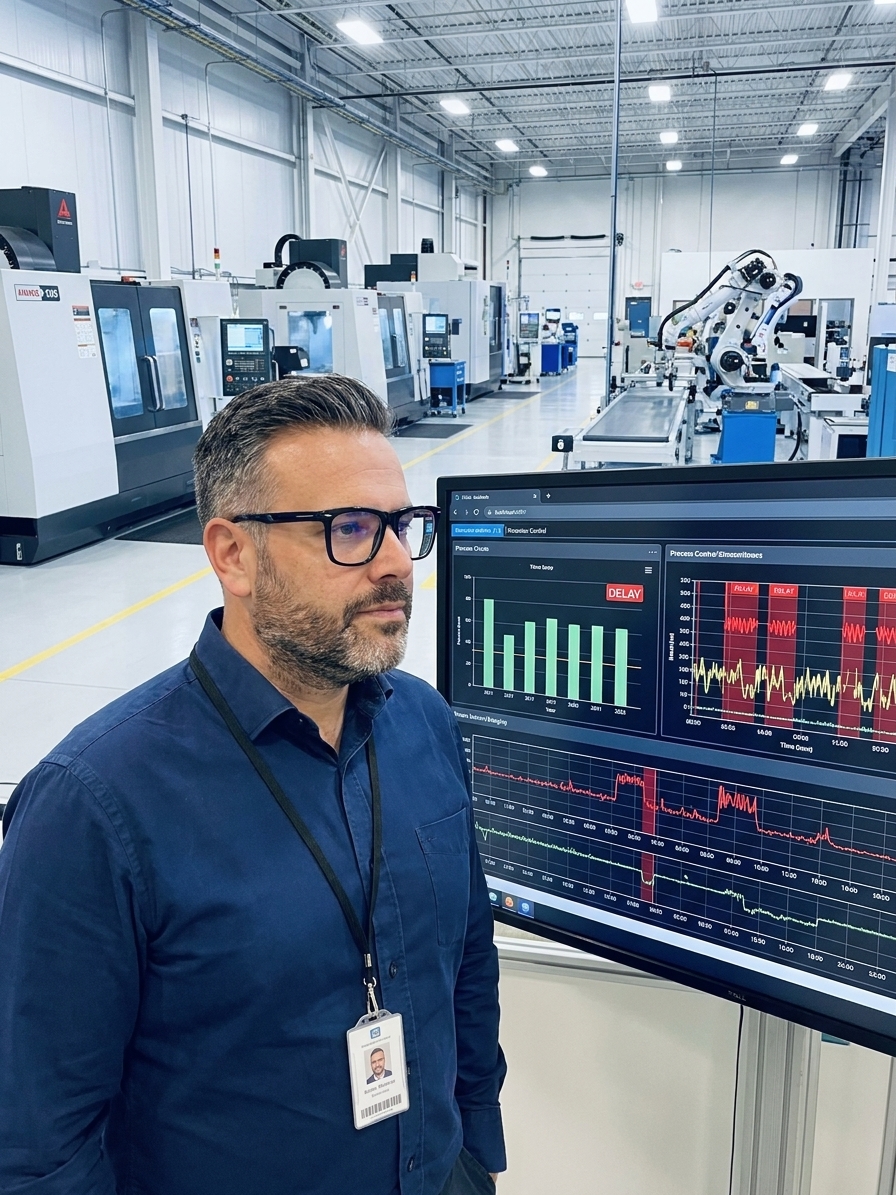
You adjust a feed rate on Monday, retrain an operator on Tuesday, and tighten a tolerance on Wednesday. By Friday, nothing has changed. Two weeks later, defect rates spike — but not where you expected, and not in a way that points back to any single adjustment. This is feedback delay, and it dismantles quality management capability more thoroughly than any individual defective part.
Feedback delay is the time gap between an action and its visible consequence. In manufacturing quality, this gap is structural. You change a supplier and the defect impact arrives three months later. You modify a heat treatment cycle and fatigue failures appear after a year of field service. You launch a training programme and the behavioural shift gets absorbed by daily routine before it ever registers in the data.
The core problem is not that feedback fails to arrive. It is that by the time it does, you have already made six more decisions, changed three more parameters, and launched two more initiatives. The consequences arrive tangled in overlapping effects, making it nearly impossible to trace any single outcome back to its cause. The systems thinker Donella Meadows identified this delay as one of the most dangerous features of any complex system — it creates the illusion that your actions carry no consequences, and that illusion breeds recklessness.
Process Changes That Appear Benign
I have audited plants where a seemingly harmless material substitution caused catastrophic quality drift months later. In one machining operation, a change of cutting fluid brand — approved because the new product met all specifications on paper — led to subtle surface finish degradation eight months later. Parts that previously measured Ra 0.4 were now arriving at Ra 0.6. Still within specification, but measurably different to a customer who had tracked these parts for years.
The investigation took another two months. The new fluid had a marginally different thermal conductivity, causing the cutting zone to run hotter. Tool wear accelerated by approximately 12 per cent. Tools were being used past their effective life because the change interval had been set against the old fluid's performance characteristics. Nobody updated the interval when the fluid changed.
The fix took minutes. The detection took ten months. The customer relationship required significant repair work. Every element of the quality system — engineering approval, production monitoring, tool management — functioned exactly as designed. The system simply was not designed to detect a delayed consequence from a change that looked completely benign on the day it was made.

Supplier Quality and Latent Failure Modes
Supplier quality operates on the longest feedback loops in manufacturing. You audit a supplier, approve their process, sign the PPAP, and receive parts for months or years before an issue surfaces. When it does, it frequently reveals a condition that has existed since the very beginning — one your incoming inspection never caught because the defect was latent, the failure mode was cumulative, or the specification was technically met in ways that masked a real problem.
Consider a stamped bracket supplier whose parts passed all dimensional inspections and material certifications. Three years after installation, stress corrosion cracking emerged in units operating in coastal environments. The supplier had been using a stainless steel grade that met chemical composition requirements but carried a different microstructure due to a modified annealing process — a change made two years before the first field failure.
Nothing in the standard testing protocol was designed to catch that specific variation. The quality system — audits, inspections, certifications — had functioned as specified. The feedback delay was measured in years, not weeks, and by the time the signal arrived, hundreds of thousands of parts were already in service. This is the fundamental challenge of supplier quality: the tools we use to validate conformity are blind to failure modes that develop over timescales far longer than the validation cycle itself.
How Delay Breaks the Quality System
Feedback delay does not merely make detection harder. It alters how the quality system behaves in three specific ways, each of which compounds the others. Understanding these failure modes is the first step toward designing countermeasures that actually work.
How Feedback Delay Distorts Quality Behaviour
What teams instinctively do
- Overcorrect: push harder when the first change shows no immediate result
- Stack changes: adjust three parameters at once hoping one works
- Reward visible activity over deliberate, slow-yielding intervention
- Abandon initiatives when monthly metrics do not move within a quarter
What the system requires
- Wait: let the system respond before adding a second intervention
- Isolate: change one variable to preserve causal clarity
- Judge decisions by their reasoning, not by delayed consequences
- Track long-term trend data alongside tactical monthly dashboards
Delay encourages overcorrection. When you do not see the effect of your action immediately, you assume it was insufficient. So you push harder, change more variables, and introduce additional interventions. By the time the original change produces its effect, you have stacked so many modifications on top of it that the system is oscillating wildly — improving and degrading in cycles you created yourself. This is the manufacturing equivalent of the beer distribution game: the manager who keeps adjusting parameters because the last adjustment has not shown results yet, creating variation that dwarfs the original problem.
Delay breaks causal inference. The human brain is wired for immediate feedback — touch a hot surface, feel pain, learn. Change a process parameter and see the result three weeks later, and the learning circuit barely fires. This is why identical quality problems recur in organisations. It is not stupidity or carelessness. The feedback loop is simply too long for natural learning to take hold, and no amount of training documentation compensates for a brain that cannot connect cause to effect across a multi-week gap.
Compressing the Feedback Loop
If the natural feedback loop is three months, find a way to make it three weeks. This does not mean changing the process itself — it means changing what you measure and when. Instead of waiting for customer complaints, build accelerated life testing that reveals failure modes in days. Instead of tracking monthly defect rates, implement real-time SPC that flags process drift as it happens. Instead of relying solely on annual supplier audits, introduce incoming testing protocols that catch material variations before they enter production.
The goal is not to eliminate delay entirely. Some delay is built into the physics of the process, the chemistry of the material, or the economics of the supply chain. The goal is to compress the loop enough that the human brain can still connect cause to effect. At SNOP, where I built a greenfield QA department for a plant of over 900 people, we introduced Routing Verification KPIs that cut internal lead time by 97 per cent. The principle was the same: shorten the distance between action and feedback, and every downstream quality decision gets sharper.
Acceleration testing, real-time SPC, and incoming material verification all serve the same function. They bring the consequence closer to the action. They do not replace the long-term feedback loop — customer complaints, field returns, warranty data — but they give you an early signal that lets you act before the full consequence arrives. The cost of building these faster loops is always lower than the cost of discovering a problem ten months after you caused it.
The Single-Variable Change Protocol
- 01Log the changeRecord the parameter, the baseline value, the new value, and the date in a controlled change log.
- 02Freeze other variablesHold all other process inputs constant. No parallel adjustments, no informal tweaks by operators or engineers.
- 03Wait for the system responseResist intervention until the full feedback delay period has elapsed and the effect is visible in SPC data.
- 04Measure against baselineCompare post-change data against the pre-change control chart. Confirm statistical significance before judging the result.
- 05Decide and documentAdopt, reject, or iterate — and record the outcome so the organisation retains the learning even if individuals move on.
Causal Discipline and Institutional Memory
In a delayed feedback environment, changing one variable at a time is not a scientific luxury. It is the only way to maintain causal clarity. When you change three process parameters simultaneously and the defect rate drops two weeks later, you have no way of knowing which change caused the improvement — or whether any of them did, or whether the improvement was random variation. Design of Experiments methodology exists precisely to solve this problem, yet the discipline of single-variable changes is violated constantly on shop floors where speed is valued over rigour.
Since individual learning is impaired by feedback delay, organisational learning must compensate. This requires rigorous documentation of every process change, every supplier modification, and every training initiative — with enough context that someone can look back six months later and connect a defect trend to the change that caused it. A process change log should be treated with the same seriousness as any controlled document under IATF 16949 or AS9100. It must be mandatory, searchable, and actually consulted when investigating quality trends.
In a delayed feedback environment, the most powerful quality tool is not a statistical method. It is patience guided by rigor.
The habit of looking backward before looking forward is rare in quality organisations. Most teams investigate a defect spike by asking what changed yesterday. The right question is often what changed three months ago — or six months, or a year. Building this discipline means training your 8D teams to consult the change log as a standard first step, not as an afterthought when the obvious causes have been exhausted.
Extending the Time Horizon
Most quality organisations operate on a tactical time horizon — this week, this month, this quarter. The most consequential quality dynamics play out over years. The supplier qualification process that seemed adequate but missed a latent failure mode. The training programme declared a failure after three months that would have shown measurable results at twelve. The process improvement abandoned because the metrics did not move fast enough to satisfy a quarterly review cycle.
The solution is not to ignore short-term metrics. It is to supplement them with long-term trend analysis capable of detecting the slow-moving signals that monthly reports miss. This means control charts that span years, not weeks. It means supplier performance data that tracks cumulative trends rather than individual lot results. It means customer complaint analysis that looks for emerging patterns across product families and time horizons, rather than simply reacting to the latest field return spike.
The fastest-moving organisations are the most vulnerable to feedback delay, because they make decisions faster than the system can validate them. Every unvalidated decision is a bet, not a strategy. The quality organisations that thrive are the ones that have learned to act decisively when the feedback loop is tight and to wait deliberately when it is not — and that have built the institutional memory to connect a consequence today to a decision someone made months ago and may have already forgotten.