
Failure Mode and Effects Analysis (FMEA) is the core prevention mechanism in modern quality engineering. Yet most organisations treat it as a documentation exercise to satisfy IATF 16949 or AS9100 auditors. They assemble a cross-functional team, fill out a spreadsheet with generic failure modes, assign arbitrary severity and occurrence ratings, and file it before the production launch. This approach actively undermines quality and leaves real failure modes undiscovered until they reach the customer.
Having implemented and transitioned ISO 9001 and sector-specific quality management systems at a major aerospace manufacturer, SNOP, and WITTE Automotive, I have seen precisely how FMEA functions when driven by engineering logic rather than compliance. FMEA works when it forces a design or manufacturing engineering team to confront specific physical and process failure mechanisms before they occur. It fails entirely when it becomes a paper-generation exercise disconnected from the actual PFMEA control plan or the DFMEA design validation.
The standard divides the discipline into three distinct engineering applications: Design FMEA (DFMEA), Process FMEA (PFMEA), and Machine FMEA (MFMEA). Each operates on a different axis of the product lifecycle. Each requires its own inputs, cross-functional expertise, and specific validation outputs. Applying them correctly is the operational difference between a stable, capable process and one that perpetually escapes control.
DFMEA: Engineering Risk Out of the Product Concept
Design FMEA examines how a product's architecture might fail under specific operating conditions. The engineering team maps the functional requirements of the design, then systematically identifies the physical ways those functions can degrade or break. This covers material fatigue, software logic errors, thermal degradation, and tolerance stack-up failures. You cannot manufacture a defect-free product from a compromised design, and DFMEA is the mechanism that exposes those compromises before tooling is cut.
Effective DFMEA requires specific mechanical and material inputs. The team must review boundary diagrams, historical warranty data from comparable product families, and application-specific engineering standards. When the team identifies a high-severity failure mode—such as a structural bracket failing under dynamic load—they must engineer it out. This is done by increasing the safety factor in the design, changing the material specification, or adding physical redundancies.
The output of a functional DFMEA is a revised design with validated mitigations. If a failure mode remains unmitigated in the final design, it must carry explicit detection controls downstream. These feed directly into the Design Verification Plan, ensuring the specific risk is physically tested and quantified before the design is ever released to manufacturing.
In the automotive sector, I have applied DFMEA during new model development to identify potential safety-critical failure modes in chassis and electronic architectures. The result was the systematic elimination of high-risk design vulnerabilities before prototype builds. By resolving these issues in the virtual and blueprint phase, the engineering changes that typically disrupt a production launch were avoided entirely.
PFMEA: Controlling Variation on the Manufacturing Floor
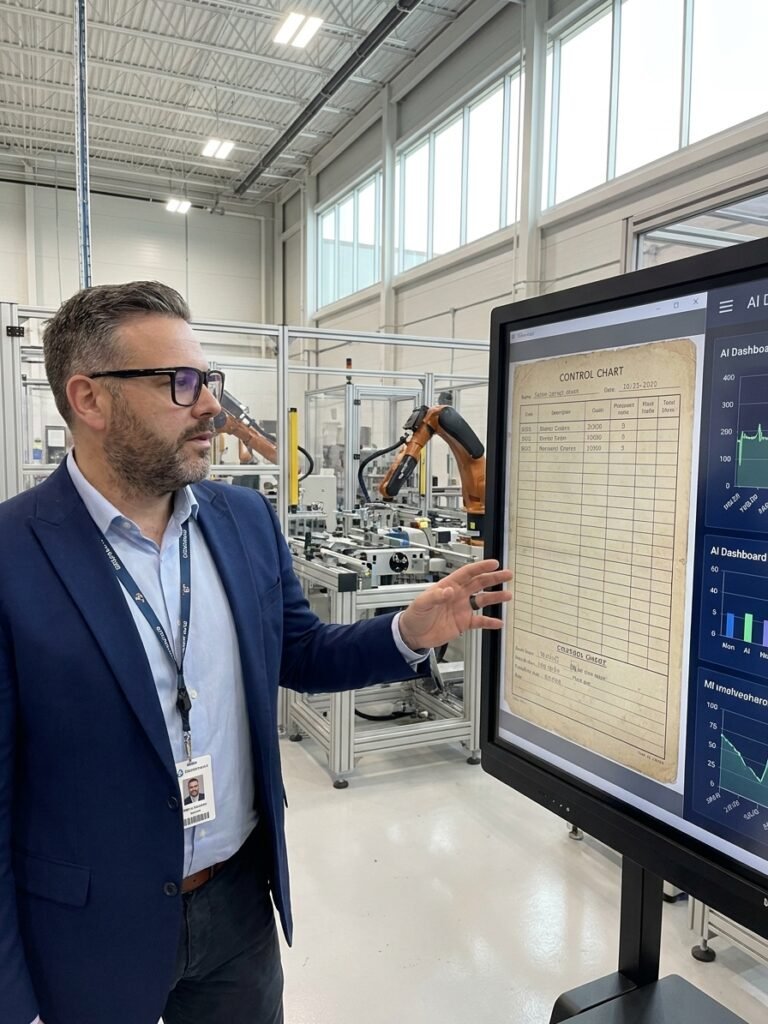
Process FMEA shifts the analytical lens from the product drawing to the manufacturing process flow. The PFMEA team breaks the routing down into individual operations and asks what can go wrong at each step. They identify the specific process parameters—torque, temperature, feed rate, cycle time—that drive variation. Without this rigorous analysis, a process cannot be stabilised, and quality will rely entirely on end-of-line inspection.
The engineering work in PFMEA focuses directly on the severity, occurrence, and detection ratings. A high severity rating for a missing weld demands an engineering change to the fixture or the addition of poka-yoke to physically prevent the error. A high occurrence rating for a dimensional tolerance drift requires tightening the process capability, often targeting a Cpk of 1.33 or greater to ensure the process remains robust over time.
A PFMEA is a strictly living document. When an 8D corrective action resolves a field escape or an internal nonconformance, that specific failure mode and its validated control must be immediately updated in the PFMEA. If the database does not reflect the plant's current process reality, the engineering team loses its primary mechanism for systemic learning. The failure will inevitably recur on the next production run.
MFMEA: Predictive Maintenance and Equipment Capability
Machine FMEA targets the reliability of the specific equipment used to execute the process. It systematically analyses mechanical, electrical, and pneumatic failure modes of the machinery itself. This methodology moves plant maintenance away from a purely reactive posture—fixing the machine after it breaks—and establishes a predictive, condition-based maintenance strategy based on actual data.
MFMEA evaluates the criticality of machine components. The analysis reviews wear parts, sensor degradation patterns, and hydraulic system reliability. By calculating the Mean Time Between Failures (MTBF) for specific subsystems, maintenance teams can schedule component replacements during planned downtime. This prevents in-process equipment failures that instantly generate scrap and halt production lines.
Equipment capability is fundamental to process capability. If a CNC machine spindle vibrates outside its baseline tolerance, the dimensional accuracy of the parts it produces will drift. MFMEA provides the engineering justification for capital expenditure on equipment upgrades and rigorously drives the overall equipment effectiveness (OEE) metrics that plant management relies on.
Core FMEA Risk Priority Thresholds
Sector-Specific Applications and Rigor
Different industry standards demand different levels of rigour. When supporting an Audi supplier facing strict Formel Q requirements for electronic modules, the FMEA had to account for highly specific electromagnetic compatibility (EMC) risks. The analysis mapped circuit-level failure modes to vehicle-level safety consequences, directly driving the implementation of shielding designs and rigorous EMC bench testing to secure approval.
In modular automotive manufacturing environments, flexibility introduces a high degree of process complexity. High model mix and shared tooling mean failure modes compound across different product variants. Applying PFMEA in this environment requires mapping the failure modes unique to the changeover process itself. Controlling the interface points between automated and manual stations is where system reliability is genuinely engineered.
An FMEA that sits in a shared drive and is never updated after launch is worse than having no FMEA at all.
In aerospace, the stakes are higher and the regulatory oversight is absolute. Under AS9100 and EASA regulations, a missed failure mode in a structural component or a flight control system can result in catastrophic loss. DFMEA in this sector requires rigorous adherence to safety-of-flight criteria. Traceability from the FMEA risk to the specific verification test is non-negotiable and heavily scrutinised during certification audits.
Integrating FMEA with APQP and the Control Plan
FMEA does not operate in a vacuum. It is a core element of the Advanced Product Quality Planning (APQP) framework. The outputs of the DFMEA and PFMEA feed directly into the Design Verification Plan and the Production Control Plan. If a PFMEA identifies a critical dimensional tolerance with a high occurrence of variation, the Control Plan must specify a 100% automated inspection or a validated statistical process control (SPC) check at that exact operation.
This direct linkage is exactly what auditors look for under VDA 6.3 process audits. They trace a specific characteristic from the engineering drawing, through the process flow, into the PFMEA risk analysis, and finally to the control method on the shop floor. A breakdown anywhere in that traceability chain represents a critical systemic failure in the quality management system. The linkage itself is the primary value of the documentation.
Production Part Approval Process (PPAP) submissions require this documented linkage to be flawless. The PFMEA must demonstrate that the organisation understands its process risks and has implemented engineering controls to mitigate them. Generic, cut-and-paste FMEAs submitted for PPAP are routinely rejected by OEM engineering teams, delaying the production launch entirely and damaging the supplier's technical credibility.
APQP FMEA Integration Cycle
- 011. Boundary DefinitionMapping system architecture and process flow diagrams
- 022. Function & Failure AnalysisLinking engineering functions to physical failure modes and severity ratings
- 033. Risk OptimisationEngineering out high-severity risks and applying prevention controls
- 044. Control Plan LinkageTranslating detection controls directly into specific manufacturing instructions
- 055. 8D Feedback LoopUpdating the PFMEA database with validated data from actual field escapes
Building Genuine FMEA Maturity in the Organisation
FMEA maturity is not measured by the volume of documentation produced, but by the engineering decisions it drives. When I built the greenfield QA/QC department for a 900+ employee plant at SNOP, the objective was not to generate paper. The objective was to engineer a process control system where the PFMEA served as the central operational reference for every process change, every piece of new equipment, and every operator training module.
A mature organisation uses FMEA to drive capital investment. If an MFMEA reveals that a critical machine centre has a low MTBF for a primary bearing, the engineering data justifies the capital expenditure for a redundant system or an equipment replacement. The analysis shifts the internal conversation from subjective operational complaints to objective engineering risk management, quantified by standard industry metrics.
Ultimately, effective FMEA requires a fundamental shift in organisational mindset. Quality professionals must transition from being the guardians of compliance documentation to being drivers of engineering risk elimination. The analysis is the mechanism. The output is engineered prevention. When applied systematically across design, process, and equipment, FMEA mathematically and physically reduces the probability of failure reaching the end customer.