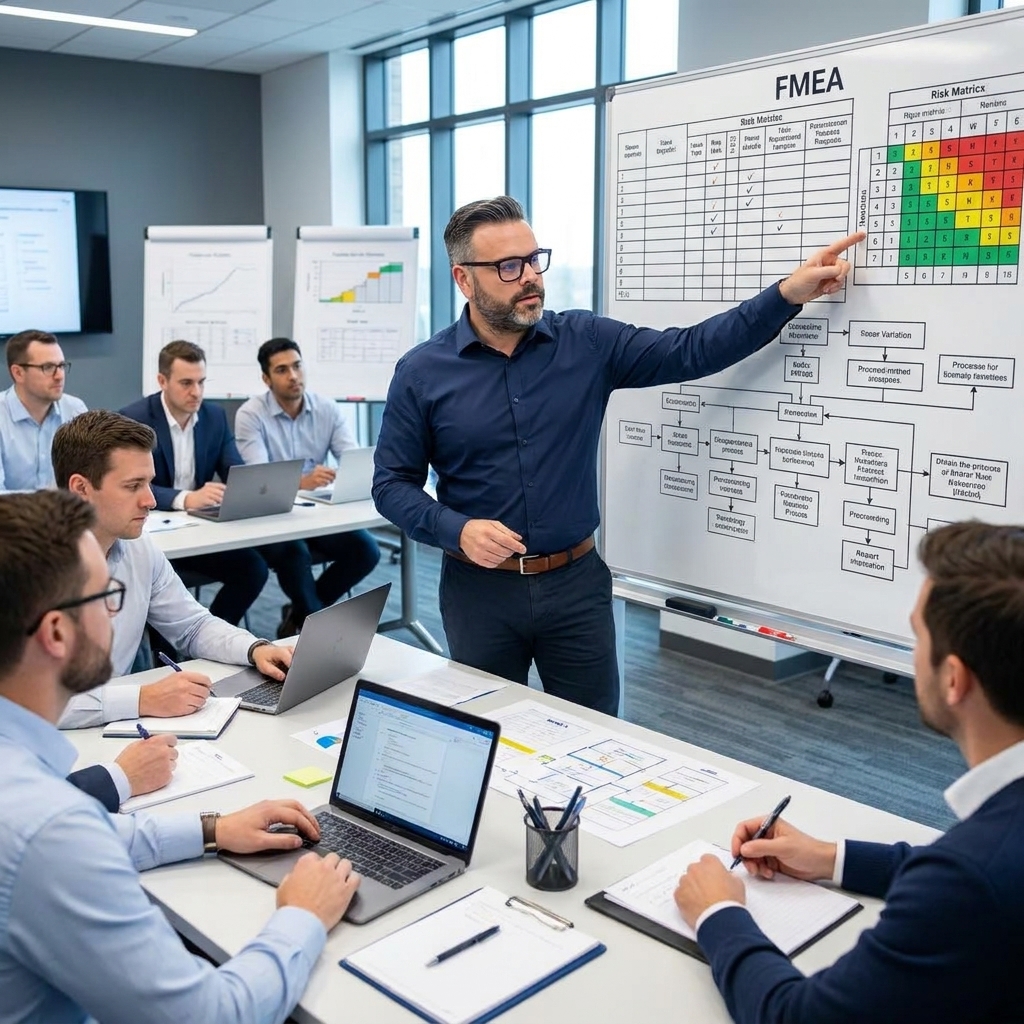
Most Failure Mode and Effects Analysis (FMEA) training is a passive exercise in compliance. Someone stands at the front of a conference room, projects the AIAG-VDA handbook definitions, and reads them aloud while the audience disengages. By the time the facilitator reaches the risk priority number matrix, the room is mentally absent.
This approach fails because it treats FMEA as a document rather than an engineering discipline. If your team only opens an FMEA file during a third-party audit, your risk analysis process is already defective. Training people on a broken process simply teaches them to go through the motions more efficiently.
Effective FMEA instruction requires a complete departure from slide-based lecturing. It demands a workshop structure where engineers build a real analysis on a real product, experience the difficulty of failure discovery, and leave with assigned actions that mitigate actual risk.
Diagnosing the Audit-Driven FMEA Culture
Before designing any training intervention, you must assess how the organization currently uses its FMEAs. Ask the engineering team when they last opened a Process FMEA (PFMEA) or Design FMEA (DFMEA) outside of an IATF 16949 or AS9100 audit cycle. The silence that follows is your baseline diagnostic.
When FMEAs are driven solely by PPAP or first-article inspection requirements, they become static artifacts. Engineers copy previous revisions, change the dates, and submit them to satisfy documentation mandates. This checkbox mentality guarantees that emerging failure modes—those caused by new tooling wear, revised material flows, or shifted cycle times—go entirely undocumented.
You cannot fix this cultural issue with a standard software upgrade or a tighter sign-off matrix. The problem is a fundamental misunderstanding of the tool's purpose. FMEA is a structured method for anticipating how a system degrades; the documentation is merely the byproduct of that thinking, not the objective.
Establishing Failure Thinking Before the Standard
The initial phase of training must isolate the concept of failure thinking from the complexity of the AIAG-VDA standard. Put an everyday object—a door hinge, a coffee maker, a ballpoint pen—on the table. Instruct the group to list every possible way the object could fail, pushing them past obvious malfunctions toward intermittent and partial failures.
Engineers instinctively list expected failures: the mechanism jams, the power cuts out, the material depletes. The exercise must force them past this point. Ask what happens if the heating element functions but the thermostat drifts. Ask what happens if the mechanism works intermittently under specific loads. This forces the cognitive shift required for effective analysis.
The core realization is that FMEA exists to uncover the failures you do not expect, not to catalog the ones you already monitor. Once engineers experience this breakthrough using a simple object, they are prepared to apply the same relentless logic to complex manufacturing processes and aerospace assemblies.
Applying the AIAG-VDA Six-Step Method
Once failure thinking is established, introduce the structured methodology. Do not rely on slides. Use a real component from the facility's own production line, a process flow diagram, and flipchart paper to build the FMEA live in the room. This transforms abstract concepts into immediate, tactile engineering work.
The AIAG-VDA Six-Step FMEA Methodology
- 01Structure AnalysisBreak down the system into process steps, work elements, and interfaces.
- 02Function AnalysisDefine the intended purpose of each element identified in the structure.
- 03Failure AnalysisLink failure modes, causes, and effects directly to the defined functions.
- 04Risk AnalysisAssign severity, occurrence, and detection ratings using established scales.
- 05OptimizationDefine specific mitigation actions, assign owners, and set closure dates.
- 06Result DocumentationCompile the final risk analysis and communicate findings to stakeholders.
Walk the team through Structure Analysis first, emphasizing why it matters. Breaking the system down into subsystems and interfaces is not bureaucracy; it is the mechanism that prevents you from missing a failure mode hidden between two components. Skipping this step guarantees an incomplete and heavily biased analysis.
Move systematically into Function and Failure Analysis. Challenge the team to define exactly what the process step is supposed to achieve before allowing them to identify how it fails. If they cannot define the function clearly, the subsequent severity, occurrence, and detection ratings will be arbitrary numbers rather than calculated risk metrics.
Execution: Building a Real Process FMEA
The critical failure of standard FMEA training is the reliance on textbook case studies. Textbook examples are too clean; they do not trigger the operational recognition required for retention. People learn FMEA by doing FMEA on the specific manufacturing processes they operate and maintain daily.
Divide the group into teams of three. Assign each team a real process from their own facility. Their task is to build a complete FMEA using the methodology established earlier. Facilitators must actively circulate, sit with each team, and aggressively challenge their assumptions to simulate the rigor of a formal technical review.
Interrogate their ratings directly. If a team assigns a severity of 7, ask exactly who is affected: the operator, the downstream station, or the end customer. If they assign a detection rating of 3, demand to know the specific inspection method and validate its statistical reliability. Force them to justify every cell on the matrix with engineering evidence.
The teams will struggle with this scrutiny. That difficulty is the entire point of the exercise. If the workshop is comfortable, the methodology is not being applied deeply enough. The discomfort of challenging entrenched assumptions is where genuine risk mitigation begins.
FMEA is supposed to be hard. If the analysis is easy, you are not thinking deeply enough about how the system degrades.
Conclude this phase with a formal peer review. Each team presents their FMEA while the rest of the group critiques it for completeness, consistency, and actionability. During this review, teams routinely discover high-severity failure modes they missed entirely that morning, proving the immediate value of collaborative analysis.
Integrating Compliance and Operational Perspectives
Effective risk analysis requires looking at the system through multiple operational lenses. A quality management perspective naturally focuses on severity, compliance, and end-customer impact. While this perspective is critical for meeting standards like AS9100, it is insufficient on its own. It must be actively paired with an operational perspective.
An operational perspective forces the team to look beyond the immediate failure to consider cascading effects across the entire production system. When a defect is identified at a specific station, the immediate question is how to contain it. The operational question is whether the upstream station must now adjust its parameters to prevent recurrence.
Facilitating a workshop with a co-trainer is highly effective because it forces two distinct engineering backgrounds to intersect. I have implemented ISO 9001 systems across automotive and aerospace plants, meaning I look for systemic documentation gaps. A co-facilitator with a production background will simultaneously challenge the team on flow disruption and line throughput.
This combination forces the room to balance the quality compliance angle with the operational impact angle. One perspective without the other leaves the organization with half the picture, resulting in robust documentation that fails to protect the actual manufacturing floor.
Measuring the Output: Actions, Not Documents
The success of an FMEA workshop is not measured by the number of completed spreadsheets. It is measured by process changes that prevent defects. I have audited plants where a properly facilitated workshop identified a missing variable in the curing cycle of a composite layup process, resulting in a severity of 9 and a detection rating of 8.
Impact of In-Situ Thermocouple Monitoring
Because the workshop forced the team to quantify the risk, they immediately implemented a process change. They installed an in-situ thermocouple monitoring system that caught temperature deviations during the cure in real time. The detection rating dropped from 8 to 2, eliminating defective composite parts from reaching final inspection.
This is the standard outcome required from FMEA training. Do not allow the workshop to end with vague intentions to investigate further. Every high-risk failure mode identified must receive a specific action item, an assigned owner, and a due date before the team leaves the room.
FMEA is the most powerful quality tool available, but only when it is treated as a way of thinking rather than an administrative hurdle. When engineering teams learn to apply disciplined failure analysis to their own processes, they stop generating paperwork and start actively designing risk out of the system.