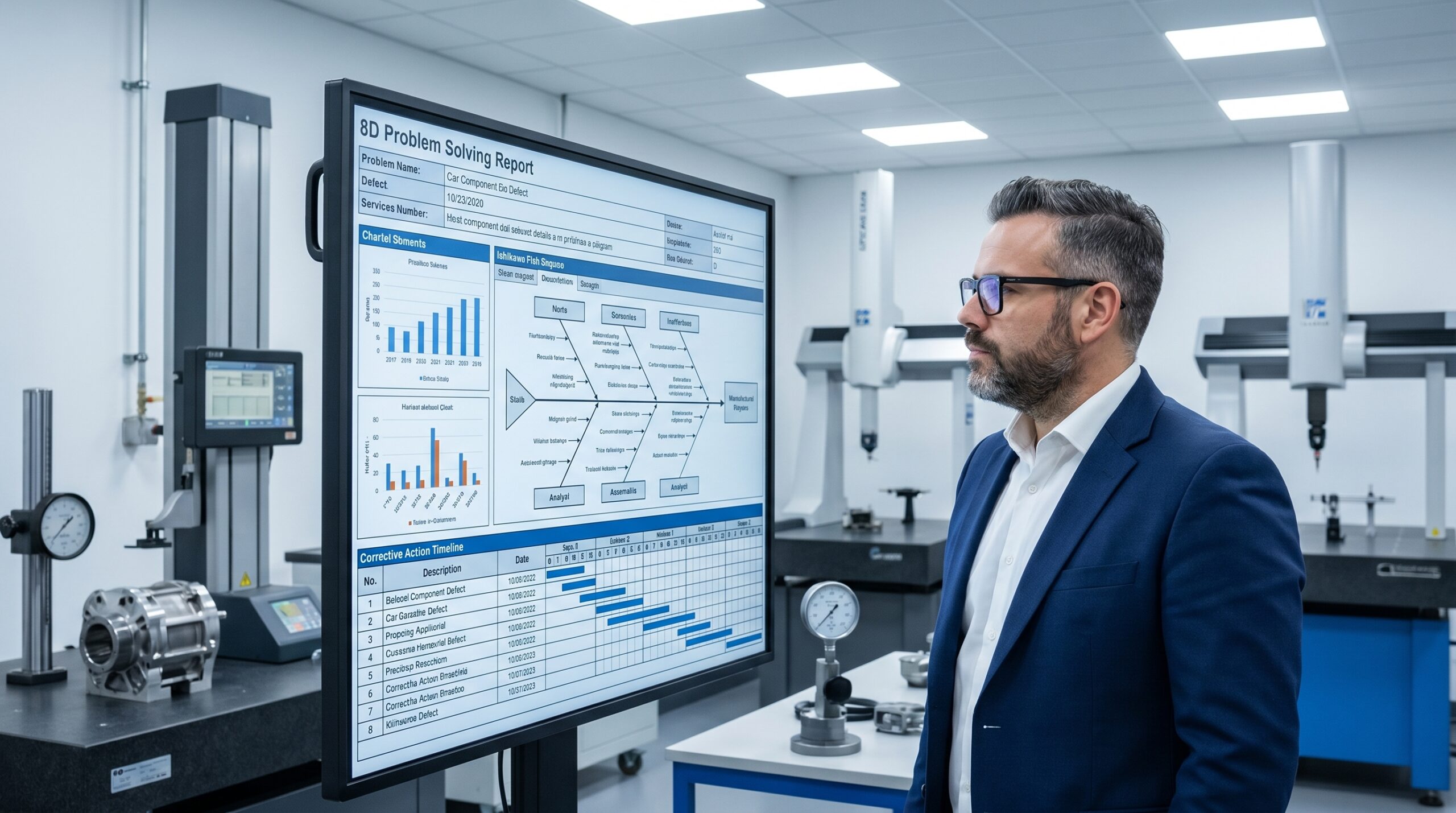
A customer stop-shipment hits differently at 3 AM. The line is down, 300 pieces are suspect, and the supply chain is grinding to a halt. They want an 8D report immediately. Most quality teams react by firefighting: tweaking a parameter, adding an inspection step, or swapping a supplier. Three months later, the identical failure returns. They treated the symptom, not the root cause.
Global 8D (G8D) was developed by Ford to stop this exact cycle. It forces a cross-functional team through eight specific disciplines to move from frantic containment to verified, permanent systemic prevention. It is a mandatory standard across IATF 16949 and AS9100 supply chains for a reason: disciplined thinking scales, while tribal knowledge does not.
Over twenty years of implementing and auditing quality systems at companies like a major aerospace manufacturer and SNOP, I have reviewed hundreds of 8D reports. The difference between a bureaucratic paper exercise and genuine problem elimination comes down to strictly executing the methodology. Here is how the eight disciplines actually work on the shop floor.
D0: Preparation and D1: Cross-Functional Team
Teams routinely skip preparation. D0 requires management commitment, resource allocation, and defining the exact scope of the failure. Without executive backing, your team will lack the authority to implement real changes on the line.
D1 is about selecting the right people. A cross-functional team needs direct contact with the process—operators, process engineers, quality technicians, and supply chain representatives. I once spent three weeks investigating a field failure on injection-moulded covers with a team of quality engineers. The breakthrough came only when we pulled the press technician into the room; we found the solution in two days.
Ineffective vs. Effective Team Formation
What teams do
- Assign three quality engineers
- Investigate from an office desk
- Exclude direct machine operators
- Deliver root cause in three weeks
What works
- Cross-functional group of 4-6 people
- Investigate at the actual process
- Include operators and technicians
- Deliver root cause in two days
D2: The 5W2H Problem Description
Most teams undercook problem definition. Writing 'customer reported a seal failure' guarantees you will never find the systemic gap. A robust D2 answers 5W2H (What, Where, When, Who, Why, How, How many) with strict operational data.
Compare the vague complaint to a properly structured description: 'During final inspection on 14 March, Shift B identified 47 of 500 headlight housings (9.4%) leaking at the upper seam during the 0.5 bar pressure test. All affected pieces trace to block 2026-10B, press LD-07, material lot M-4471.' The data already points toward the specific machine, material, and timeline.
D3: Interim Containment Actions
D3 stops the bleeding. You are not solving the problem here; you are isolating nonconforming product to protect the customer. This means 100% sorting of suspect inventory, blocking shipments, and quarantining stock. It is a tourniquet, not a cure.
The most dangerous trap is treating D3 as the final solution. I have audited plants running 100% manual inspection for months as a permanent fix. That is not corrective action; it is an admission of process failure. If your 8D ends at D3, the defect will inevitably recur.
D4: Root Cause Analysis (RCA)
Root Cause Analysis is where the real detective work happens. You use Ishikawa (fishbone) diagrams to map potential causes and 5 Why analysis to drill past the symptom. The goal is to find the systemic failure, not the human error.
Take cracking headlight housings. Why do they crack? The material is brittle. Why is it brittle? It was insufficiently dried. Why was it wet? The dryer was set to 80°C instead of 120°C. Why? The process engineer did not update parameters when changing to a new resin. Why? There is no formal engineering change control for material transitions.
Most teams stop at 'the dryer was set wrong' and adjust the dial. The real root cause is a gap in change management. Blaming 'operator error' is equally weak. The correct question is: why did the system allow the operator to make that error?
A beautifully filled 8D form without rigorous analysis is worse than no report, because it creates the illusion the problem is solved.
D5 and D6: Corrective Action and Validation
Once the systemic root cause is identified, D5 requires a permanent fix. Setting the dryer back to 120°C is a D3 containment action. The D5 corrective action requires building a material-parameter matrix, implementing a changeover checklist, and installing an interlock that stops the machine if temperature drops below specification.
Never implement a corrective action without verification. D6 is validation. Run a pilot batch, measure the output, and compare statistical data before and after. Monitor the production Cpk for at least 30 days. Check for unintended side effects. If the new process fixes the leak but lowers OEE, you have just invented a different problem.
| Phase | Action Type | Purpose |
|---|---|---|
| D3 | 100% sorting, quarantine | Stop defective product from reaching the customer |
| D5 | Process redesign, poka-yoke | Eliminate the engineering root cause permanently |
| D6 | Cpk tracking, pilot runs | Prove the fix works without side effects |
D7 and D8: System Prevention and Team Recognition
D7 is what separates good plants from excellent ones. It asks: where else in the organisation can this exact root cause trigger a failure? If the headlight line lacked changeover controls, what about the ten other injection presses? Horizontal deployment means applying the D5 fix to all similar processes. Update your PFMEA, revise SOPs, and train operators across the entire facility.
D8 closes the loop through team recognition. This is not a soft HR exercise. Teams that are recognised for their rigorous work will actively engage in the next crisis. Teams ignored after delivering a complex fix will shrug when the next defect appears. Acknowledge the work, document the lessons learned, and integrate the success into your corporate knowledge base.
The best organisations do not reserve G8D solely for external customer complaints. They apply the eight disciplines to internal deviations, safety incidents, and chronic scrap issues. When this disciplined thinking permeates from the operator to the executive floor, you build a resilient quality system.
G8D is a commitment to your customer that their problem is taken seriously, and a promise to your own organisation that you will not pay for the same failure twice.