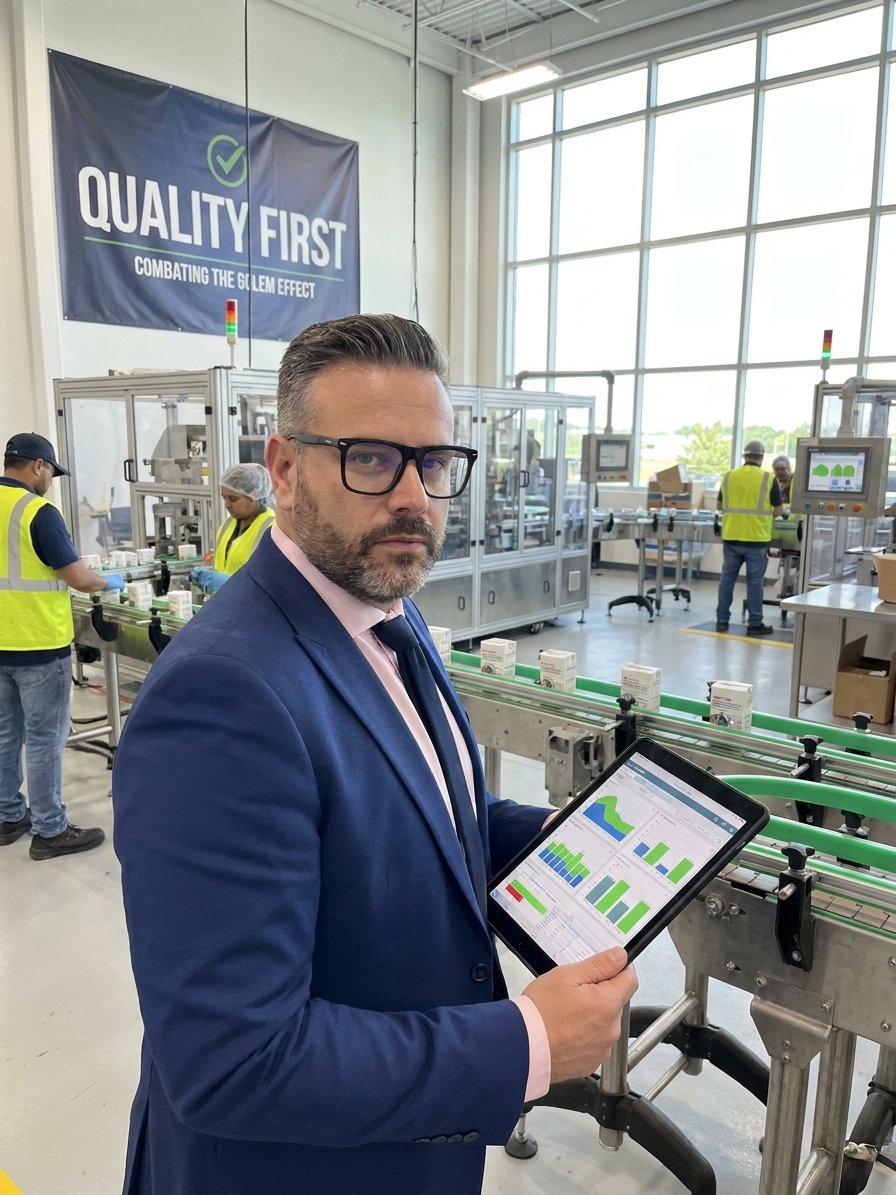
Organisational psychology maps a specific risk to quality management: the Golem Effect. Coined by researchers Dov Eden and Abraham Shapira, it describes how low expectations placed on individuals actively diminish their performance. It is the inverse of the Pygmalion Effect. Where high expectations elevate outcomes, low expectations systematically degrade them.
In manufacturing, this is not a matter of morale. It is a structural risk. Every day, managers communicate—often without a spoken word—that they do not expect excellence from specific teams or shifts. The workforce receives this message and complies. They do so not out of rebellion, but because human beings are exquisitely tuned to the expectations of those holding power over their employment.
When a second shift produces higher defect rates, management often attributes the failure to the personnel. They rarely audit their own signalling. The Golem Effect is not a character flaw in the workforce. It is a design flaw in the management system. If your quality system communicates low expectations, it will engineer the exact defects it fears.
The Mechanism of Diminishing Performance
The Golem Effect operates through a closed, self-reinforcing loop. It begins when a supervisor forms a low expectation of a team. Perhaps the team is newer, or perhaps they failed a single VDA 6.3 process audit months ago. The origin of the prejudice barely matters. Once formed, the belief dictates resource allocation.
The expectation is then communicated environmentally. No competent manager explicitly demands defects. Instead, the communication is structural. The targeted team receives abbreviated training. Their questions are answered impatiently. Their measurement equipment is older, calibrated less frequently, or shared across more stations. They are monitored closely but coached rarely. Their suggestions in continuous improvement meetings are met with polite nods and zero follow-up.
Workers internalise these structural cues. When every signal dictates that excellent work is not expected, the workforce rationally reduces its effort. If meticulous inspection is never rewarded, operators stop inspecting meticulously. The cognitive cost of pursuing quality is no longer worth paying.

The Golem Cycle in Manufacturing
- 01Assumption FormedManager decides a specific shift or team lacks competence based on inherited bias.
- 02Resource ReductionTeam receives older gauges, less calibration time, and abbreviated work instructions.
- 03Rational DisengagementWorkers sense the distrust and reduce cognitive effort to match the expected baseline.
- 04Defect ConfirmationFirst-pass yield drops and rework hours increase, confirming the manager's original bias.
Performance declines, and the data confirms the original bias. The manager sees the rising defect rates and concludes they were right all along. The loop tightens. Resources are stripped further. Eden’s research in military units proved that randomly assigned low expectations measurably degraded objective competence test scores. The expectation alone created the failure.
Where the Bias Hides in Standard Quality Logic
The Golem Effect does not appear as a line item in audit reports. It hides inside practices that look perfectly logical on paper. Consider inspection assignment patterns. Most organisations assign their most experienced inspectors to the most critical products. This seems rational: place your best people on high-stakes work.
But consider the implicit message sent to newer inspectors. They learn that the organisation's lowest-stakes work is their ceiling. Placed on easier work with lower expectations, they develop habits of inattention. They learn to inspect at the level the system has signalled is sufficient. When they are eventually promoted to critical products, they bring those diminished habits with them.
The organisation has trained them to be mediocre, and then management wonders why quality suffers. The same dynamic infects supplier quality management. Strategic partners receive collaborative problem-solving and joint development. Interchangeable vendors receive cold scorecards, aggressive audits, and threats of re-sourcing.
The vendors treated as adversaries learn to game the scorecard. They do the minimum required to pass the next audit rather than improving the underlying process. The Golem Effect creates precisely the supplier behaviour you feared, simply because you signalled that you expected it.
Corrective Action as a Weapon
How an organisation handles 8D corrective action reveals its Golem exposure instantly. In healthy systems, a nonconformance triggers a systemic investigation. The focus is on the process: what control was missing, what fixture failed, what PFMEA gap allowed the defect to reach the customer.
In Golem-affected organisations, the focus shifts immediately to the person. Management demands to know who made the mistake and what disciplinary action is required. This personalisation of failure is the Golem Effect made explicit. It tells every worker that mistakes are career-threatening rather than information-generating.
When excellence is treated as an anomaly, defect generation becomes a rational response to the management system.
Under a punitive regime, the rational response is to hide defects, underreport near-misses, and deflect blame. The organisation’s quality data degrades immediately. Visibility into actual process capability is intentionally destroyed by the very people who need it most, because surfacing the truth has become unsafe.
The Financial and Operational Cost
The financial impact of the Golem Effect is difficult to isolate because it operates as a second-order cost. It does not appear as a discrete entry on the cost of poor quality ledger. However, its consequences are visible across every operational metric. Defect rates rise. First-pass yield drops. Overtime costs increase as rework hours multiply.
I have audited plants where an entire shift was written off by management and performed exactly to that expectation. The cost of replacing a trained quality inspector who leaves this environment ranges from 50% to 200% of their annual salary. That figure accounts for recruitment, training downtime, and the steep learning curve of their replacement.
Continuous improvement stalls completely. Kaizen depends entirely on frontline engagement. Workers who believe their insights are dismissed stop offering them. The improvement pipeline narrows to whatever management can conceive—a tiny fraction of the collective intelligence available on the floor. External audit failures follow, because the workforce refuses to volunteer context to an auditor they distrust.
Measuring the Trust Deficit
Breaking the Cycle of Low Expectations
Reversing the Golem Effect requires structural changes to the quality system, not motivational posters. Walk the production floor with fresh eyes and audit your expectation signals. If one area is cleaner, better lit, and better equipped than another, ask whether the distinction is based on product criticality or simply on the team that works there.
Equalise developmental investment. If your high-performing teams receive advanced statistical process control training, extend it to the struggling teams. Developmental investment must be distributed based on need, not past performance. The teams failing their OEE targets need better fixtures and deeper coaching, not tighter monitoring and fewer resources.
Force your corrective action process to begin with systemic analysis. Mandate the use of 5 Whys, Ishikawa diagrams, and fault tree analysis before anyone is permitted to review individual performance data. In most defect scenarios, the systemic cause—a missing poka-yoke, an outdated work instruction, or an uncalibrated gauge—will be obvious long before individual blame is considered.
System Blame vs. Personnel Blame
Golem-driven response
- Identify the specific operator who built the nonconforming part.
- Initiate disciplinary action or issue a formal written warning.
- Retrain the operator on the exact same flawed work instruction.
- Close the 8D report without fixing the underlying process.
System-driven response
- Map the process to identify missing or inadequate poka-yoke devices.
- Analyse gauge R&R to ensure the measurement system captures the defect.
- Update the PFMEA and control plan to reflect the new failure mode.
- Verify the systemic fix with a capability study before closing.
Finally, protect psychological safety rigorously. Organisations with high psychological safety report more defects, not because they produce more, but because their workforce is willing to surface them. That visibility is the absolute foundation of improvement. You cannot fix what your operators are afraid to show you.
Expectations as a Quality Instrument
The most critical quality instrument in any manufacturing facility is not the coordinate measuring machine or the optical comparator. It is the expectation that managers carry and transmit through their allocation of resources. If that expectation is low, no amount of final inspection will compensate for the defects generated upstream.
High expectations must be explicitly stated, repeatedly communicated, and backed by tangible investment. When a team struggles with a new product launch, tell them you know they are capable of hitting the Cpk target, and then provide the engineering support required to stabilise the process. Stating high expectations without providing the resources is negligence dressed as motivation.
Over twenty years implementing ISO 9001 and AS9100 systems across automotive and aerospace, I have watched organisations transform struggling lines by simply deciding to believe in the team. They backed that belief with training, upgraded tooling, and genuine coaching. The turnaround is never instantaneous, but it is measurable, and it compounds rapidly.
Look at your lowest-performing shift, your highest-defect process, or your weakest supplier. Have they failed because they are fundamentally incapable, or because your management system never gave them a reason to succeed? The Golem Effect feeds on management comfort. Breaking it requires the discipline to invest in the people you have already decided are not worth the investment.