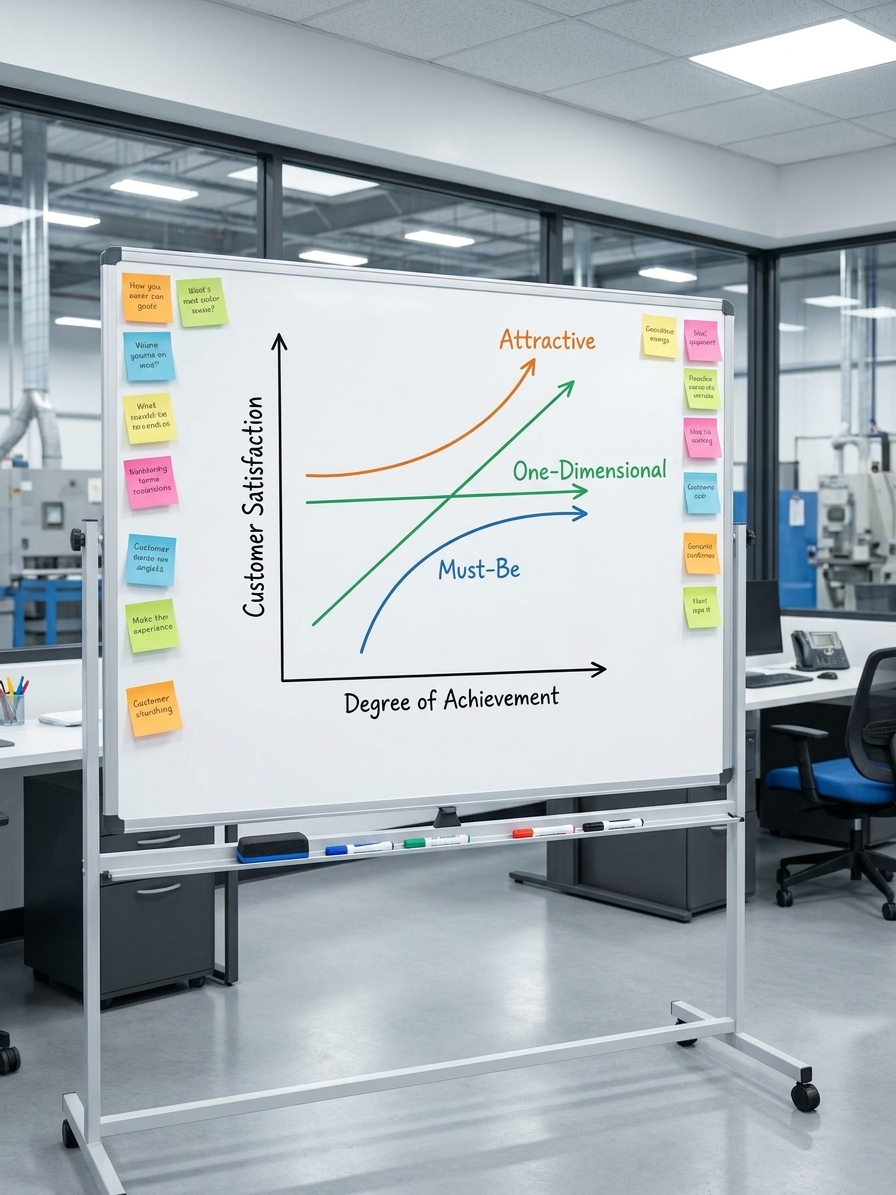
Noriaki Kano gave the quality profession a vocabulary for the non-linear relationship between product execution and customer reaction. The model distinguishes between threshold features, performance variables, and excitement generators. It maps exactly how a manufacturing defect or a product attribute drives either retention or churn. It is a rigorous analytical tool.
In my experience auditing quality management systems at automotive and aerospace plants, I rarely see the Kano Model applied with operational rigor. Teams run the analysis, build a matrix, and file the output. The data rarely survives first contact with the engineering change process. The framework becomes a sticky-note exercise disconnected from the PFMEA.
The model fails because organisations treat a dynamic lifecycle as a static snapshot. They prioritise excitement features while neglecting threshold reliability. They flatten complex customer responses into a linear ranking. The resulting administrative theatre produces no actionable intelligence for the production line.
The Five Categories and the Decay Dynamic
Must-Be requirements are the threshold. In automotive manufacturing, a door latch must secure the door. A brake calliper must hold hydraulic pressure. Their absence creates extreme dissatisfaction, but their presence generates zero satisfaction. Meeting threshold requirements simply prevents failure.
One-Dimensional requirements operate on a linear spectrum. Higher fuel efficiency, tighter dimensional tolerances, faster assembly line throughput. Customers explicitly demand these attributes, and satisfaction scales proportionally with performance. Most traditional quality improvement initiatives, such as raising a process capability index from Cpk 1.33 to Cpk 2.0, target this category.
Attractive requirements are the unexpected delights. Features the customer did not ask for, did not imagine, but immediately values upon experience. The first keyless entry system. The first adaptive cruise control. These attributes drive market differentiation and premium pricing until competitors replicate them.
The critical dynamic insight is that attributes decay over time. What is Attractive today becomes One-Dimensional tomorrow and Must-Be the day after. Automatic emergency braking was a premium delight a decade ago. It is now a baseline expectation. This lifecycle migration is the most practically important aspect of the model, and it is almost universally ignored during implementation.
| Category | Customer Reaction | Quality Management Action |
|---|---|---|
| Must-Be (Threshold) | Absence causes extreme dissatisfaction | Guarantee zero-defect reliability |
| One-Dimensional (Performance) | Satisfaction scales linearly with execution | Drive continuous improvement |
| Attractive (Excitement) | Unexpected presence creates high satisfaction | Innovate and differentiate |
| Reverse | Presence creates dissatisfaction | Eliminate or reduce complexity |
The Survey Trap: From Analysis to Administrative Theatre
The typical Kano implementation follows a predictable path toward administrative theatre. A product manager organises a cross-functional workshop. The team builds a methodologically correct dual-questionnaire, asking customers how they feel if a feature is present and if it is absent. The responses are cross-referenced in a standard Kano evaluation table.
Deployment is where competence ends. The questionnaire targets a convenience sample rather than a representative cross-section of the user base. The dual-question format doubles cognitive load. Response rates plummet. Data quality degrades. But the survey was deployed, so the project box is checked.

The analysis phase produces a spreadsheet classifying each feature by category. The spreadsheet is shared in a review meeting. Stakeholders nod at the classifications. Then nothing happens. The actual engineering decisions regarding resource allocation are made through internal politics and gut feeling, exactly as they were before the analysis.
The classification exists to prove the model was used, not to change what the organisation builds. The Kano analysis becomes an artefact rather than an input. It sits in a PowerPoint deck alongside outdated FMEA data and ignored 8D reports, serving no operational purpose.
Snapshot Thinking and the Delight-to-Baseline Migration
The second failure mode involves the dynamic aspect of attribute decay. A company engineers an Attractive feature through genuine customer insight. They launch it. Customers are delighted. Competitors reverse-engineer and replicate it. Within eighteen months, the feature migrates to One-Dimensional. Within three years, it becomes Must-Be.
This lifecycle is the model working exactly as predicted. The organisational failure occurs when the company treats the feature as permanently Attractive long after it has become baseline. The internal Kano classification, frozen at the moment of the original survey, still lists it as a differentiator.
The company continues investing capital into polishing a feature that customers now categorise as the bare minimum. Meanwhile, competitors who understand attribute decay have already moved resources to the next innovation cycle. The delight you were supposed to deliver became the baseline expectation you could never exceed, because you stopped running the model dynamically.
The Kano Model requires periodic re-administration every twelve to eighteen months to track classification shifts. Almost no organisation does this. Re-running the analysis has no champion and no budget until a competitor launches a feature that makes the company realise the landscape has shifted beneath them.
The Attribute Decay Lifecycle
- 01Attractive (Excitement)Unexpected feature creates market delight and drives premium differentiation.
- 02One-Dimensional (Performance)Competitors replicate the feature; it becomes a linear performance metric.
- 03Must-Be (Threshold)Total market saturation; absence of the feature now loses customers permanently.
- 04Strategic Reset RequiredRe-survey necessary to identify new Attractive attributes and retire legacy investments.
Must-Be Neglect: Building Castles on Sand
The most dangerous failure mode is the systematic neglect of Must-Be requirements. The internal logic, visible in budget allocations, assumes that threshold features are already met. Resources flow toward Attractive innovation, where the perceived upside lies. This is a catastrophic misreading of the model.
The defining characteristic of a Must-Be feature is that its failure is catastrophic. A Must-Be failure does not marginally reduce satisfaction. It destroys the customer relationship. When an aerospace fastener fails torque specifications, it does not matter how innovative the cabin lighting is. When a medical device fails sterilisation audits, ergonomic design is irrelevant.
Organisations that over-invest in excitement features while under-investing in threshold reliability build castles on sand. The Attractive features generate positive marketing. The Must-Be failures generate field returns, warranty claims, and regulatory action. In industries governed by IATF 16949 or AS9100, a single threshold failure can trigger a complete product recall.
The Kano insight is to understand which category each attribute occupies and resource it accordingly. Threshold features require relentless attention to process capability and defect prevention. Performance features need continuous improvement. Excitement features need innovation. Treating Kano as a prioritisation hierarchy where Attractive sits at the top is the exact opposite of what the model prescribes.
A single Must-Be failure can erase years of Attractive investment in a single product recall or audit finding.
The One-Dimensional Trap and Reverse Features
Many manufacturing organisations default to treating all quality attributes as One-Dimensional. Tighter tolerances, more processing power, greater material strength. The linear logic is seductive: if customers are satisfied with a certain specification, they will be more satisfied with a higher specification.
This logic ignores the Reverse category. Past a certain threshold, more becomes worse. More configurable options create assembly complexity and decision paralysis. More surface treatments add processing time and corrosion risks. Additional sensors increase diagnostic overhead and false-positive rates on the production line.
The Kano Model explicitly accounts for this non-linear reaction, but teams that flatten everything into One-Dimensional thinking never test for it. They keep pushing the specification dial further, adding more of what the market is starting to find excessive. They are then surprised when satisfaction scores plateau and warranty claims rise.
You optimised a dimension that had already passed its peak of marginal satisfaction. The resources spent pushing past the tipping point would have been better spent identifying the next Attractive feature or shoring up a Must-Be requirement. Precision engineered past the point of customer value becomes manufacturing confusion.
Operationalising Kano: What Effective Practice Looks Like
Organisations that use the model effectively treat it as a continuous discipline, not a one-time deliverable. They re-survey the market on a fixed cadence. They track attribute migration and adjust their engineering investment strategy accordingly. They maintain a roadmap not just for product features, but for the lifecycle stages of those features.
They segment their analysis. Different customer segments classify the same attribute differently. What is Must-Be for a Tier 1 automotive OEM may be Attractive for a Tier 2 supplier. Effective organisations run Kano analysis per segment, integrating the results directly into their Quality Function Deployment matrices and product roadmap prioritisation.
They act on the findings. A Kano study that does not change resource allocation was a waste of engineering time. The output must drive specific, actionable decisions regarding what to innovate, what to maintain, and what to cut from the production scope. The findings feed directly into APQP gate reviews and FMEA prioritisation.
Most importantly, they respect the threshold. They understand that Must-Be reliability is not a lower priority than Attractive innovation. It is the precondition for everything else. They resource their threshold requirements with the same statistical rigour and preventive maintenance intensity as their innovation pipeline, because they know the cost of failure in that category is absolute.