Engineering teams routinely pour six-figure budgets into optimising characteristics that customers never perceive. A sealing gasket on an automotive HVAC housing might exceed its accelerated life test specification by a factor of seven, validated through multiple DFMEA cycles and prototype iterations. Six months after launch, the customer satisfaction data returns without a single mention of the gasket.
What does appear in the warranty claims and dealer feedback is a complaint about a cosmetic trim clip that rattles at highway speeds. The clip costs $0.03 per unit. It was flagged during design review as non-critical and deprioritised in favour of the gasket work. This is not an isolated incident. It is a systematic failure to distinguish between the types of quality that register with customers and the types that do not.
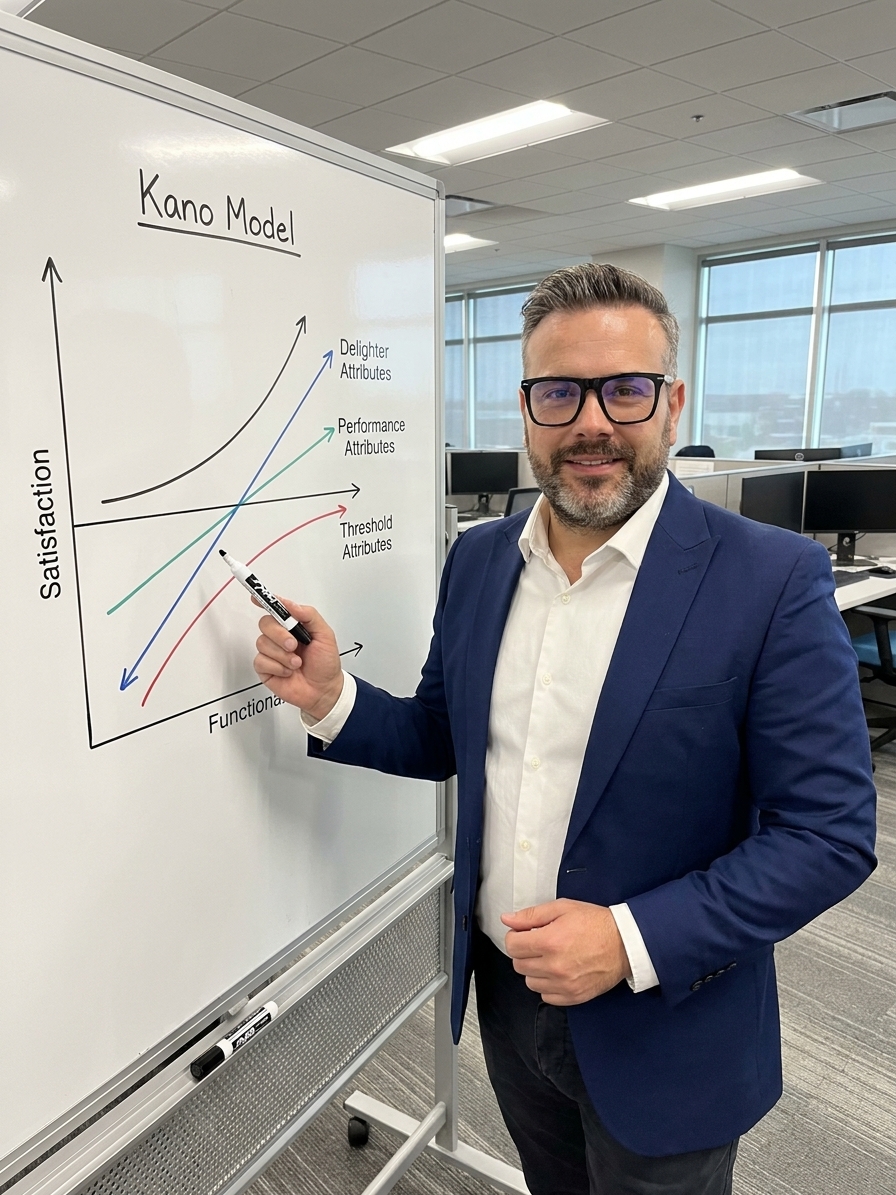
The framework that prevents this misallocation of resources was presented in 1984 by Noriaki Kano at the Japanese Society for Quality Control. It classifies product attributes into five categories based on how they influence customer satisfaction. The Kano Model remains one of the most underused analytical tools in quality engineering today, largely because it requires organisations to confront the gap between technical achievement and customer perception.
The Five Categories of Customer Perception
The model plots degree of achievement on the horizontal axis against degree of customer satisfaction on the vertical axis. The relationship between these two dimensions is not linear, and that non-linearity is the critical insight. Treating every specification as equally important ignores how customers actually experience a product.
Must-be requirements are the features customers assume will be there. Dimensional conformance, material integrity, basic functionality. They do not generate satisfaction when present, but they generate immediate dissatisfaction when absent. In IATF 16949 terms, these are your PPAP baseline. Your customer does not thank you for meeting the print. They expect it.
One-dimensional requirements create satisfaction in proportion to their degree of achievement. Tighter tolerances, longer mean time between failures, faster cycle times. The customer notices improvement and notices degradation. The relationship is linear and predictable. These are your measurable, competitive specifications where marginal investment yields proportional returns in customer perception.
Attractive requirements are the features the customer did not expect. When present, they generate outsized satisfaction. When absent, they generate no dissatisfaction at all. These are your competitive differentiators. The first automotive supplier to integrate a soft-touch surface on a frequently handled interior component created an attractive feature. The cost of implementation was low relative to the satisfaction it generated.

Indifferent requirements are where the degree of achievement has no meaningful impact on satisfaction. The internal gasket in the opening example fell into this category. As long as it met the basic threshold, additional improvement was invisible to the customer. This is where manufacturing organisations waste the most engineering effort. Reverse requirements are features where more achievement actually reduces satisfaction: a surface finish so glossy it creates glare, a notification system so frequent it becomes noise.
Building the Classification Matrix
Classification begins with a structured customer survey built around paired questions. For each quality attribute, you ask a functional question: if this feature performs well, how do you feel? Then a dysfunctional question: if this feature performs poorly or is absent, how do you feel?
Responses are captured on a five-point scale: I like it, I expect it, I am neutral, I can tolerate it, I dislike it. The intersection of the functional and dysfunctional responses classifies each attribute into one of the five Kano categories. This paired-question structure is what distinguishes a Kano survey from a standard satisfaction survey.
Internal Assumptions vs Customer Classification
How engineering teams classify features
- Technically complex characteristics treated as high-priority
- Internal defect rates used as a proxy for customer satisfaction
- Every specification on the print treated as equally important
- Innovation measured by engineering hours consumed
How customers actually experience them
- Complex internal components classified as indifferent
- World-class defect rates on invisible features go unnoticed
- Cosmetic and tactile issues drive disproportionate complaints
- True differentiation comes from unexpected, low-cost delighters
The Migration Lifecycle and Its Strategic Cost
Features do not stay in their original category. Every attractive feature eventually becomes a one-dimensional feature, and then a must-be feature. Heated seats delighted in 1995, performed competitively in 2005, and are now simply expected in any premium vehicle. Backup cameras followed the same trajectory. USB charging ports followed it faster.
This migration has a direct implication for quality strategy. The features you invest in for differentiation today must be maintained as basic expectations tomorrow. Your innovation budget must constantly seek new attractive features while your operational budget must relentlessly deliver on must-be features without over-engineering them.
Organisations that fail to understand this lifecycle find themselves spending innovation money on features that have already become table stakes. They compete on must-be requirements instead of differentiators and wonder why their customers seem perpetually unimpressed. The technical excellence is there. The strategic timing is not.
Implementing Kano Analysis in a Manufacturing Context
The first step is to catalogue every quality characteristic of your product or service. Include dimensional specifications, functional performance, cosmetic appearance, reliability metrics, service responsiveness, and packaging. If the customer experiences it or it influences what the customer experiences, it goes on the list.
Run the paired survey with a statistically meaningful sample of actual customers, not internal stakeholders. Engineering teams frequently assume a feature is one-dimensional when customers classify it as indifferent. The only reliable classification comes from direct customer research. Internal assumptions are the enemy of effective prioritisation.
Most organisations do not have a quality problem. They have a prioritisation problem disguised as a quality problem.
Map the results and cross-reference against your current engineering and continuous improvement spend. You will typically discover that a significant portion of your budget is going toward indifferent features. Redirect that investment based on category: guarantee reliable delivery on must-be features, optimise competitively on one-dimensional features, and pursue attractive features selectively.
Reallocating Quality Budgets: A Practical Case
I have audited plants that were spending the majority of their continuous improvement budget on reducing dimensional variation on internal components never visible to the end user and with no functional impact on performance. Every one of those characteristics was classified as indifferent or must-be with no room for competitive advantage.
We redirected the budget toward three attractive features that had been sitting on the engineering wish list for two years. Within one product cycle, the supplier moved from Tier 2 to preferred status for two major OEMs. The technical capability had always been there. The prioritisation had not.
Investment Allocation After Kano Reclassification
The mechanism is straightforward. When you stop funding over-engineering on indifferent characteristics, you free up capacity for features that actually shift customer perception. The savings are not theoretical. They show up in the next quotation cycle, in the next supplier scorecard, in the next contract negotiation.
Common Failures in Kano Application
The most frequent failure is assuming you know the classification without asking. Engineering teams consistently rank technically challenging features as high-priority for customers, when customers classify them as indifferent. The gap between internal technical assessment and external customer perception is where competitive advantage is created or destroyed.
The second failure is treating the analysis as a one-time exercise. Feature migration is continuous. A Kano classification that is eighteen months old is already outdated for a fast-moving market. Build the re-analysis into your periodic management review cycle, aligned with your AS9100 or IATF 16949 internal audit schedule.
The third failure is underinvesting in must-be features. Organisations focused on innovation sometimes assume must-be characteristics are unimportant because they do not generate positive satisfaction. This is catastrophically wrong. Must-be features generate disproportionate dissatisfaction when they fail. The penalty for underperformance far exceeds the investment required to prevent it.
The final failure is confusing internal metrics with customer satisfaction. Your Cpk on a characteristic may be world-class, but if that characteristic is indifferent to the customer, the achievement is technically impressive and strategically irrelevant. Quality dashboards that report only internal performance measures without customer classification perpetuate this blindness.
Every dollar spent on quality is a dollar chosen not to be spent somewhere else. The Kano Model provides the framework for making that choice based on customer data rather than engineering preference. It replaces equal treatment of all specifications with strategic prioritisation grounded in how customers actually perceive and experience the product.
Your gasket may exceed specification by a factor of seven. But if your trim clip rattles at highway speed, that is what your customer remembers. That is what they report to the dealer. And that is what determines whether your next quote wins or loses.