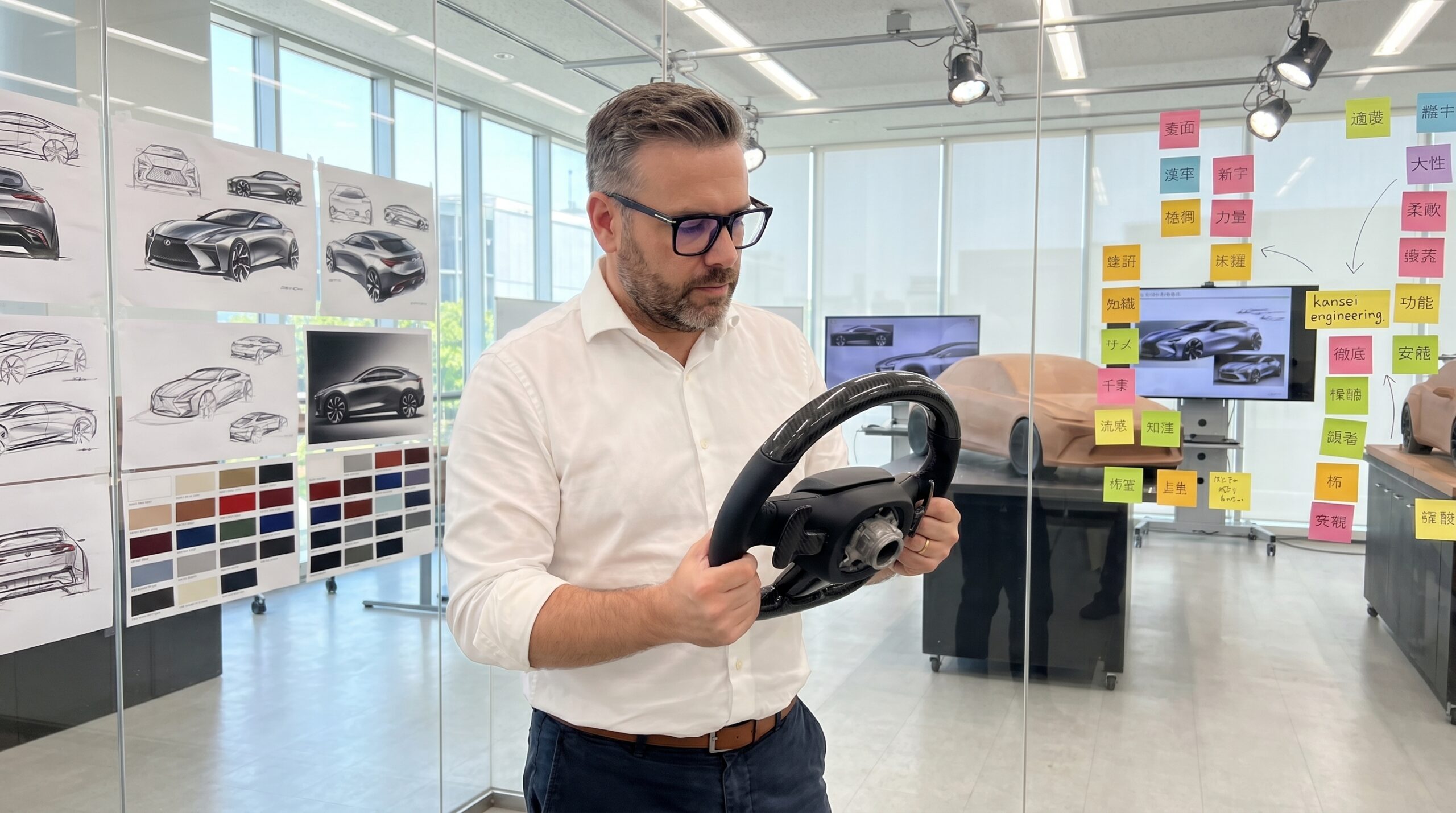
I was standing in a Japanese plant reviewing a prototype steering wheel when the lead engineer asked me a question that stopped my ISO 9001 train of thought dead. He did not ask about dimensional tolerances, material fatigue, or ergonomic compliance. He asked: 'How do you feel when you grip it?'
At the time, I was deep into routing verification KPIs and process capability metrics. That single question shifted my entire perspective on quality engineering. It was my first practical encounter with Kansei Engineering, a disciplined methodology that bridges human emotion and technical design.
After two decades of implementing quality management systems across automotive and aerospace, I recognise a fundamental gap in how we approach customer satisfaction. We meticulously measure Cpk, track defect rates, and audit to IATF 16949 and AS9100 standards. Yet we frequently ignore how the user actually perceives the product in their hands.
The Mechanics of Kansei Engineering
Kansei Engineering is not a focus group exercise where a moderator asks consumers if they like a product. Developed by Professor Mitsuo Nagamachi at Hiroshima University in the 1970s, it is a systematic process that translates emotional needs into concrete technical parameters.
The methodology relies on quantitative semantic differential scales to map user emotions against physical product traits. It discards vague preferences and establishes statistical causality between design features and psychological responses.
In practice, this means a desired emotional state—such as 'confident' or 'secure'—is decomposed into measurable geometric and material properties. This structured translation allows engineering teams to design for perception with the same rigour they apply to structural integrity.

Mapping Emotion to Physical Parameters
To illustrate how Kansei Engineering functions on the shop floor, consider the design of a new industrial tool handle. Instead of immediately drafting CAD models based on legacy designs, the engineering team begins by capturing semantic data from actual users.
Users describe their ideal experience using terms like 'solid,' 'precise,' or 'secure.' These descriptors are filtered down to five core Kansei dimensions. Existing products are then tested against these scales, while engineers concurrently break down the physical properties of those same products.
Using regression analysis, statistical correlations are drawn between the subjective ratings and objective measurements. A 'solid' perception might correlate to a specific weight range and a Shore A hardness of 70, while a 'precise' feel is driven by surface roughness and grip diameter.
Translating Kansei Data into Design
- 01Semantic CaptureGather and filter emotional descriptors from target users.
- 02Product DecompositionBreak existing samples into measurable properties (Ra, weight, Shore).
- 03Statistical MappingApply regression analysis to link physical traits to emotions.
- 04Specification LockOutput precise manufacturing tolerances that drive the desired perception.
Integrating Kansei into QMS and ISO 9001
As a Quality Director, my focus is on tools that systematise the seemingly unmeasurable. Kansei Engineering fits perfectly within a robust Quality Management System, specifically satisfying the ISO 9001:2015 requirements for understanding customer needs and enhancing customer satisfaction.
During design and development reviews (Clause 8.3), prototypes can be evaluated against Kansei targets alongside functional requirements. This shifts validation from merely confirming 'does it work?' to measuring 'does it evoke the intended response?'
Integrating emotional metrics into the QMS allows risk-based thinking (Clause 6.1) to capture perceptual failures. If a component meets all technical prints but feels cheap to the operator, it represents a design failure that traditional quality gates will miss entirely.
| ISO 9001 Clause | Traditional QMS Approach | Kansei-Enhanced Approach |
|---|---|---|
| 8.3.3 Design Inputs | Functional requirements, dimensions | Kansei dimensions, emotional targets |
| 8.3.4 Design Review | Verify against engineering tolerances | Validate emotional response with users |
| 9.1.2 Customer Satisfaction | Track returns, complaints, surveys | Measure emotional resonance and loyalty |
| 6.1 Risk-Based Thinking | Address supply chain, safety, delays | Include perceptual and emotional risks |
Translating Data into Manufacturing Reality
Returning to that Japanese steering wheel: the team was targeting a younger demographic (25-35 years). Traditional design logic dictated aggressive styling, glossy finishes, and bright contrasts to appeal to this segment.
Kansei analysis revealed a different reality. The target demographic associated 'confidence' with a thicker grip and a matte texture, not a glossy racing aesthetic. The emotion of 'freedom' was linked to the spatial geometry between the wheel's spokes.
The resulting prototype looked conventional but felt entirely different. By optimising the surface texture and grip dimensions to match the statistical emotional data, the final product significantly outperformed its predecessor's initial sales.
Traditional design is not wrong. It just only covers half the specification. Kansei Engineering defines the rest.
Implementing Kansei in Industrial Environments
Do not attempt to apply Kansei Engineering to an entire product line simultaneously. Start with a single, high-impact component—a handle, a control interface, or a housing. Run a limited analysis to demonstrate value to management before scaling.
Build a multidisciplinary team. You need a quality engineer who understands manufacturing constraints, a statistician who can run multivariate regressions, and a researcher capable of structuring unbiased user testing protocols.
Invest heavily in the semantic differential scale. The quality of the Kansei words determines the quality of the entire project. Avoid generic adjectives like 'nice' or 'good' in favour of terms that carry specific emotional weight for the target demographic.
Kansei Engineering is an iterative process. Each design cycle refines your understanding of the user and tightens the tolerances on the emotional translation. It must become a standard phase in your APQP process, not a one-off experiment.
Traditional vs. Kansei-Driven Design
Traditional Design
- Begins with legacy technical specifications
- Validated purely by functional pass/fail tests
- Customer loyalty is driven primarily by price
- Ignores the perceptual gap of physical interaction
Kansei Design
- Begins with the customer's emotional requirements
- Validated by statistical analysis of user response
- Customer loyalty is driven by emotional connection
- Translates subjective feel into objective tolerances
Scaling Kansei with Industry 4.0
Digitalisation amplifies the precision of Kansei Engineering. Integrating artificial intelligence and digital twin technologies allows teams to simulate and analyse emotional responses on virtual prototypes before committing to hard tooling.
Biometric sensors, such as galvanic skin response monitors and heart rate trackers, provide objective physiological baselines to supplement subjective semantic ratings. This removes the remaining guesswork from emotional evaluation.
The goal is not to replace human intuition with machine learning. The objective is to use advanced analytics to process vast amounts of unstructured customer review data, rapidly identifying new Kansei dimensions as market expectations shift.
Quality without emotional resonance is just a collection of parameters. A product can have the lowest defect rate on the line and still fail in the market if it does not feel right to the end user.