Your SPC charts sit well within control limits, your first-pass yield exceeds 99%, and your registrar just renewed your ISO 9001 or IATF 16949 certification without a single major nonconformity. By every standard metric, the production line is operating flawlessly.
Yet six months from now, a critical component will seize in the field. The root cause will not be a sudden process failure, but a slow, invisible degradation driven by environmental factors your control plan was never designed to simulate.
This is the latent defect. Standard quality systems are structurally blind to them because they are optimized for point-in-time detection. Incoming, in-process, and final inspections are snapshots. You cannot catch a time-lapse failure mechanism with a snapshot.
The Architecture of a Time-Delayed Failure
A latent defect is a nonconformity present at manufacture that remains undetectable during standard production inspection. It only manifests after extended operation under specific thermal, chemical, or mechanical stresses that exist in the customer's environment, not on the shop floor.
Consider a manufacturer of precision hydraulic valves operating with a robust Cpk of 1.67. They shipped zero defective parts according to final inspection. Yet eight months later, they faced a 2.3% field failure rate. A minor process optimization involving a new lubricant formulation interacted catastrophically with a surface treatment during thermal cycling.
No functional test on the production line could have caught this. The degradation required hundreds of hours of real-world temperature variations to initiate micro-cracking. The quality system was not broken; it was looking at the wrong timeline.
The Escalation of Latent Defect Costs
Primary Mechanisms of Latent Degradation
Time-dependent degradation is the most common mechanism. Polymers embrittle, adhesives lose bond strength, and protective coatings break down. A material perfectly within specification at t=0 can become catastrophic at t=2 years because your test conditions failed to approximate real-world stress accumulation.
Environmental interactions also trigger dormant failures. I have audited plants where sterilization validations were flawless for the tested packaging configuration, but failed completely when a hospital used a different wrapping technique. The defect was latent because nobody had modeled the interaction between the product and an uncontrolled external variable.

Cumulative wear and tolerance stack-up create a system-level defect invisible to component-level inspection. Individually, every part passes. Over time, normal wear patterns combine with manufacturing tolerances to cause misalignment or interference. The failure mode lives in the dynamic system behaviour, not in any single static measurement.
Systemic Gaps in Standard Quality Control
Your test coverage is a compromise between thoroughness and cycle time. You sample, you accelerate, and you simulate. In doing so, you make assumptions about which stress conditions matter. When those engineering assumptions are wrong, your test coverage develops gaps, and latent defects escape through those exact gaps.
The most insidious source of these escapes is the silent supply chain change. A tier-two supplier alters a raw material sub-supplier, or a chemical vendor adjusts a formulation. All within specification. All properly documented. But if that change affects long-term behaviour in a way your short-term incoming inspection cannot detect, you have just introduced a latent defect.
Legacy processes compound this risk. When an older process has produced acceptable parts for years, teams assume it is inherently robust. But equipment ages, and raw material properties evolve subtly. What was once a robust process window becomes marginal, and the first indicator of trouble is a field failure months later.
Accelerated Life Testing and Stress Screening
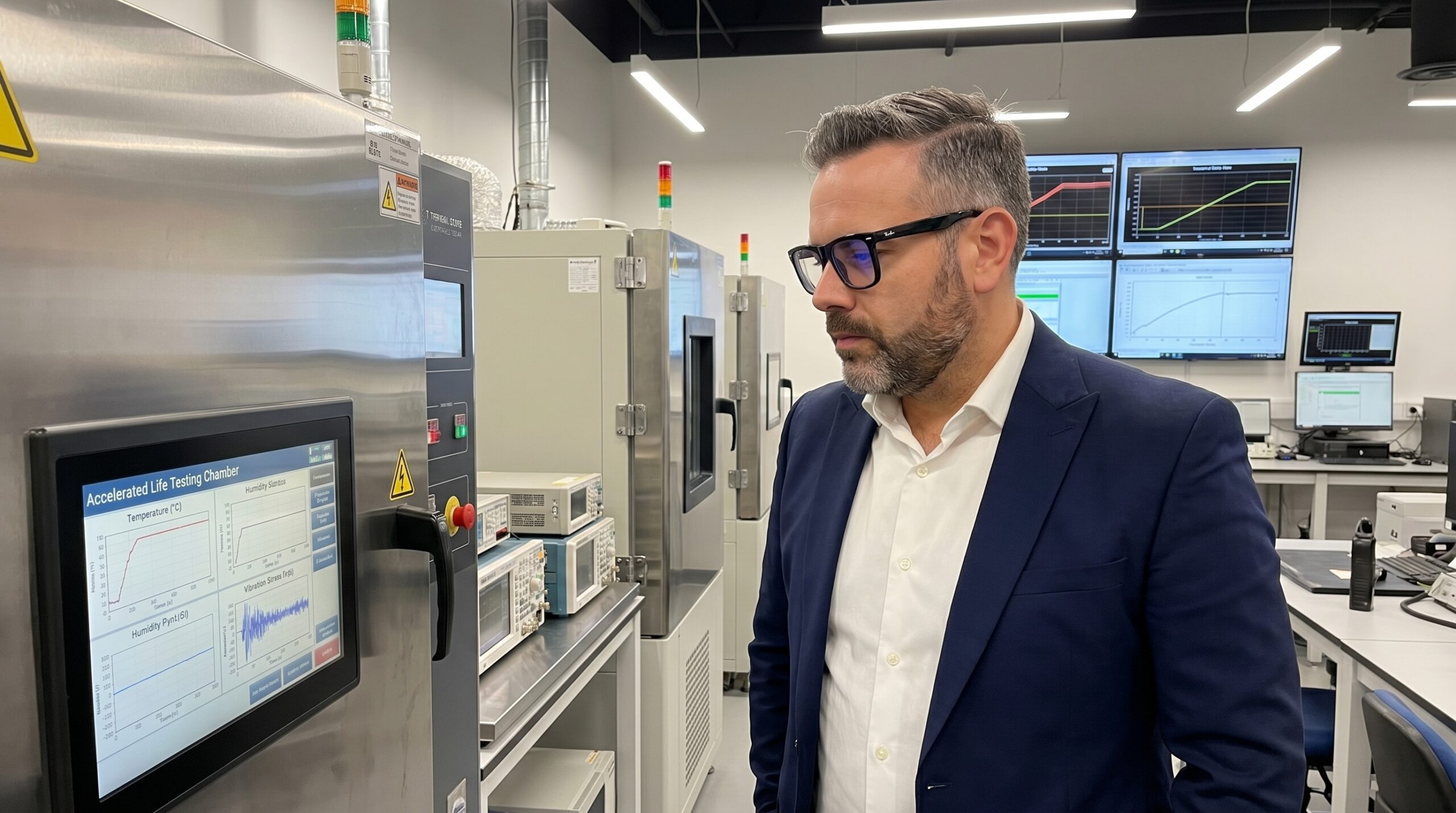
If your defects reveal themselves over time, you must compress time. Accelerated Life Testing (ALT) subjects products to elevated stress levels—temperature, vibration, humidity—to simulate years of use in weeks. However, ALT is only as good as the stress profiles you engineer. Real-world stress is combinational, not singular.
Highly Accelerated Life Testing (HALT) takes this further by pushing products far beyond design limits to force failure. It is destructive and aggressive, but it is the most effective tool for uncovering failure modes you did not know existed. HALT answers what breaks first and at what stress level.
Your test conditions are a pale approximation of real-world stress. When those assumptions are wrong, latent defects live in those gaps.
Highly Accelerated Stress Screening (HASS) applies these principles during production. It filters out marginal units that would survive normal testing but fail prematurely in the field. The critical discipline is ensuring your ALT and HASS profiles are updated continuously using field failure data, not static engineering assumptions.
Closing the Field Failure Feedback Loop
Every warranty claim is a signal from the future. The problem is that most quality systems capture field returns but fail to close the analytical loop. Capturing failures is only the first step; tracing them back to their exact manufacturing origin is where the actual defect prevention occurs.
When a field failure occurs, you must trace it back to the specific lot, process condition, and material source. That data must then feed directly back into your PFMEA and control plan. If a field failure mode does not trigger an update to your design FMEA or test protocols, your quality system is not actually learning.
The Field Failure Closure Sequence
- 01Capture Full ContextLog operating conditions, time in service, and environmental factors.
- 02Trend AnalysisIdentify correlations and clusters across multiple returns, not isolated incidents.
- 03Manufacturing TraceabilityTrace the failure back to exact lot numbers, material batches, and process records.
- 04Update Quality ProtocolsFeed findings into PFMEA, control plans, and ALT profiles immediately.
Connected products offer a powerful advantage here. Telemetry and predictive quality metrics allow embedded sensors to report early degradation signals before the customer experiences a failure. Vibration monitoring can predict bearing degradation with high accuracy, transforming a latent defect into a scheduled maintenance event.
Supply Chain Visibility and Risk Management
Your suppliers' processes represent a significant black box for latent risk. You receive material that passes incoming inspection, but you have limited visibility into how that material will behave mechanically or chemically over a two-year service life. Standard supplier PPAP packages do not cover this.
You must require suppliers to share their actual ALT and HALT protocols, not just the pass-fail test results. A supplier passing a test that fails to simulate your actual use conditions provides a false sense of security. You need to audit their ability to detect and prevent time-dependent failure modes.
Change notification requirements must have teeth. This extends beyond dimensional changes to include process changes, sub-supplier changes, and equipment modifications. Maintain batch traceability that spans the full lifecycle so that when a latent defect surfaces years later, you can pinpoint the exact material source.
Embedding Temporal Analysis in Quality Strategy
Building a defence against latent defects requires a structural mindset shift. Most quality organizations are evaluated on present-tense metrics: today's defect rate, this week's nonconformances, this shift's SPC compliance. A latent defect defence requires leadership to value the investigation of a future-tense problem just as highly as a present-tense containment action.
Integrate a temporal dimension directly into your FMEA process. Map the product lifecycle from manufacturing through storage, installation, and operation. At each stage, ask what could go wrong that would not be visible at that point but would manifest later. This forces engineering teams to look beyond the final factory gate.
If you are not finding latent defects, it does not mean they do not exist. It means your inspection criteria lack the time-compression and environmental simulation required to force them. Challenge the assumption that a product passing today will perform tomorrow, and re-engineer your control plans to see the defects you are currently blind to.