Every year, the quality industry reinvents itself. A new framework lands on the conference circuit, consultants publish books promising that old problems will finally disappear, and inboxes fill with webinar invitations. Meanwhile, a process in your facility that has been producing defects for a decade continues doing so, because the engineering team was pulled into a workshop on the new methodology instead of fixing the actual failure.
I have audited plants across the automotive and aerospace sectors that have cycled through three or four management frameworks in a single decade. The ISO 9001 certificate remains on the wall, but the fundamental process capability has not improved. The organization adopted new vocabulary without building new capability, and the core tools of quality management were abandoned in the pursuit of novelty.
The mental model that changed how I evaluate quality investments is not found in a management textbook. It comes from a mathematical heuristic called the Lindy Effect, and applying it rigorously is the most effective filter I have found for separating tools that transform operations from tools that merely impress auditors and executives.
What the Lindy Effect Demands of Quality Strategy
The Lindy Effect states that for non-perishable things like ideas, technologies, and methodologies, life expectancy is proportional to how long the thing has already existed. A methodology that has survived fifty years of industrial application has a stronger statistical claim on the next fifty years than a framework launched at a trade show last quarter.
This principle matters because the quality industry is poor at distinguishing between genuine innovation and newly packaged repackaging. A framework introduced as a paradigm shift often turns out to be a repackaging of core principles that were already available, just without the premium consulting fee attached to the new name.
The heuristic forces a question that vendor proposals and conference presentations systematically avoid: if this methodology is genuinely superior, why has the underlying problem it addresses been managed successfully for decades without it? The answer is usually that the new framework offers convenience or presentation, not fundamental new capability.

The Graveyard of Quality Management Trends
Total Quality Management dominated the 1990s as the universal solution. Posters went up, committees formed, and training consumed weeks of engineering time. The principles of TQM were sound, but it failed in most organizations because it was adopted as a time-bound program rather than embedded as operational practice.
Six Sigma followed in the early 2000s, introducing statistical rigor through a belt-based hierarchy. In disciplined organizations, it delivered measurable improvements. In many others, the belt system became an internal credentialing exercise where project selection prioritized certificate completion over manufacturing impact, leaving actual defect rates untouched.
Each cycle repeats the same structural failure. The initiative launches with executive sponsorship, the methodology is implemented at a superficial level, measurable results remain absent, and leadership quietly moves to the next framework. The organization has spent capital and time but has not built any durable quality capability, because the tools were never applied at the depth required to change outcomes.
The Core Tools That Pass the Lindy Test
Statistical Process Control originated when Walter Shewhart developed the control chart at Western Electric in the 1920s. A century of practitioners across every manufacturing sector has refined its application, but the core mathematics remain unchanged. The ability to distinguish between common cause variation and special cause signals is the foundational skill of process control.
Failure Mode and Effects Analysis emerged from the aerospace industry in the 1940s and was formalized by NASA for the Apollo program. The fundamental logic, identifying what could fail, rating severity, occurrence, and detection, and acting on the highest risk, drives every modern IATF 16949 PPAP submission. PFMEA works because the engineering logic of risk does not expire with new software.
The Ishikawa diagram has structured root cause analysis since the 1950s, and the 8D problem-solving process has driven automotive corrective actions since the Ford system formalized it. These tools survive because they encode universal engineering logic into a repeatable format. No framework has proposed a better way to structure a brainstorming session around cause and effect.
Lindy Survival: Proven Quality Tools by Age
Real Innovation versus Replacing Wisdom with Technology
The critical distinction lies between amplifying old wisdom and replacing it with unproven methodology. Real-time SPC software that updates control limits automatically is a genuine improvement over plotting points on graph paper. Machine learning that detects patterns across hundreds of process variables provides capabilities that manual analysis cannot match.
The danger emerges when the new tool is positioned as a replacement for foundational understanding. A quality manager who implements a predictive analytics platform demonstrates measurable investment in innovation. A quality manager who insists on rigorous manual SPC training for every line operator appears resistant to progress. The organizational incentive structure rewards the visible investment, even when the deeper capability would deliver greater defect reduction.
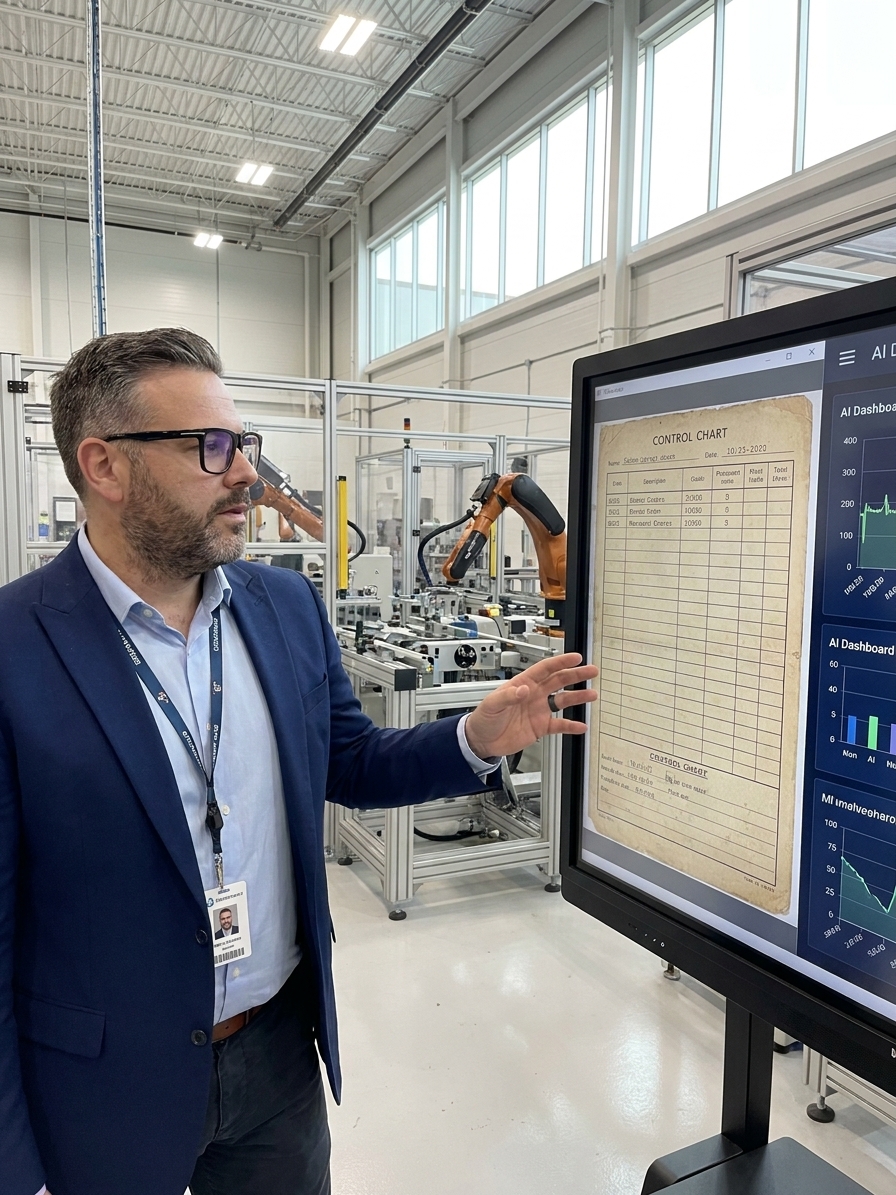
I have audited manufacturing plants where sophisticated AI-driven anomaly detection flagged signals that a competent SPC practitioner would have caught in the first hour of analysis. The operators on the floor could not interpret a basic X-bar and R chart. The organization had spent significant capital on algorithmic detection while neglecting the foundational process knowledge that makes any monitoring system, manual or automated, genuinely effective.
The most dangerous quality initiatives substitute technology for the process understanding the organization never built.
Applying a Lindy Filter to Quality Investment Decisions
Every quality investment should be evaluated against five practical criteria derived from the Lindy Effect. The goal is not to reject innovation but to ensure that new investments build on proven foundations rather than replacing them. A methodology that passes this filter has a high probability of delivering durable value, regardless of its marketing presentation.
The Lindy Filter: Five Evaluation Steps
- 01Test the underlying principleIf the methodology is built on an idea that has survived decades, the investment is safe. DMAIC is structured PDCA.
- 02Assess vendor independenceIf the vendor disappears tomorrow, does your quality system still function? Capability must not be outsourced to a single platform.
- 03Verify sustained track recordLook for organizations that adopted the approach over five years ago and integrated it into daily work, not just a website badge.
- 04Identify what it replacesIf the new tool requires abandoning SPC or FMEA, proceed with extreme caution. Automation should not replace engineering judgment.
- 05Confirm old-tool masteryOrganizations that benefit from new technology have already mastered the fundamentals manually. They know what the algorithm should find.
Building Systems That Outlast the Next Framework
The organizations that build durable quality capability share a specific trait. They go deep on fundamentals before going wide on technology. They train every operator to read a control chart before implementing automated data collection. They complete FMEA documentation as genuine engineering analysis, not as paperwork to satisfy an IATF 16949 auditor, and they verify Cpk values against real production data.
This depth-first approach means that when new tools arrive, the organization can evaluate them accurately. Engineers who have manually calculated process capability understand what a software platform should produce. When the algorithm flags an anomaly, they know whether the signal reflects a real process shift or a sensor calibration issue. They use technology to amplify judgment, not to replace it.
When I trace a customer complaint back through the corrective action system using 8D methodology, I almost never find that the organization lacked the latest analytical tool. I find that the FMEA was completed as a formality, the control plan was not updated after the last process change, or the operator was never trained on the specific inspection requirement. The system had the right tools. The organization failed to apply them with discipline.
The Lindy Effect reminds us that quality fundamentals have survived for a reason. SPC, FMEA, PDCA, and structured root cause analysis will outlast every framework currently being marketed as a revolution. Invest in the depth of their application, and your quality system will remain robust regardless of what the conference circuit promotes next year.