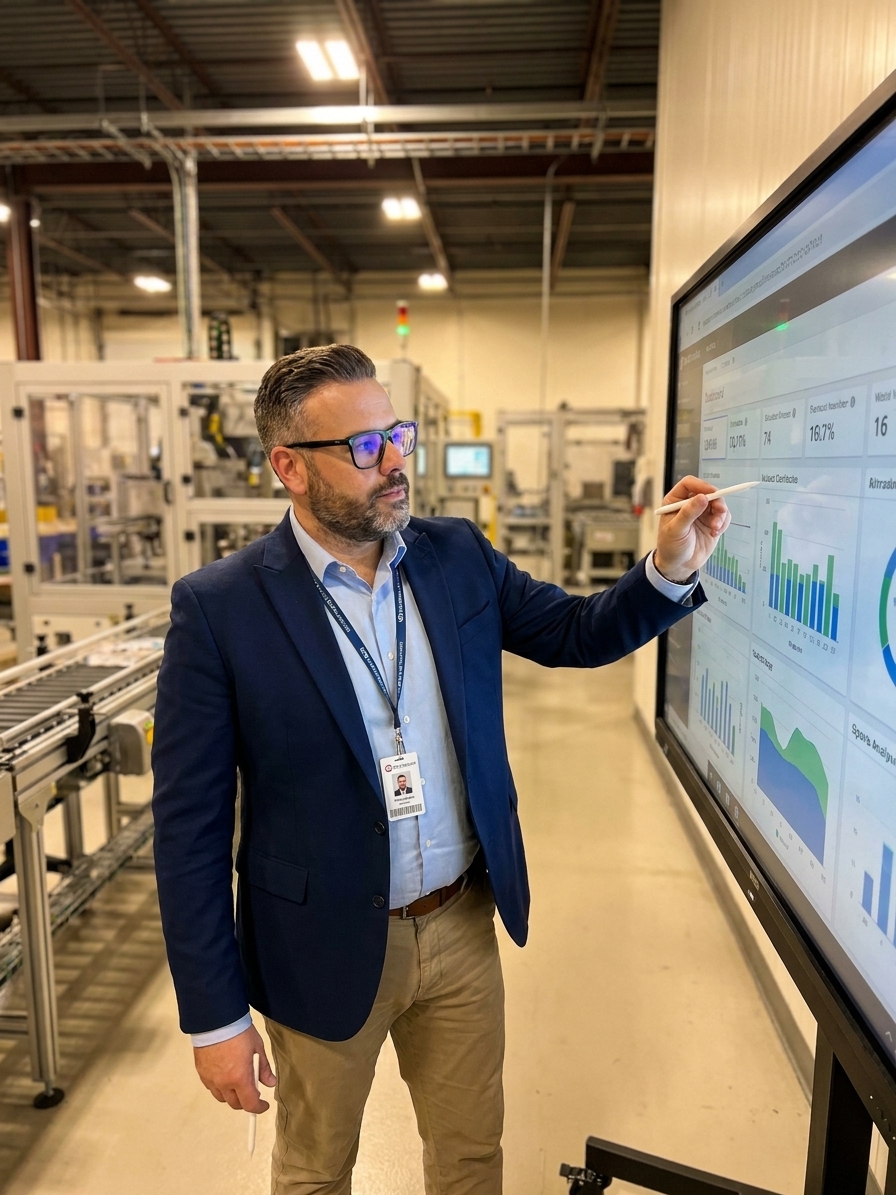
In the early 1960s, US Secretary of Defense Robert McNamara managed the Vietnam War through spreadsheets. Body counts, sortie rates, and tons of bombs dropped dictated strategy. Every available metric indicated progress. The analytical framework felt rigorous, but it omitted the variables that actually determined success. The result was a catastrophic failure of strategic judgment now known as the McNamara Fallacy.
The fallacy progresses in four distinct stages. First, you measure whatever can be easily quantified. Second, you disregard what resists easy measurement. Third, you presume that unmeasured variables are unimportant. Fourth, you conclude that unmeasured variables simply do not exist. This cognitive drift destroys quality management systems by narrowing organizational focus to compliant data entry.
I have audited plants where ISO 9001 and IATF 16949 dashboards were pristine, yet the shop floor was actively circumventing the process. Management worshipped daily defect rates while ignoring the systemic cultural failures causing the scrap. When metrics replace actual process understanding, compliance becomes theater. The measurement system optimizes the measurable at the direct expense of the meaningful.
Stage One: The Seduction of Easy Data
Every quality department initiates measurement with good intentions. You need data to track process improvement and drive decisions. However, organizations inevitably default to measuring what is immediately accessible. Scrap rates, cycle times, DPMO, and the cost of poor quality dominate initial dashboards. These quantitative metrics are objective and readily extracted from ERP systems.
These low-hanging metrics feel rigorous. They fill management reviews with colourful charts that easily impress auditors and executives. During my time implementing quality systems at WITTE Automotive, I observed departments tracking hundreds of isolated metrics. Every station had a target. The volume of data created a powerful illusion of analytical control.
The problem is that these convenient metrics rarely correlate with end-user satisfaction. When challenged, quality directors often admit that only a fraction of their tracked KPIs ever trigger meaningful process change. The rest exist purely because they can be counted. This is the first stage of the fallacy: measuring what is convenient rather than what is consequential, while mistaking data volume for operational insight.

Stage Two: Disregarding Unquantifiable Variables
The most critical variables in any quality system resist easy quantification. Operator engagement, the clarity of work instructions, psychological safety, and the trust between frontline workers and supervisors dictate your defect rate. Research consistently proves these factors heavily impact quality outcomes. Yet, standard quality systems systematically ignore them.
I recall auditing an automotive plant struggling with an unexplained spike in defects. Their SPC charts were flawless. Their PFMEA documentation was comprehensive. Inspection stations caught defects before shipment. But the failure rate kept climbing because a newly assigned shift supervisor managed through intimidation rather than support.
Operators were terrified of reporting problems. When a process parameter drifted, they quietly adjusted the machinery themselves to avoid the supervisor's temper. No dashboard captured this dysfunction. No control chart detected the systemic breakdown. The most vital variable in the quality equation—the relationship between leadership and the floor—was invisible to the measurement framework.
Stage Three: Presuming the Unmeasured Is Unimportant
Once a measurement system establishes itself, a dangerous cognitive shift occurs. Organizations begin believing that measured variables are the only variables that matter. This is rarely a conscious decision. No quality manager explicitly declares they will ignore culture. Instead, the existing dashboards create a gravitational pull. Resources flow toward whatever generates data.
Meeting agendas get built around available metrics. Improvement projects target visible KPIs. Factors that cannot be reduced to a number are pushed aside as soft, qualitative concerns. The measurement system effectively dictates the organization's entire definition of quality, excluding complex variables like process handoff accuracy.
In heavily regulated environments like pharmaceuticals or aerospace, companies invest heavily in tracking every batch deviation and CAPA. Yet, they routinely fail to measure the critical translation of development parameters into production instructions. The human interpretation required during cross-functional handoffs is presumed unimportant simply because it cannot populate a real-time interactive dashboard.
Dashboard Metrics vs Reality on the Floor
What the System Rewards
- High volume of data entry and tracking
- Scrap percentage reductions on paper
- Strict adherence to SPC chart rituals
- Closure of CAPAs within target timeframes
What Actually Drives Excellence
- Operators feeling safe enough to stop the line
- Accurate translation of engineering intent
- Supervisors coaching rather than intimidating
- Trust between development and production teams
Stage Four: Denying the Existence of Unmeasured Risk
The terminal phase of the fallacy occurs when management actively suppresses experiential intelligence. A seasoned operator raises a concern based on years of tacit knowledge, and leadership asks for data. This demand sounds rigorous and scientific. In reality, it is a defensive weapon used to dismiss anything outside the established measurement framework.
If an observation is not quantified, the system dictates it is not real. During my aerospace work, an experienced composite technician sensed a batch of material would fail fatigue testing. The incoming inspection data was within specification. The batch records were complete. But the material behaved differently during layup.
The technician reported the anomaly to the quality engineer. Because she had no hard data, the engineer approved the batch. Months later, the components failed testing at sixty percent of their expected life. The supplier had altered the resin formulation. It passed standard checks but altered the material's performance. The operator's expertise was real, but the measurement system denied its existence.
The absence of data is not the absence of a problem; it is merely the absence of a measurement.
External Pressures and the Illusion of Control
Intelligent quality professionals fall into this trap because measurement provides what organizations crave most: the illusion of control. A green dashboard indicator suggests predictable variation. Trend lines suggest operational mastery. This false sense of security is incredibly sedative in high-stakes industries like automotive and medical devices.
Furthermore, the entire regulatory ecosystem reinforces this bias. Certification bodies audit against documented procedures. Regulators expect quantitative evidence of effectiveness. Customers demand statistical proof of process capability, such as Cpk targets during PPAP submissions. The external validation system forces organizations to prioritize quantification over the qualitative nuances that actually determine long-term reliability.
Core Metrics Boundaries
Breaking the Measurement Cycle
Escaping the McNamara Fallacy requires restructuring how you interact with data. You must audit your measurement system annually with the same rigour applied to production lines. For every tracked metric, ask if it predicts customer satisfaction, if anyone uses it for daily decisions, and if its removal would change operational behaviour.
If a metric fails these tests, stop measuring it. Free those resources to investigate actual process constraints. You must formalize mechanisms for capturing qualitative intelligence. Structured gemba walks, operator interviews, and cross-functional huddles are not soft activities. They are essential sensors that detect the subtle drift your dashboards naturally ignore.
Create proxies for unmeasured variables like culture, handoff integrity, and leadership behaviour. Track the frequency of voluntary floor stops or the number of clarification calls between development and production. Distinguish between measurement and understanding. A quality engineer who can execute a Gage R&R study but cannot read operator hesitation is only half-equipped for the job.
Integrating Qualitative Intelligence into Quality Systems
- 01Metric AuditEliminate tracked metrics that fail to predict outcomes or drive daily decisions.
- 02Sensor MappingIdentify critical qualitative variables like handoff accuracy and psychological safety.
- 03Proxy CreationEstablish directional indicators for unquantifiable cultural factors.
- 04Hypothesis TestingTreat operator concerns as valid leads requiring investigation, not proof.