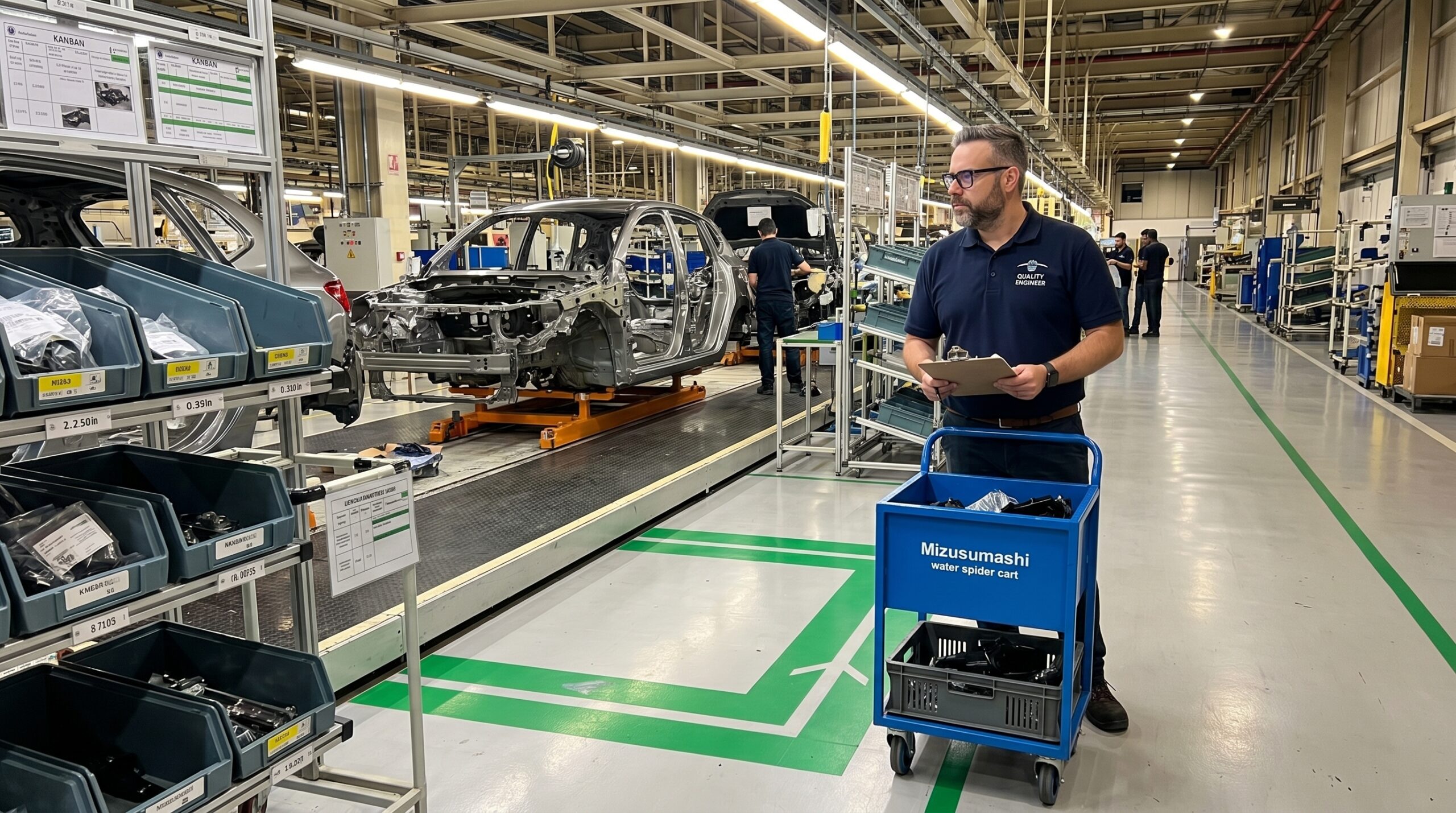
I was standing near an assembly cell in a mid-sized automotive supplier plant recently. The line was running, shift targets were nominally met, but the takt was erratic. An operator finished her cycle, reached for the next component, and found an empty container.
She left her station, walked to a rack three metres away, found the Kanban position empty, and shouted to a neighbouring cell. The line halted for ten minutes while someone located the parts and replenished the station. When asked, the shift supervisor shrugged: 'It's normal. Sometimes the material is not ready.'
That word 'normal' is the exact problem. In a functioning Toyota Production System environment, an operator turning around to find missing parts is an abnormality, not a baseline. The solution is not better forecasting or more floor stock; it is the structured implementation of a Mizusumashi, or water spider.
The Hidden Cost of Operator Logistics
Ask most plant managers what their direct labour utilisation is, and they will quote a figure between eighty-five and ninety-five percent. When you actually time-study the floor, the reality is far lower. I have audited plants where nearly forty percent of an operator's shift was consumed by logistics.
Walking to fetch parts, hunting for missing components, and waiting for replenishment are non-value-added activities. If an operator spends fifteen minutes per shift walking for material, a twenty-person line loses five hours of direct labour per shift. That is the equivalent of paying a full-time employee just to wander the floor.
The Mizusumashi role eliminates this by decoupling material handling from production. A dedicated handler runs a strictly defined route on fixed time intervals, delivering parts and removing finished goods. The operator never leaves the workstation, and the line maintains a steady takt time.
Engineering the Mizusumashi Route
A water spider does not wander. The role operates on a standardised loop, typically shaped like a figure-eight, connecting the central supermarket directly to the assembly cells. This route is physically marked on the floor with painted lines, directing the handler exactly like rails guide a train.
The pace of the route is dictated by the production takt time. If the line produces one unit every sixty seconds, the Mizusumashi completes the replenishment loop in a fixed multiple of that interval, often every fifteen or thirty minutes. During each pass, they refill empty bins, clear finished goods, and visually verify the status of every station.
To make this work, every workstation must have strictly defined minimum and maximum stock levels, visualised using Kanban markers or coloured lines on the racks. The water spider tops up the inventory only to the maximum level. This prevents overstocking, keeps the workstations uncluttered, and makes shortages visible at a glance.
The tool for this job is a custom-designed cart. It is essentially a mobile mini-warehouse, with shelves zoned by operation sequence. In my experience implementing these systems at plants like WITTE Automotive, the most effective carts are designed jointly with the operators themselves, ensuring every component has an exact, ergonomic place.
Implementation: Securing Operator Buy-In
When you introduce this role, the most common failure is treating it as a demotion. If you assign a low-performing operator to the cart, you signal that the job is menial. In a TPS framework, the Mizusumashi is one of the most critical roles on the floor; without them, the entire cell stops.
I oversaw the introduction of this role on a problematic assembly line. The experienced operator assigned to the cart was deeply skeptical, viewing it as a downgrade from assembly to mere courier. It took three weeks of sustained coaching to shift that perspective.
The shift occurred when he realised his job was not carrying parts, but guaranteeing zero stoppages. Once the assembly operators stopped running for components, the line stabilised, work-in-progress dropped, and the water spider began proactively suggesting route improvements.
Grade and pay structures must reflect the importance of the role. If the water spider is paid less than the operators they support, the system will collapse. You are entrusting them with the stability of the entire line; the compensation must match that accountability.
Measurable Impact on KPIs and OEE
The data from a correctly implemented Mizusumashi route is immediate and verifiable. On the line where I supervised the rollout, downtime caused by material shortages plummeted from forty-seven minutes per shift to just three minutes.
Because operators remained at their stations, direct labour utilisation, or value-added time, increased significantly. Work-in-progress inventory shrank because the line operated on a true pull system rather than batching parts at the point of use.
Furthermore, ergonomic complaints dropped dramatically. You cannot sustain ISO 45001 or general safety standards when operators are constantly twisting, bending, and walking to fetch heavy containers. Centralising that physical strain on a purpose-built cart reduces risk.
| Metric | Baseline | Post-Implementation | Delta |
|---|---|---|---|
| Downtime (material shortages) | 47 min/shift | 3 min/shift | -94% |
| Operator utilisation (value-added) | 42% | 71% | +29 pts |
| Work-in-progress (WIP) | ~340 units | ~120 units | -65% |
| Ergonomic complaints (walking) | 12/month | 1/month | -92% |
Integration with Industry 4.0 and AGVs
Plant managers often ask if Automated Guided Vehicles (AGVs) and smart warehouses make the human water spider obsolete. They do not. Automation excels at moving heavy loads from point A to point B, but it cannot diagnose anomalies or adapt to supply chain disruptions on the fly.
An AGV will blindly deliver a bin of non-conforming parts if the upstream process failed. A trained Mizusumashi notices that the parts look different, stops the delivery, and escalates the issue immediately. Digital systems provide data; humans provide situational awareness.
The highest-performing facilities integrate both. Sensors monitor bin levels and send smartwatch notifications to the water spider when stock drops below the minimum threshold. The human still runs the route, but the digital system eliminates the need to visually guess consumption rates.
Automation moves the box. The water spider ensures the right parts are in it, exactly when the line demands them.
This combination of standardised work and digital telemetry typically yields another twenty to thirty percent improvement in replenishment efficiency over manual systems. But the human intelligence remains the critical fail-safe.
A Structured Rollout Plan
Do not deploy a water spider on a whim. The implementation requires rigorous preparation. You must map the current state of material flow, identify the constraints, and engineer a route that aligns with your actual takt time.
The rollout spans roughly six weeks. Skipping the preparation phase guarantees failure. If you simply hand someone a cart and tell them to deliver parts, you have created a wandering picker, not a Mizusumashi.
Mizusumashi Implementation Sequence
- 01Week 1: Map the FlowTime-study current state. Log who fetches what, how often, and how long it takes.
- 02Week 2: Engineer the RouteDesign the loop connecting the supermarket to the cells. Validate cycle time against takt.
- 03Week 3: Set Visual ControlsPaint floor lines, define min/max stock levels on racks, and build the custom cart.
- 04Weeks 4-5: Pilot and AdjustRun one line. Measure downtime reductions. Refine the route based on actual demand.
- 05Week 6+: StandardiseLock in standard work documents. Roll out to additional lines. Begin tier reviews.
When Not to Use a Water Spider
This system is not a universal cure. It works brilliantly for lines with defined takt times, steady material consumption, and multiple stations clustered along a logical loop. It fails in highly customised, low-volume job shops where the product mix and routing change daily.
If your operations require a new part only once per shift, assigning a dedicated water spider is over-engineering. A standard warehouse attendant or a simple kanban pull from a central storage area will suffice without adding operational overhead.
Furthermore, if management does not understand the difference between a logistics handler and a line-sustaining water spider, the initiative will fail. The role requires absolute commitment to standard work and the authority to stop the line if material flow is compromised.
Implementing a Mizusumashi is fundamentally about respect for the operator. It states that direct labour should focus entirely on value-added assembly, inspection, and machining. When you remove the burden of logistics, quality improves, lead times compress, and the factory operates as designed.