
A precision gear plant ran for decades at a respectable 0.3% defect rate, well within customer specification. A new quality director arrived, looked at that figure, and saw opportunity where others saw stability. He announced a Zero Defect Excellence initiative: additional inspection stations, sampling frequency increased from every 50th part to every 10th, and a 100% re-inspection layer on the final audit. By every conventional playbook, he was doing exactly the right things.
Within three months, the defect rate climbed to 0.8%. The director responded the way most quality professionals would: he added more inspectors, instituted daily quality review meetings, and walked the floor twice a day questioning operators about every deviation. The defect rate climbed to 1.2%.
The failure was not in the process. It was in the observation system. The director had changed the observers, and the observers had changed the system. This is the territory of second-order cybernetics — the principle that the people measuring, inspecting, and auditing are not separate from the system they observe. Their presence, expectations, and incentives reshape the reality they are trying to measure, and until you account for this coupling, your quality interventions will produce effects you cannot predict.
First-Order Versus Second-Order Observation
First-order cybernetics, the framework most quality engineers implicitly operate within, treats the quality system as a machine observed from the outside. You have a process, you measure it, you compare the measurements to specification, and you adjust. The inspector stands apart from the process like a doctor examining a patient. The measurement, presumably, does not change the disease.
Second-order cybernetics, developed in the 1970s by Heinz von Foerster, Humberto Maturana, and Francisco Varela, shatters that assumption. Every observer is part of the system they observe. The act of observation changes the observed. The observer's own model of the system — their expectations, training, and fears — shapes what they see and what they do, which in turn shapes the system itself. In quality management, this is not academic abstraction. It is a daily operational reality with measurable cost.
When the gear plant director increased inspection intensity, he changed the psychological environment in which operators worked. The operators knew more parts were being rejected, knew the director was watching closely, and knew deviations were scrutinised in daily meetings. Their behaviour changed, but not in the direction the director intended. The system did not get worse. The measurement of the system changed, and because the measurement changed, behaviour changed, and because behaviour changed, actual quality changed.
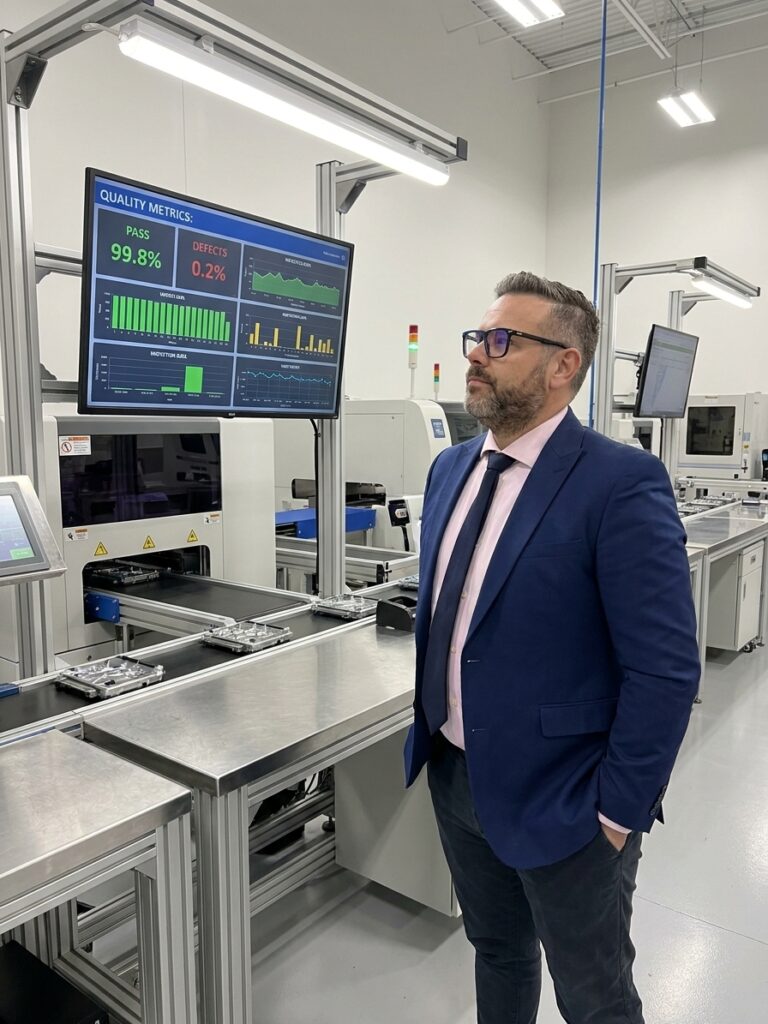
How Inspection Changes Operator Behaviour
Operators respond to inspection pressure through specific, predictable mechanisms. Some begin over-adjusting their machines, chasing the centre of the specification on every part. This actually increases variation because they are compensating for random noise — the statistical equivalent of turning the steering wheel for every ripple in the road. The process mean shifts, control limits widen, and Cpk degrades.
Others begin passing borderline cases to the next station faster, calculating that a downstream flag is less personally costly than a deviation on their shift. This distorts first-pass yield data, concentrates defects at later stages where root cause is harder to trace, and breaks the feedback loop that SPC depends on. The data looks different not because the process is different but because the operators are gaming the observation system.
Inspectors, meanwhile, recalibrate their own judgement under scrutiny. When daily review meetings second-guess every reject decision, inspectors begin rejecting parts they would previously have passed — not because the parts are worse, but because the perceived cost of passing a marginal part under the new regime feels higher than the cost of rejecting a good one. False rejects rise. Scrap increases. The defect metric climbs because the definition of a defect, at the margin, has shifted. None of this appears in an MSA study, yet all of it directly affects the measurement system's integrity.
The Recursive Surveillance Loop
The most dangerous characteristic of second-order effects in quality systems is recursion. It is not a one-time perturbation. It loops. A quality manager notices a spike in defects and increases surveillance. The heightened surveillance makes operators anxious. Anxious operators make more mistakes and more aggressive adjustments. More mistakes confirm the manager's suspicion that the process is out of control, triggering further escalation.
Consider the annual ISO 9001 or IATF 16949 surveillance audit. In the weeks before the auditor arrives, the organisation cleans up documentation, follows procedures to the letter, and applies meticulous attention to every process. The auditor visits, sees a controlled system, and issues a positive report. The certificate is renewed. Within a week of the auditor's departure, practices drift back to their steady state.
The auditor is not measuring the system. The auditor is measuring the system's response to being measured — and the two are not the same thing.
In first-order terms, the audit is a snapshot of system performance. In second-order terms, the audit is a perturbation that temporarily reshapes the system being measured. This means that many of the quality metrics organisations rely on — audit scores, inspection results, defect rates — are not measurements of quality. They are measurements of the interaction between the quality system and its observers. The metric and the reality are coupled, and treating them as independent is a category error.
Why Metrics Are Active Interventions, Not Passive Measurements
Every metric you introduce changes the system you are measuring. A defect rate target does not just measure defects; it creates incentives to redefine what counts as a defect. A first-pass yield target creates pressure to rework parts in-line and categorise them as first-pass successful. A customer complaint metric creates motivation to reclassify complaints as technical inquiries or feedback to protect the scorecard.
This does not make metrics useless. It makes them active interventions. Before introducing any new metric or tightening an existing target, the quality function must ask what behaviours the metric will encourage and discourage, and whether those encouraged behaviours actually improve quality or merely improve the metric. The gap between those two outcomes is where most well-intentioned quality programmes fail.
First-Order vs Second-Order Quality Thinking
First-order assumption
- The observer stands outside the process being measured
- Adding inspection stations increases measurement capacity without side effects
- Higher sampling frequency directly improves quality outcomes
- Defect rate metrics accurately reflect process capability
Second-order reality
- The observer is embedded in the process and changes it by observing
- Each inspection point alters operator behaviour and incentive structures
- Tighter sampling increases anxiety, over-adjustment, and false rejects
- Defect rates reflect the coupling between process and observation system
Inspectors Are Not Cameras
An inspector is not a passive recording device. They are a human being with expectations, biases, and social relationships inside the plant. Their judgement is shaped by what they expect to see — confirmation bias. By what they have recently seen — recency effect. By what their colleagues are finding — the Asch conformity effect. And by what they believe management wants them to find — the Pygmalion effect.
When you change the inspection system, adding inspectors, increasing sampling frequency, or restructuring reporting lines, you are not simply adding measurement capacity. You are changing the social and cognitive environment in which judgement happens. The best inspection systems account for this explicitly. They rotate inspectors regularly to prevent expectation-setting. They blind the inspector to the production source of the part when feasible. They calibrate inspectors against known reference samples, not just the gauges, to check for drift in human judgement.
They also create psychological safety so that inspectors can flag borderline cases without fear of being blamed for slowing production. I have audited plants where the inspection function was so politically charged that inspectors routinely passed marginal parts to avoid conflict with line supervisors. The MSA study showed gauge R&R well within acceptable limits. The measurement system was statistically sound and operationally broken at the same time, because the human element of the system had been corrupted by organisational pressure.
The Observer Audit: A Practical Framework
Applying second-order cybernetics without descending into philosophical abstraction requires a structured method. The Observer Audit is a five-question examination applied to every metric, inspection point, and audit mechanism in your quality system. It forces the quality function to confront how its observation systems are reshaping the processes they are meant to monitor, and it produces actionable findings that traditional tools like FMEA and SPC cannot generate on their own.
The Observer Audit Method
- 01Identify the observerName the actual person or team, their expectations, pressures, and incentive structures — not just the job title.
- 02Map their expectationsAn inspector who expects to find defects will find more defects than one who expects the process to be in control, given the same parts.
- 03Assess systemic impactDetermine what operators and managers do differently because this observer exists. Ask what would happen if the observer were removed tomorrow.
- 04Trace feedback loopsMap how the observer's output — reject rates, audit scores, reports — flows back into the system and changes operator behaviour.
- 05Estimate the unobserved stateCompare behaviour during audit periods to behaviour between audits, or metrics before and after a new measurement system was introduced.
The Observer Audit does not replace traditional quality tools. PFMEA still predicts failure modes. SPC still distinguishes signal from noise. MSA still quantifies gauge variation. PDCA still drives improvement. But second-order cybernetics reminds you that these tools are wielded by human observers embedded in the system they are observing, and that the act of wielding the tool changes the system itself.
Designing Observation Systems That Improve Quality
The resolution in the gear plant illustrates the principle. Once the director understood the recursive effect, he removed half the additional inspection stations, cancelled the daily review meetings, and returned sampling to every 50th part. He then told operators directly that he trusted their judgement. The defect rate dropped below 0.3% within six weeks — not because the process had improved, but because the observation system had stopped making the process worse.
Operators stopped over-adjusting. Inspectors stopped over-rejecting. The system relaxed into its natural operating state, which turned out to be better than the state it had been forced into by an observationally naive intervention. This is not an argument against inspection or measurement. It is an argument for understanding that these activities are interventions with side effects, and that those side effects must be managed with the same rigour applied to any process change.
Heinz von Foerster formulated what he called the ethical imperative of second-order cybernetics: act always so as to increase the number of choices. For quality professionals, this translates into a concrete design principle. Build observation systems that increase the system's capacity for quality — operator autonomy, process understanding, feedback fidelity — not merely your capacity to measure it. The organisations that achieve world-class quality are not the ones with the most inspection stations. They are the ones that understand the coupling between observer and observed, and design their quality systems to account for it.