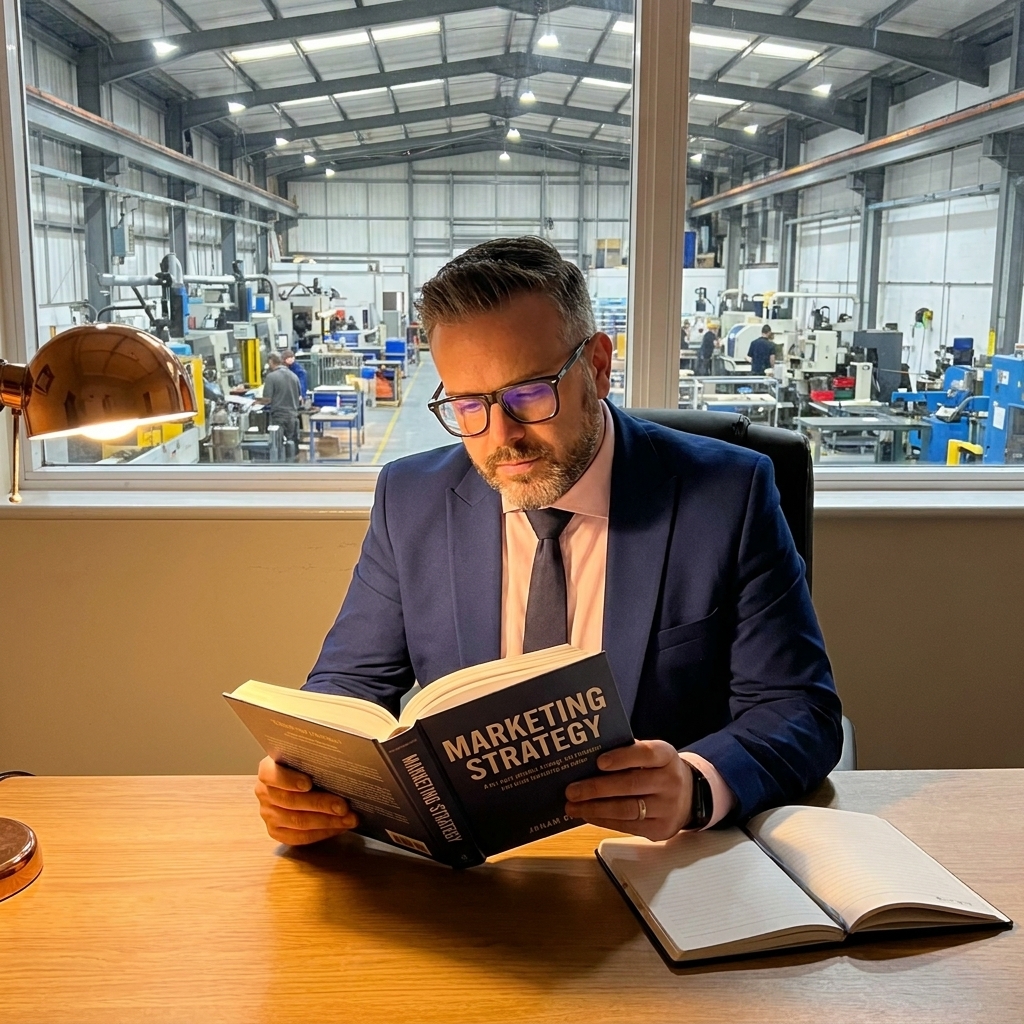
Manufacturing companies routinely fail to articulate their strongest competitive advantage. They invest in capable processes, hold tight tolerances, and maintain rigorous IATF 16949 or AS9100 quality management systems, then go to market with messaging indistinguishable from every competitor in their sector. The website says quality products, reliable service, competitive pricing. So does everyone else's.
I have audited plants across automotive and aerospace that operate at genuinely world-class levels, then undermine their market position with generic sales collateral that mentions none of it. The discipline that goes into achieving Cpk 1.33 on critical characteristics, the 8D rigour embedded in their corrective action process, the supplier development work that stabilises the entire value chain, none of it reaches the customer's decision-making process in a form they can evaluate.
The problem is not a lack of substance. It is a failure to identify, name, and communicate the operational qualities that actually drive customer retention. Companies sit on advantages built over decades, advantages their best customers already value, and never convert them into a deliberate market position.
The Diagnostic Gap in Manufacturer Positioning
The diagnostic failure follows a consistent pattern. When asked what their company stands for, most manufacturing leaders describe their product catalogue. They list specifications, materials, capacities, and certifications. These are important, but they describe what the company makes, not what it delivers. A PPAP package documents process capability. It does not explain why a customer should choose you over the next certified supplier with identical documentation.
The gap between what companies believe differentiates them and what actually drives customer loyalty is measurable. In my experience conducting supplier evaluations and customer feedback reviews across automotive and aerospace, the stated differentiators, which are invariably price, quality, and service, almost never match the reasons customers give for staying. The real reasons are operational: responsiveness when a nonconformance occurs, engineering support during launch phases, and the stability of the working relationship over multi-year programmes.
These operational qualities are not soft attributes. They are the direct output of the quality management system, the process controls, and the organisational culture. The problem is that the people responsible for maintaining those systems rarely participate in how the company positions itself commercially. The quality function builds the advantage, and the commercial function fails to communicate it.

Four Questions That Expose Your Real Position
A workable diagnostic framework requires answering four questions with specificity, not aspiration. These are not abstract marketing exercises. They are the same kind of disciplined inquiry that underpins a solid PFMEA or a VDA 6.3 process audit. The objective is to identify what is actually true about your operation and whether it reaches the market.
First: what does the company stand for operationally? Not the vision statement, but the working principle that governs decisions on the floor. If the answer takes more than one sentence or requires qualifiers, it is not yet clear enough. Second: who is the specific decision-maker you are addressing? Not a market segment, but the individual with a defined problem and authority to solve it.
Third: why should they select you over every other qualified supplier? The answer must be something competitors cannot credibly claim or have not bothered to articulate. Fourth: is that message delivered consistently across every customer touchpoint, from the website homepage to the way a nonconformance report is handled during an audit? Most companies fail at the fourth question even when they can answer the first three.
Manufacturer Positioning: Stated vs Actual
What companies claim
- Quality products and reliable service
- Competitive pricing and on-time delivery
- Full IATF 16949 / AS9100 certification
- Experienced team with modern equipment
What customers actually value
- Direct engineer access when problems occur
- Predictable, stable processes across multi-year programmes
- Rigorous, transparent handling of nonconformances
- A working relationship built on demonstrated trust over time
Asking Customers What They Actually Buy
The fastest way to close the diagnostic gap is structured customer interviews. Not satisfaction surveys, which produce averaged scores on categories the company defines itself. Direct conversations with key accounts, asking a question most suppliers never ask: what is the specific reason you continue to buy from us? The answers consistently diverge from what internal teams expect.
In my experience, customers rarely cite specifications, pricing, or certifications as their primary reason for staying. They cite accessibility, the ability to reach a decision-maker when a delivery is at risk. They cite consistency, the fact that the product works without requiring constant oversight. They cite trust, which in operational terms means confidence that the supplier will flag issues proactively rather than concealing them until they become critical.
These are not intangible qualities. Accessibility is a function of organisational structure and response-time discipline. Consistency is the output of process capability and statistical process control. Trust is the result of transparent nonconformance management and rigorous corrective action processes. Each maps directly to elements of the quality management system that the company is already maintaining, but has not recognised as a commercial asset.
The insight from these conversations is typically that the company's competitive advantage is not something it needs to create. It is something it needs to name, document, and communicate with the same discipline it applies to a production control plan. The advantage exists in the operation. It simply has not been translated into market-facing language.
Converting Operational Strength into Commercial Language
Once the real advantage is identified, the execution challenge is converting it into language that works across every customer interaction. This is not a marketing campaign. It is a consistency discipline, comparable to maintaining calibration records or updating control plans when processes change. The message must be present everywhere the customer encounters the company.
The advantage exists in the operation. It simply has not been translated into market-facing language.
Start with the website homepage. Replace the generic quality-and-service formulation with a single, specific promise that reflects what long-term customers already know. If your data shows that customers stay because of engineering accessibility during crisis situations, the homepage should say that directly. If your retention driver is process stability over multi-year programmes, state it in concrete terms.
Restructure proposals and quotations the same way. Most manufacturers lead with specifications, lead times, and pricing. Lead instead with the operational problem the customer is trying to solve, reference similar problems you have solved under comparable constraints, and then present your technical solution. Specifications and pricing belong later in the document, after the relevance has been established.
Apply the same principle to how nonconformances and customer complaints are handled. A disciplined 8D response that arrives quickly, identifies root cause with evidence, and implements verified corrective action is itself a communication of operational strength. Customers read the rigour of that process as a signal of overall organisational maturity.
The Sales Meeting as Process Audit
The positioning framework changes how sales conversations work in practice. The standard approach is to present capabilities, walk through specifications, offer pricing, and wait. This treats the meeting as a presentation rather than a diagnostic process. It gathers almost no information about what the prospect actually needs, which makes it impossible to connect your operational strengths to their operational problems.
Open with a diagnostic question instead. Ask the prospect to describe the single most frustrating aspect of their current supplier relationship. In automotive and aerospace manufacturing, the answers are remarkably consistent: missed deadlines without early warning, engineering changes communicated after implementation, quality escapes discovered at the receiving inspection, and the inability to reach a decision-maker when something goes wrong.
Restructuring the Supplier Sales Conversation
- 01DiagnoseAsk what specifically frustrates them about their current supplier relationship.
- 02ListenDocument the operational pain points without comparing specifications or pricing.
- 03ConnectMap their stated problems to your demonstrated process strengths.
- 04CommitState your operating principle in one sentence and back it with examples.
Once those frustrations are on the table, the response is straightforward. Map each pain point to the specific operational practice that prevents it in your company. If their current supplier communicates poorly during deviations, explain your change management process and give a concrete example. If their supplier misses deliveries silently, explain your capacity planning and early-warning escalation procedure.
This approach works because it treats the sales conversation with the same rigour as a process audit. You gather evidence before proposing a solution. You connect your capabilities to documented failures in the current system. You are not claiming to be better in abstract terms. You are demonstrating, with specifics, that your operational discipline addresses the exact problems the prospect is experiencing.
Building the Consistency Discipline
The final challenge is sustaining the message across time and touchpoints. Most positioning efforts fail not at the insight stage but at the consistency stage. The company identifies its real advantage, updates the website, and then drifts back to generic language within six months. The proposals revert to specification-led formats. The sales calls return to capability presentations.
Preventing this drift requires the same approach used to sustain any quality management system. Build the message into the standard work for customer-facing processes. Make the positioning statement part of the proposal template. Include it in the onboarding documentation for new sales and engineering staff. Review it during quarterly business reviews alongside OEE, delivery performance, and customer complaint metrics.
Treat the positioning statement as a controlled document. It should have an owner, a revision history, and a review cycle. When the company's operational capabilities evolve, the statement should be updated to reflect that. When a new competitive threat emerges, the response should consider whether the current positioning adequately differentiates against it.
The objective is not to create marketing material. It is to ensure that the operational qualities built into every process, every control plan, and every corrective action are consistently communicated to the people making purchasing decisions. The advantage is already there. The discipline lies in making sure it is visible, specific, and present at every point where the customer encounters the company.