The most dangerous person in a manufacturing plant is not the inexperienced operator. It is the experienced supervisor whose confidence vastly exceeds their grasp of quality engineering. When a customer complaint lands on their desk, they bypass root cause analysis because their mental model already supplied the answer.
They reject the batch, blame the supplier, and close the 8D. Meanwhile, the actual failure mechanism goes unaddressed. I have audited plants where this exact dynamic allowed a worn fixture to drift on Line 7 for six weeks. The resulting dimensional variation triggered a customer complaint, a rejected shipment, and a supplier dispute.
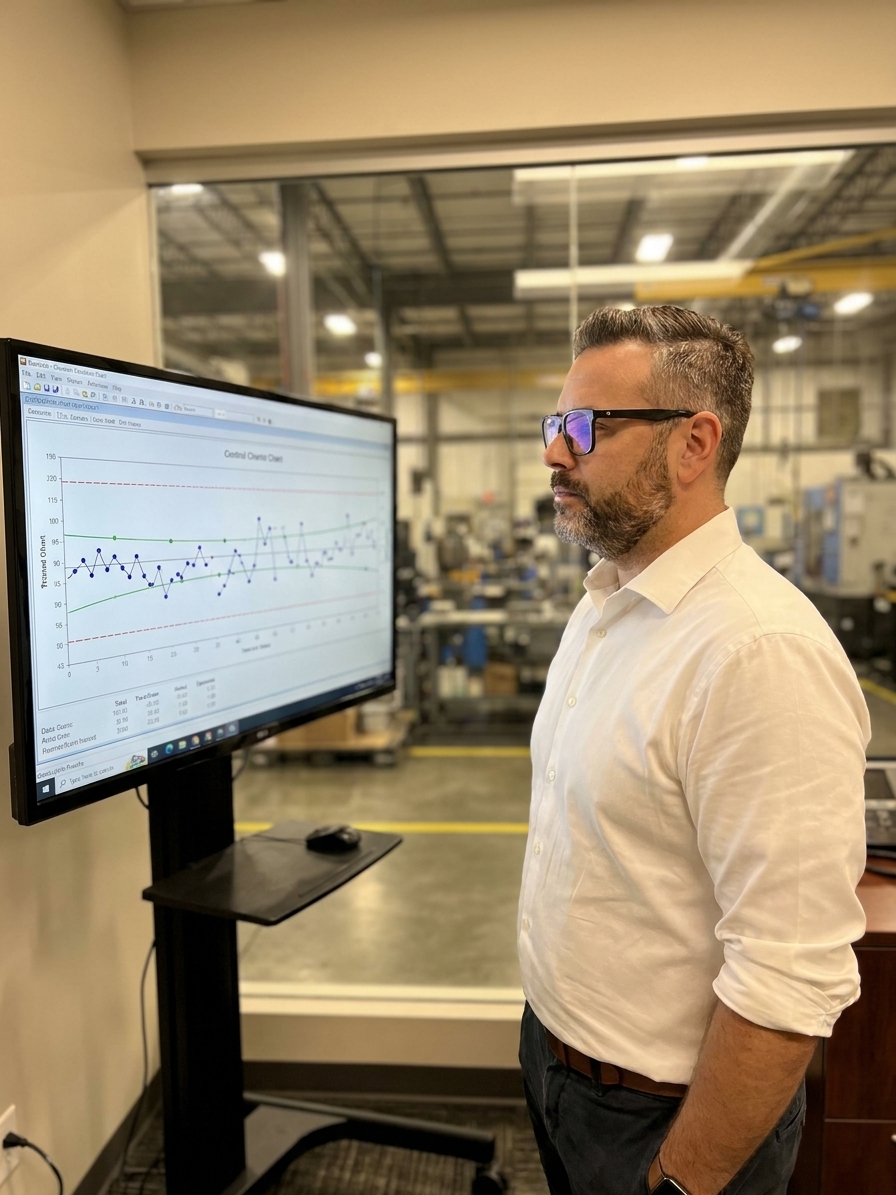
The supervisor had personally approved skipping the statistical process control (SPC) charting during an urgent production push. The SPC data would have caught the drift in its first week. This is the Dunning-Kruger Effect applied to quality management. The skills required to assess a process are the exact same skills required to recognise a flawed assessment.
Why Quality Management Breeds Overconfidence
Quality management is uniquely vulnerable to misplaced confidence. The terminology feels intuitive. Words like "good," "bad," and "defect" imply that quality judgment is simply common sense. It is not. Determining whether a process is in statistical control requires specific knowledge of capability indices and variation.
Most quality decisions are made by people whose actual expertise lies elsewhere. Production managers prioritise output. Procurement officers target cost reductions. They make critical quality decisions based on domain confidence they unconsciously generalise to quality engineering. They lack the training to distinguish a symptom from a root cause.
Worse, quality failures suffer from severely delayed feedback loops. If a leader makes a catastrophic financial decision, the ledger shows the damage immediately. When a leader reduces inspection frequency or approves a unilateral deviation, the consequences might not surface until a field failure occurs months later.
By the time the defect escapes, the original decision-maker has moved on. The broken feedback loop prevents course correction. The manager remains certain of their judgment, and the organisation repeats the exact same category of mistake during the next production cycle.
Identifying Unrecognised Incompetence on the Floor
Unrecognised incompetence manifests in highly predictable patterns. The most common is the Confident Simplifier. This person reduces every complex failure to the most obvious variable: operator error, supplier material, or a broken machine. They view structured methodologies like 8D, Ishikawa, and 5 Whys as bureaucratic friction.

Because simplifiers are fast and decisive, organisations promote them. They close corrective actions rapidly, making the lagging metrics look excellent. However, recurring customer complaints about the exact same defect reveal that they simply applied a convenient patch rather than solving the actual problem.
A close variant is the Metric Evangelist. This leader demands dashboards quoting first pass yield and Ppk values. They fail to realise that a Cpk of 1.33 is entirely meaningless if the measurement system producing the data has a Gage R&R of 40%. They treat the dashboard as truth, ignoring whether spec limits are appropriate or data is normally distributed.
Confidence Versus Competence in Problem Solving
High Confidence / Low Competence
- Immediately blames operator error or supplier material
- Quotes high-level dashboard metrics without context
- Views 8D and structured analysis as bureaucratic friction
- Closes corrective actions within days to clear backlogs
Calibrated Competence
- Investigates process variation and machine capability data
- Validates the Gage R&R before trusting yield percentages
- Uses 5 Whys to bypass assumptions and find systemic gaps
- Keeps actions open until the effectiveness check is verified
The Audit Optimist and the Tool Collector
The Audit Optimist equates passing an external audit with possessing a robust quality system. They optimise for audit performance through rehearsed responses and staged evidence. They fail to understand that an AS9100 or IATF 16949 audit is a sample, not a census. Certification proves a documented system was acceptable on a specific day.
Organisations led by Audit Optimists regularly sail through certification cycles only to suffer major nonconformances in the field. They genuinely do not understand how a system deemed compliant could produce defective hardware. The confidence they place in the certificate blinds them to daily process drift.
The Tool Collector presents a different challenge. They hold certificates in Six Sigma, APQP, FMEA, and MSA. Their documentation is flawless. However, they cannot facilitate the challenging, honest conversation required to make a PFMEA genuinely useful. They can draw a perfect control chart but cannot prescribe an action when a point breaches the upper control limit.
Tool Collectors confuse theoretical knowledge with practical application. Their training records look immaculate, yet process capability indices remain stagnant. This paralysis by analysis delays actual improvements because leadership believes the presence of tools equates to the execution of quality methodology.
Systemic Costs of the Confidence Trap
When unearned confidence dominates a culture, decision velocity exceeds decision quality. Organisations that reward speed over accuracy systematically promote people whose confidence outpaces their competence. The person who claims to know the answer advances faster than the engineer who requests time to investigate.
Over time, this filters true expertise out of the leadership pipeline. The genuinely competent professionals understand the limits of their knowledge. They hedge. They demand more data. In a culture that punishes hesitation, they are overshadowed by the loud and the certain. They eventually stop speaking up during management reviews.
The skills required to assess a process are the exact same skills required to recognise a flawed assessment.
The resulting environment suppresses the very expertise needed to correct systemic failures. Continuous improvement stalls entirely because the organisation can no longer accurately assess its baseline maturity. Every internal gap is minimised, and every external benchmark is dismissively explained away as irrelevant to their specific product line.
Breaking this cycle requires acknowledging that you cannot train people out of cognitive bias with a presentation. Telling an experienced manager they suffer from the Dunning-Kruger Effect triggers defensiveness, which only reinforces their resistance to new standards or updated methodologies.
Designing Systemic Countermeasures
You must design management systems that compensate for overconfidence. The most effective countermeasure is forcing structured decision pathways. Mandate alternative analysis before accepting any root cause. Require the problem-solving team to document and evaluate at least three potential failure mechanisms before closing an 8D.
Implement mandatory pre-mortems for significant quality decisions. Before approving a deviation or reducing inspection frequency, ask the team to imagine the decision failed spectacularly. This exercise forces decision-makers to bypass their overconfidence and actively search for hidden failure modes in their logic.
Assign explicit red team roles during root cause reviews. A knowledgeable engineer must be tasked with challenging the proposed solution. Their job is not to approve the decision, but to stress-test the statistical evidence and find the weaknesses that the original decision-makers could not see.
Validating Quality Decisions Through Forced Challenge
- 01Document AlternativesRequire three documented hypotheses before accepting any single root cause.
- 02Execute Pre-MortemHave the team articulate exactly how the proposed corrective action could fail in practice.
- 03Red Team ChallengeAn independent expert questions the data validity and statistical assumptions.
- 04Verify ApplicationMonitor the implemented action on the floor to ensure it works, not just on paper.
Measuring Competence Instead of Confidence
Most organisations rely on training certificates to prove capability. This fails. Stop certifying people in FMEA because they passed a written test. Certify them because they successfully facilitated a cross-functional review that the quality team agrees was rigorous and actionable.
Shift to application-based assessments. Test whether an engineer can correctly identify special cause variation on an SPC chart. Test whether a supervisor can spot a flawed measurement system analysis. Present them with real manufacturing scenarios and evaluate their diagnostic logic, not their vocabulary.
Implement calibration exercises across your quality staff. Present the same borderline nonconformance report to three different managers. If their disposition decisions vary wildly, you have exposed a gap in understanding that dashboard metrics and confident assertions were actively concealing.
Periodically conduct retrospective reviews of past corrective actions. Revisit an 8D closed six months ago. Did the action actually work? Did the failure mode return? This creates the critical feedback loop that day-to-day operations destroy. It transforms misplaced certainty into operational learning.
The most resilient quality cultures share one trait: they normalise saying "I don't know." When a plant manager publicly acknowledges uncertainty and demands investigation over speed, they model the intellectual humility required for IATF 16949 and AS9100 compliance. They build systems that do not rely on individual omniscience.