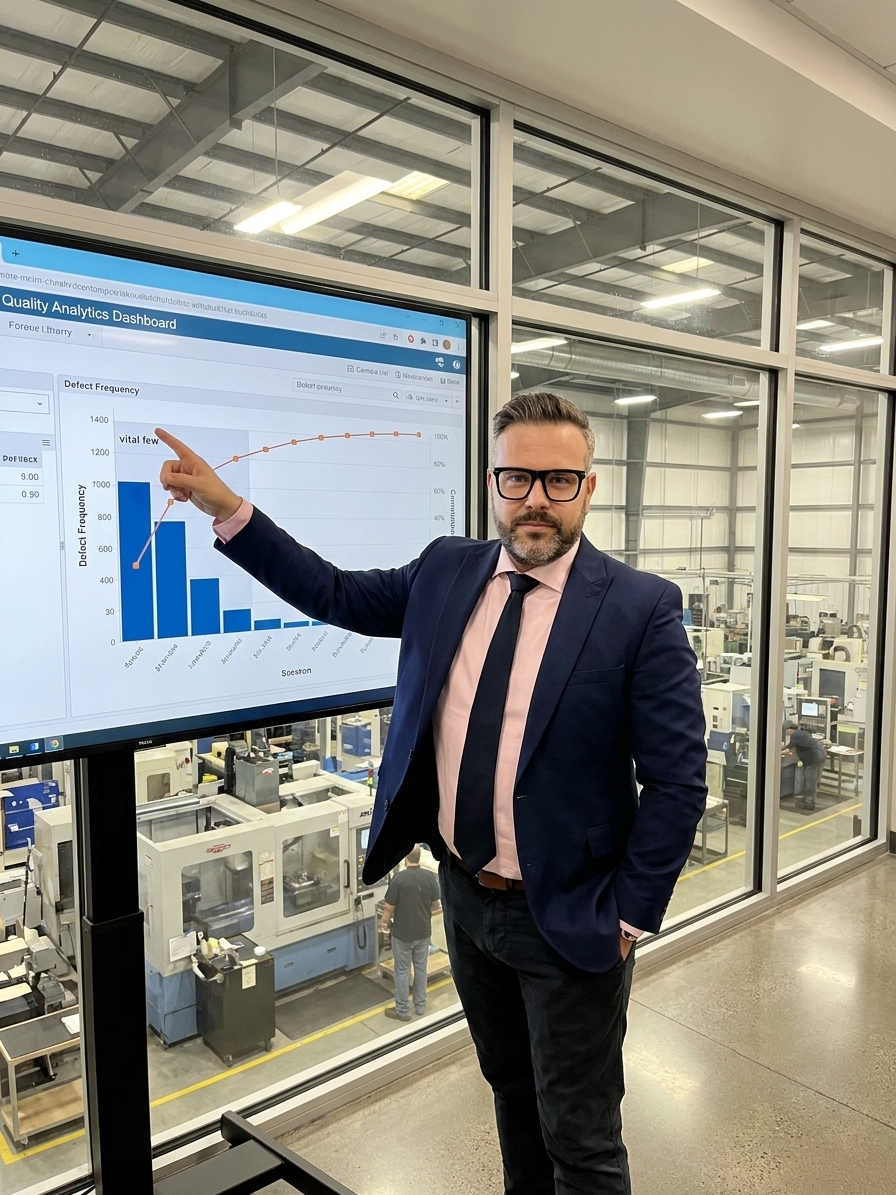
Joseph Juran recognised that Vilfredo Pareto's observation about uneven wealth distribution governed industrial defects. Eighty percent of manufacturing problems consistently originate from twenty percent of identified causes. Juran categorised this dynamic as the Pareto Principle and spent his career urging organisations to concentrate their engineering effort accordingly.
Most organisations still resist this discipline. Engineering teams generate the chart, present the skewed bar graph, and immediately resume attempting to resolve every documented nonconformance simultaneously. They treat all defects as equal, spreading scarce quality engineering resources across forty-seven distinct categories rather than focusing on the four driving systemic failure.
This equal-treatment approach guarantees operational exhaustion without yielding measurable improvement. Defect rates stagnate while quality managers drown in parallel 8D investigations. The discipline required to improve lies not in complex statistical analysis, but in the management courage to consciously deprioritise low-impact issues until the primary drivers of cost are genuinely resolved.
The operational cost of treating all defects equally
I have audited dozens of plants where the quality manager presents a weekly defect summary listing forty-plus distinct nonconformance categories to the production team. These meetings routinely consume ninety minutes. By the conclusion, the only output is a vague directive to monitor the situation, while engineers return to managing five unrelated scrap reduction initiatives with no measurable progress.
This exhaustion is structural, not personal. The manager works ten-hour days advancing multiple supplier quality surveys and training programs. Yet defect rates remain static across quarters. The organisation fails to see that four specific categories account for the vast majority of total defect cost. Worse, the politically sensitive projects consume the most time, while the highest-impact corrective actions remain untouched.
Failure occurs because the system treats every reported symptom as equally deserving of engineering time. The Pareto Principle dictates that it does not. An organisation that learns to discriminate between the vital few and the trivial many is the only one that improves at all. Equal resource distribution guarantees equal neglect of your most critical process vulnerabilities.
Misapplying the 80/20 rule in quality engineering

The most common analytical failure is the counting trap. Teams build Pareto charts based strictly on defect occurrence frequency. A dimensional nonconformance on a safety-critical bore that costs thousands in field failures gets visually buried under a high-frequency, low-cost cosmetic scratch. Optimising for frequency rather than financial impact directs engineering effort toward the wrong process.
The classification trap distorts the analysis from the other direction. Grouping nonconformances too broadly, such as labelling everything as a surface defect, merges unrelated root causes into a single meaningless bar. Classifying too narrowly fragments a systemic machine fault into dozens of individual part numbers. Both approaches obscure the vital few behind an arbitrary filing system.
The timeframe trap locks organisations into outdated targets. A consumer electronics manufacturer reduced its top three defect categories by forty-five percent over two years, yet total defects dropped only eleven percent. The problems ranked four through six had grown into the new top tier. By freezing their Pareto targets, the team hunted resolved ghosts while new systemic failures accumulated unnoticed across the line.
Standard Pareto Analytical Checkpoints
Structuring data around financial impact, not frequency
Stop counting defects and start weighing them. Every nonconformance category must be evaluated by its total financial impact. This includes scrap material, rework labour hours, warranty claims, and the projected cost of customer loss. A frequency-based Pareto chart actively misleads engineering teams by masking low-volume, high-cost failures behind high-volume, low-cost irritations.
I observed this failure mode at a pharmaceutical packaging plant. Their most frequent defect was a minor label misalignment generating over three hundred occurrences monthly. The ninth most frequent defect was a seal integrity failure occurring only twelve times monthly, yet each required a forty-five thousand dollar batch hold investigation. The plant had spent two years optimising labels while ignoring the seal process.
Constructing a cost-weighted Pareto chart immediately realigns engineering priorities with business risk. When the financial data is presented transparently to the management team, the political friction of deprioritising low-cost defects dissolves. The organisation can visibly see that the seal integrity failure threatens operational viability, while the label misalignment is a manageable rounding error in the overall quality budget.
Impact-weighted analysis also exposes shared root causes that frequency charts hide. Reclassifying defects by failure origin rather than symptom frequently reveals that multiple high-cost categories trace back to a single process deficiency. Addressing that specific deficiency, such as an inadequate cooling cycle, eliminates several defect categories simultaneously, generating a massive return on the engineering investment.
Implementing dynamic recalibration of quality targets
A Pareto chart is a snapshot, not a permanent operational destination. The moment your engineering team solves the highest-impact problem, the second problem becomes the primary target. When new products or processes are introduced, entirely new categories of nonconformance emerge. The analysis must function as a living document, updated and acted upon with sustained urgency.
Rigid adherence to outdated targets creates blind spots. The timeframe trap causes teams to celebrate the elimination of a historical defect while ignoring emerging failures that have grown to dominate the cost structure. Continuous recalibration requires establishing strict review intervals tied to actual production cycles, rather than relying on annual or quarterly management reviews.
Implement weekly Pareto reviews for critical processes and monthly assessments for the overall plant. These are not ninety-minute production meetings. They are focused fifteen-minute stand-ups where the updated cost-weighted chart is displayed, the top three drivers are explicitly identified, and the sole operational question discussed is whether current corrective actions are adequately resourced.
The Pareto chart doesn't care about internal politics. It simply exposes where your actual engineering leverage exists.
The political reality of resource concentration
Truly acting on Pareto data requires significant political courage within the organisation. Prioritising the vital few means explicitly deprioritising the trivial many. Every deprioritised defect has a stakeholder, whether a department head, a shift supervisor, or a sales director. They will invariably argue that their specific issue demands immediate engineering attention.
Effective quality leaders navigate this friction through transparency. They do not impose Pareto priorities unilaterally from the quality department. They construct the cost-weighted analysis with cross-functional input, ensuring the financial data is visible to all stakeholders. When priorities are built collectively, the resulting focus belongs to the entire organisation, not just the quality manager.
This shared ownership is what makes it politically viable to decline low-impact work. When the management team collectively agrees that a visible but inexpensive cosmetic defect must wait while engineering resolves a safety-critical dimensional issue, the quality function gains the necessary operational space to actually reduce systemic risk. Without that collective agreement, engineering effort remains fragmented and ineffective.
Holding the line on prioritisation is the core competency of a mature quality system. A leader who can confidently state that a specific defect matters but will not be addressed today, without losing the trust of the affected stakeholders, is actively managing the system. This discipline ensures that engineering resources strike the highest-leverage failure points.
Asymmetric leverage across the manufacturing system
The Pareto Principle reflects a deeper operational truth. Quality improvement is fundamentally asymmetric. A remarkably small number of actions generate the vast majority of results. A small number of root causes generate a disproportionate volume of scrap. This asymmetry exists at every structural level of the manufacturing operation, from individual workstations to the global supply base.
At the process level, a single machining step often generates the majority of dimensional variation. At the supplier level, two incoming sources out of twenty typically account for most nonconforming material. At the product level, a handful of SKUs out of the complete catalogue generate the highest volume of warranty claims and customer complaints.
This asymmetric distribution extends to the human element of process control. A handful of experienced operators and engineers frequently hold the tacit knowledge that prevents systemic failure. Recognising this leverage allows you to focus training, maintenance, and engineering support precisely where it neutralises the most operational risk, rather than distributing it evenly across all shifts.
The Pareto-Driven Quality Cycle
- 01Weigh by costMap defect categories by total financial impact, overriding raw frequency counts.
- 02Identify top threeSelect the vital few categories driving the highest organisational cost.
- 03Concentrate engineeringApply dense root cause analysis and corrective action solely to the selected targets.
- 04Dynamic recalibrationRe-run the cost-weighted analysis immediately after resolving the top target.
- 05Manage the trivial manyAccept the existence of low-cost defects until they naturally rise to the top.
Focusing on the vital few does not mean ignoring the trivial many permanently. It means managing them sequentially. The trivial many become the vital few the moment the current top-tier failures are resolved. The defect currently ranked twelfth inevitably moves up to fourth. The root cause previously buried under larger systemic issues becomes the primary source of variation.
The Pareto Principle is a prioritisation engine, not a dismissal system. Every nonconformance matters, but not every nonconformance demands engineering attention today. Plants that enforce this discipline see total defect cost drop rapidly while management hours shrink. The quality system transforms from a reactive fire-fighting brigade into a focused, predictive engineering function.