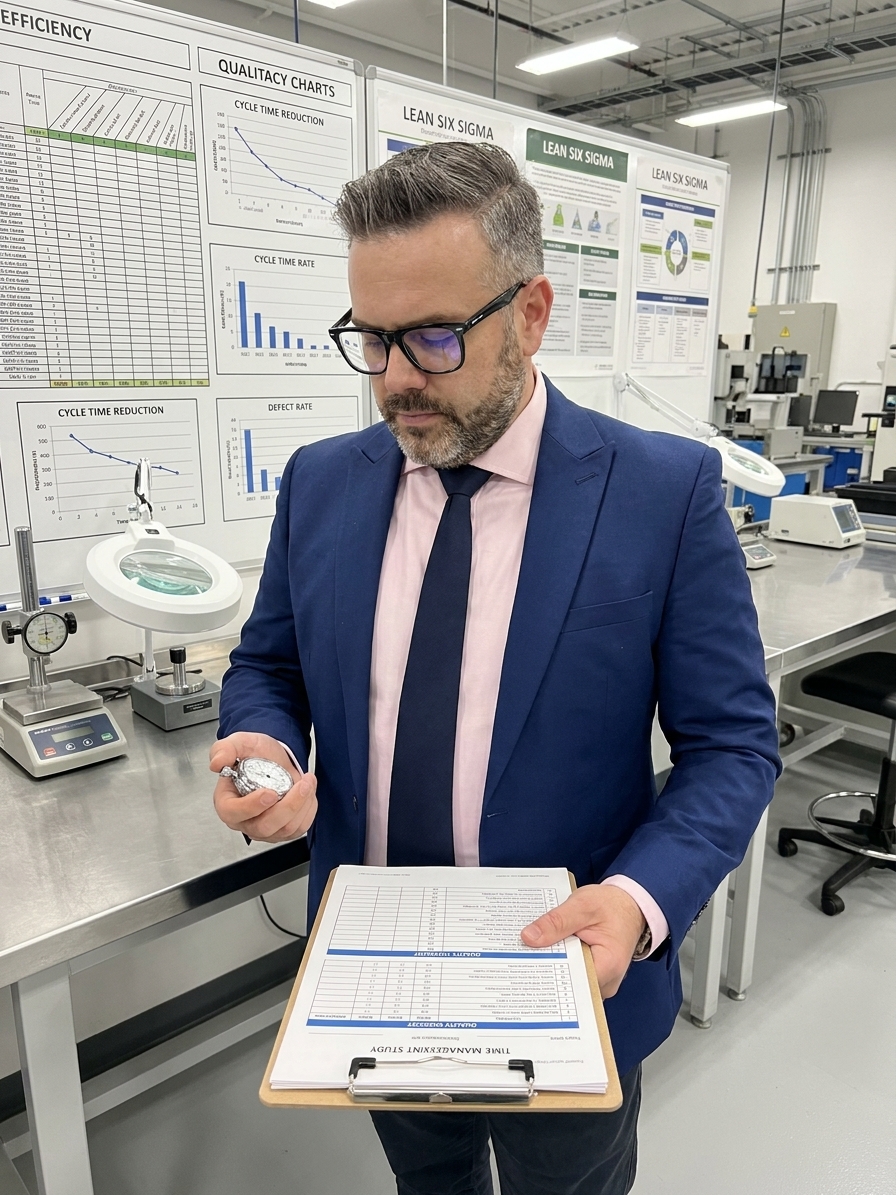
Parkinson's Law states that work expands to fill the time available for its completion. In manufacturing quality systems, this organisational behaviour is not a joke. It is a structural bottleneck that inflates labour costs and destroys lead times.
Quality functions are highly susceptible to this expansion because the ambiguity of inspection work makes it difficult to distinguish between thoroughness and slowness. When a quality task lacks a defined endpoint, the time allocated becomes the default duration.
If your final inspection routings consistently miss delivery deadlines while yielding standard defect detection rates, you are likely managing inflated processes. The solution is not to rush the work. It requires defining the minimum viable inspection, establishing engineered time standards, and relentlessly eliminating quality activities that add comfort rather than value.
Why Quality Systems Are Vulnerable to Time Inflation
Production work has objective endpoints: a part is stamped, a truck is loaded, a line is cycled. Quality work has soft boundaries. An 8D root cause analysis, a layered process audit, or an incoming material check concludes when the investigator is satisfied, which is highly subjective.
This ambiguity creates a low-visibility environment for output. When a machinist produces ten parts an hour, productivity is clear. When an inspector finds two nonconformities per shift, the metric is opaque. The inspector may have found two because there were only two defects present, because they lacked competence, or because they worked slowly. Management often misreads time spent as a proxy for thoroughness, which validates the expansion.
Quality systems also operate with built-in slack. I have audited plants where the overarching philosophy is that you cannot rush quality. This cultural belief results in generous, uncontested time allocations for inspection. Those allocations become self-fulfilling prophecies, giving Parkinson's Law exactly the slack it requires to inflate the workload.
The Mechanisms of Inflated Quality Work
The expansion of quality work is rarely malicious. Inspectors do not deliberately drag their feet. The mechanism is a subtle drift toward a comfortable pace that fills the allocated shift hours. An engineer with a 90-day CAPA window will naturally stretch the investigation to fill those three months.
When a routing allocates four hours for a batch inspection, the work settles into that rhythm. The first hour involves settling in and retrieving tools. The middle hours cover the actual dimensional checks and functional tests. The final hour is consumed by double-checking and documentation. Give the same inspector two hours, and they will bypass the preparation waste, compress the routine, and maintain the critical defect detection.

Specification creep drives further inflation. An inspector with excess time begins examining dimensions not called out on the control plan. They add unvalidated cosmetic checks that nobody requested. Each addition seems reasonable in isolation, but together they create an inspection process that violates the original PPAP intent.
This triggers an escalation loop. Extended inspections create a backlog. The backlog causes production delays. Management responds by allocating more inspection time or hiring more inspectors, which provides even more slack for the work to fill. The bottleneck becomes the justification for its own expansion.
Scheduled Duration vs Engineered Standard
What teams do with slack time
- Fill the entire allocated shift with the current batch
- Check non-critical features not listed on the control plan
- Duplicate data capture across paper forms and ERP records
- Escalate the timeline to accommodate the comfortable pace
What works under constraint
- Execute only the specified dimensional and functional checks
- Adhere strictly to validated PFMEA risk priorities
- Record pass/fail data directly into the defined quality system
- Release conforming product immediately upon completion
The Measurement Trap in Inspection Routing
Organisations often try to manage inspection bottlenecks by implementing metrics. They track time per unit and set throughput targets. When applied incorrectly, this makes the problem worse by creating perverse incentives that encourage inspectors to hit time targets by cutting critical corners.
Measuring inspection speed without simultaneously measuring defect detection rates destroys data integrity. Inspectors learn to hit the time target by skipping checks, or they ignore the time target entirely to ensure quality. The root cause of this conflict is the failure to define the minimum viable inspection.
Most facilities know what a comprehensive inspection looks like, and they know what a rushed inspection looks like. They have never systematically studied what a sufficient inspection looks like. The minimum viable inspection is the validated set of checks that catches the critical-to-quality characteristics within a timeframe that does not destroy manufacturing throughput.
Without this engineered baseline, every discussion about inspection routing becomes subjective. Operators express that they feel rushed, while management feels the pinch of delayed shipments. You cannot optimise a routing based on feelings. You must optimise it based on validated process capability and documented risk.
Time Inflation Across the Quality Management System
The inspection floor is where time inflation is most visible, but Parkinson's Law operates throughout the entire quality management system. Internal audit schedules, corrective action loops, and training development programs all expand to consume their allocated timelines.
Consider your CAPA system. If your procedure mandates closure within 90 days, most investigations will take exactly 90 days. Urgent corrective actions drafted in a week often possess the same rigour as those taking three months. The difference is the deadline, not the complexity of the root cause analysis.
The work expands. The time fills. And somewhere in that expanded time, your competitive advantage quietly dissolves.
Internal audits suffer the same fate. A two-day allocation for a production audit will yield a two-day audit. A different auditor covering the same scope with a one-day allocation will find the same major nonconformities. The first auditor was not generating additional value; they were simply using all the time available.
Root cause analysis teams suffer from meeting inflation. A cross-functional team assembled to address a customer complaint might meet weekly for six weeks, producing a thorough 8D report. Given a strict three-week mandate, that same team would reach identical conclusions, proving that the extra weeks were consumed by scheduling delays and report formatting.
Engineering Constraints That Protect Outcomes
Constraints do not reduce quality. They focus it. When you give an inspector a tight, engineered time window based on a stopwatch study, they prioritise the checks that matter most. They develop efficient routines and stop examining non-critical features. The constraint forces a discipline that unlimited time never produces.
At a major aerospace manufacturer, I introduced Routing Verification KPIs that cut internal lead time by 97% without compromising first-pass yield. We achieved this not by rushing the inspectors, but by defining exact inspection content. We transitioned the process from a judgment call to a designed sequence of specific characteristics verified using prescribed methods.
Effective quality systems separate value from comfort. Value-added inspection activities catch defects, prevent escapes, and validate process stability. Comfort activities include rechecking already verified dimensions, over-documenting context, and examining non-critical features. Value gets protected. Comfort gets eliminated.
To implement this, you must measure both sides of the equation simultaneously. Track the duration of the inspection and the defects caught. Calculate the Cpk of the process you are verifying. When you correlate time spent with defects found, you can identify your most efficient and accurate inspectors and standardise their methods.
Metrics for a Controlled Inspection Process
Implementing a Discipline of Compression
To reclaim lost throughput, begin by auditing your inspection times. Look at the variation in duration for the same product across different inspectors, shifts, and facilities. The variation will be significant, and that variance is the physical footprint of Parkinson's Law in your plant.
Study your fastest, most accurate inspectors. They have already solved the problem. They have found the efficient path through the verification process that catches the defects that matter. Conduct a time study on their methods, document their sequence, and establish it as the new engineered standard.
Implement regular process compression. Periodically challenge every quality function to accomplish the same outcome in less time. This does not mean cutting corners. It means eliminating genuine waste: redundant data entry, inefficient material routing, unnecessary signature loops, and the hundred small specification creeps accumulated over years of unmanaged slack.
When someone requests more inspection time, more audit days, or a longer CAPA timeline, ask what specific additional value the time will produce. If the answer is a vague commitment to more thoroughness without technical specifics, you have identified expansion at work. Quality requires the right amount of time applied to the right activities, not unlimited slack.