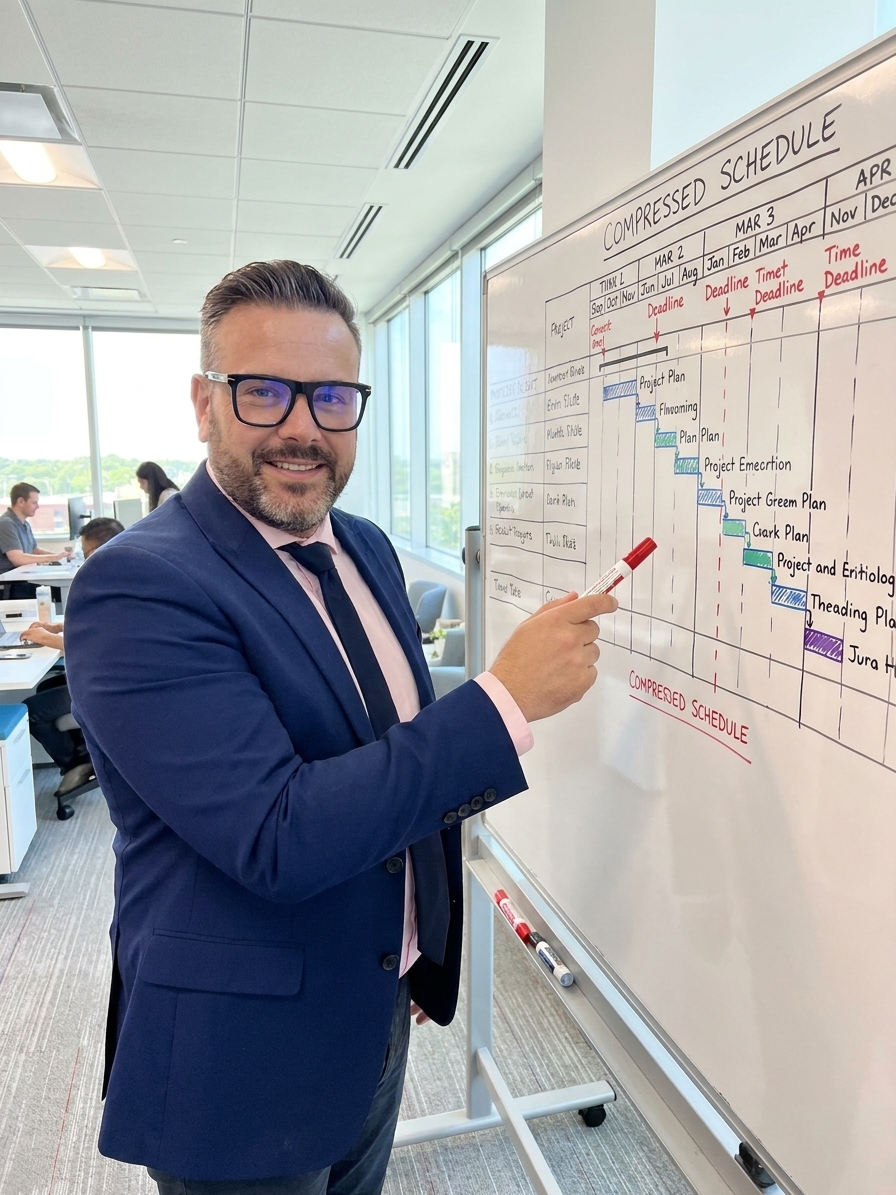
In 1955, Cyril Northcote Parkinson observed that the British Admiralty's administrative staff was expanding even as the fleet shrank. He formulated a principle that governs management science to this day: work expands so as to fill the time available for its completion. This single sentence explains a dysfunction every quality professional has witnessed but rarely names.
Consider the eight-week corrective action that closes in exactly eight weeks, or the six-month FMEA update that finishes on the last day of month six. These timelines rarely reflect the technical difficulty of the problem. They reflect the arbitrary deadline someone wrote on a project charter at the outset.
This is Parkinson's Law operating inside your management system. It is not a sign of laziness or incompetence. It is a structural property of how engineering teams manage complex, ill-defined work when constraints are soft and the finish line is set by administrative convention rather than technical necessity. When you give a cross-functional team six months, they will consume all six months.
The Corrective Action Database as Proof
If you want to see this law in action, do not study management theory. Open your corrective action database, export the last fifty closures, and sort by allocated lead time versus actual closure date. The data will show that duration is determined by the assigned deadline, not the defect category.
Actions assigned a 30-day deadline typically close around day 28. Actions assigned a 90-day deadline close around day 85. You will find the same defect type — a missing control plan element, a dimension out of tolerance, a supplier deviation — taking wildly different durations to resolve based solely on the arbitrary timebox assigned by a supervisor.
The only variable that predicted the closure date was the deadline on the form. The root cause analysis did not change. The containment action was identical. When a team is given six months to implement IATF 16949 requirements for a new process, they will use the full six months. Give them six weeks, and they will engineer a solution in six weeks. The technical work adapts to the available time.

Why Quality Work is Highly Vulnerable to Expansion
Parkinson's Law operates across all corporate functions, but it has a particular affinity for quality engineering. The primary reason is scope ambiguity. An instruction to 'implement SPC on Line 7' could mean printing a basic X-bar R chart and taping it to the fixture, or it could mean deploying an automated real-time statistical monitoring system linked to the ERP.
This ambiguity actively invites expansion. With a twelve-week deadline, 'implement SPC' metastasizes to include comprehensive operator training, custom dashboard development, and automated data collection. With a three-week deadline, the same project shrinks to its functional core: plot the data, calculate the control limits, assign responsibility for out-of-control conditions, and begin reacting.
Furthermore, improvement work lacks the natural stopping point of production. Manufacturing a lot ends when the required parts are complete. Quality improvement has an infinite horizon — there is always one more data point to collect or process FMEA scenario to test. The deadline is not merely a constraint; it is the only constraint defining the scope of the deliverable.
We compound this by training our engineers to be perfectionists. We teach them to verify, validate, and audit. We then express surprise when they use every available minute to verify a countermeasure one additional time. The same mindset that prevents nonconformities also prevents efficiency.
The Hidden Costs of Padded Lead Times
Assigning generous deadlines feels responsible. It communicates diligence to the customer or the executive board. But the financial impact of padded lead times is substantial, even though it never appears as a discrete line item on the quality budget. It hides in the operational metrics.
The most immediate penalty is extended problem duration. Every day a known defect continues, it generates real scrap, rework, warranty claims, or customer escapes. A corrective action that takes six months instead of six weeks is not just slower. It is exponentially more expensive, because the failure mode keeps producing financial damage for five additional months.
There is also a severe opportunity cost. The quality engineer who spends six months perfecting a single 8D report could have closed four defects in the same period. Finally, there is the cost of over-engineering. With excessive time, a simple fixture modification evolves into a systemic process redesign. The resulting twelve-deliverable action plan introduces new failure modes. The cure becomes more dangerous than the disease.
Cost Impact of a Known Defect
The Mechanics of Artificial Expansion
Examine the lifecycle of a typical six-month corrective action. The first two weeks involve genuine urgency: the problem is fresh, data is collected, and containment is implemented. Then the planning phase begins. This is legitimate work, but it is highly expandable. Defining scope and assigning roles takes a week under tight constraints. It takes a month under generous ones.
The root cause analysis phase is where expansion truly takes hold. With a strict deadline, the team identifies the most likely cause using a 5-Why analysis, verifies it against the data, and moves to implementation. With a generous deadline, the team investigates peripheral theories, runs unnecessary capability studies, and builds elaborate Ishikawa diagrams that look impressive in presentations but fail to isolate the true cause.
Implementation follows the same pattern. Under pressure, the team implements the minimum viable countermeasure and monitors the results. With abundant time, they attempt to optimize the entire value stream. The final weeks are inevitably consumed by documentation cycles, sign-offs, and the slow mechanics of administrative closure. Each step is legitimate. Each step could be executed significantly faster.
The constraint doesn't reduce quality. It sharpens it.
Timeboxing and the Minimum Viable Countermeasure
The solution to scope expansion is not working harder or adding layers of management review. The solution is aggressively reducing available time. Implementing rapid problem-solving methodologies — Toyota's Practical Problem Solving, strict 8D timeboxing, or focused Kaizen events — forces teams to prioritize. The quality of the engineering solutions does not degrade; it improves.
Shorter deadlines mandate collaboration. When time is abundant, a quality engineer can work in isolation for weeks, analyzing data and writing procedures before engaging production. When time is short, the engineer must go directly to the shop floor, interview operators, and build countermeasures cooperatively with the personnel who understand the process nuances.
Crucially, aggressive deadlines generate faster verification feedback. A countermeasure implemented in two weeks generates real production data within thirty days. If the Cpk improves, you can close the 8D and standardize the work. If it fails, you pivot immediately. A countermeasure implemented over six months generates feedback so slowly that the organization has forgotten the original context before effectiveness is verified.
The Timeboxed 8D Cycle
- 01Define and containStrict 48-hour limit for identifying the failure mode and stopping the bleeding.
- 02Root cause analysisTimeboxed to three days. No infinite Ishikawa diagrams; force a decision using available data.
- 03Implement countermeasureDeploy the minimum viable fix. Do not redesign the entire process for a localized defect.
- 04Verify and closeMonitor the process for one production cycle to confirm the failure mode is eliminated.
Setting Deadlines Based on Minimum Required Time
Setting shorter deadlines does not mean rushing critical work. System-level projects — a multi-site AS9100 transition, a comprehensive supplier quality program, or a multi-site PFMEA rollout — genuinely require months. Parkinson's Law does not claim all work is fast. It claims work will expand to fill the available container, meaning your deadline dictates efficiency more than complexity does.
The practical fix is to base deadlines on the minimum time required, not the maximum time available. Break large, amorphous projects into small, specific deliverables. Instead of a single six-month corrective action, define six one-month milestones. Each milestone must have a concrete output, a clear owner, and a firm deadline.
Distinguish critical-path work from optional work. The critical path is the absolute minimum set of actions required to eliminate the root cause and verify effectiveness. Everything else — expanded PPAP documentation, aesthetic improvements to the MSA study, broader operator training scope — is secondary. Complete the critical path first. Add refinements only if the business case justifies it.
Conduct progress reviews at the midpoint, never at the endpoint. A six-month project reviewed only at month six will take exactly six months. A project reviewed at week two, week four, and week eight will still meet its deadline, but the technical work will be sharper. The frequent checkpoints create accountability that a distant, arbitrary deadline cannot enforce.