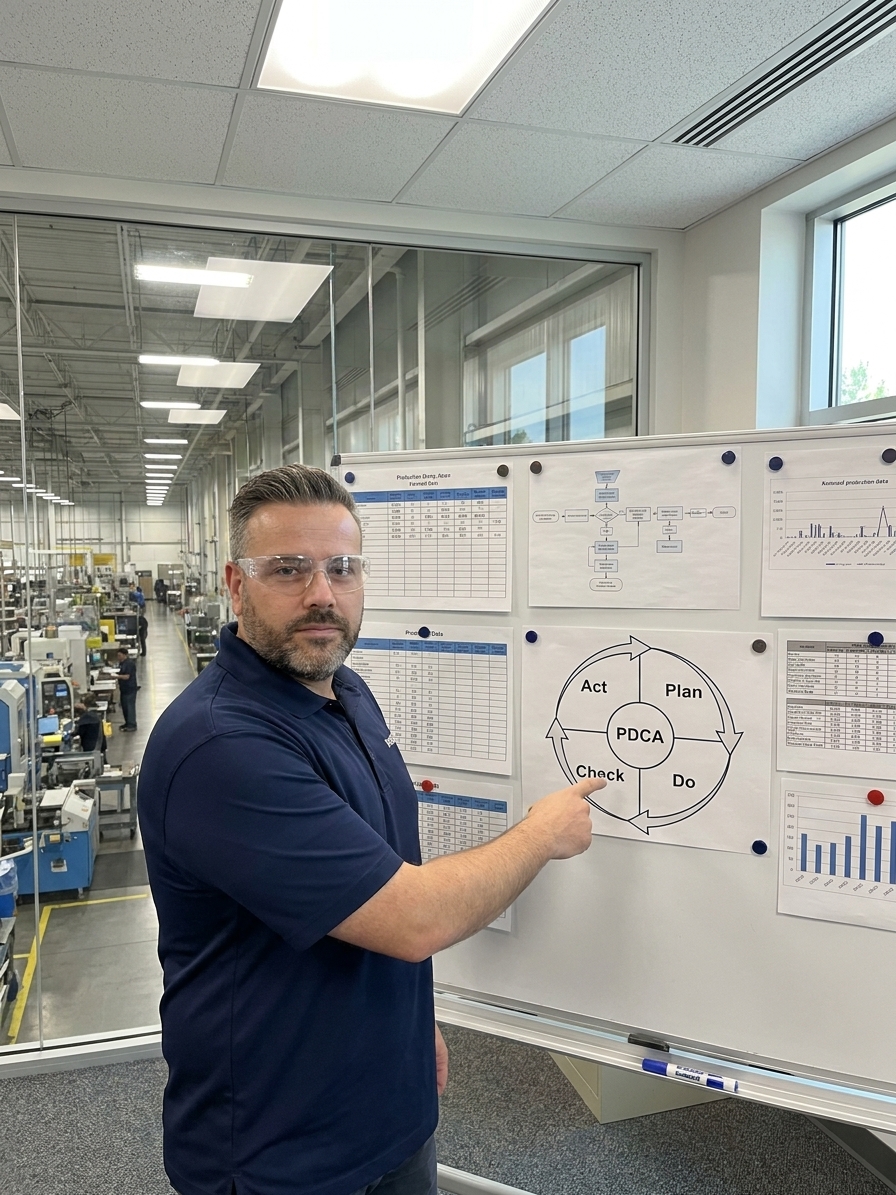
Plan-Do-Check-Act is the most widely taught improvement framework in quality management. It is also the most frequently abandoned. Ask quality professionals what actually changed in their process as a result of their last PDCA cycle, and you will watch the confidence drain from the room.
The vast majority of implementations stall long before the Act phase. They die at Check, where the organization discovers that nobody defined what success would look like, or at Do, where production pressure compresses a planned four-week implementation into a single afternoon.
The framework itself is sound. The failure is in execution. I have audited plants across automotive and aerospace supply chains, and the failure modes are remarkably consistent. They are preventable, but only if management recognizes PDCA as a discipline requiring rigid constraints, not a brainstorming exercise.
The mechanics of iterative improvement
Walter Shewhart sketched the first version of the cycle in the 1920s. W. Edwards Deming turned it into a global movement. The architecture is sequential: define the problem and design an intervention (Plan), implement it on a small scale (Do), measure against expectations (Check), and standardize what worked (Act).
The power is in the iteration. Each cycle feeds into the next, compounding marginal gains over time. A process improvement of two per cent per cycle, repeated monthly, yields roughly twenty-seven per cent improvement over a year. This is the exact mechanism that drove Toyota from a postwar domestic manufacturer to the largest automaker in the world.
The simplicity of the model is real, which makes the widespread failure to execute it all the more baffling. Organizations do not fail at PDCA because the concept is too complex. They fail because they systematically bypass the constraints that make the methodology work.
Anatomy of a Completed PDCA Cycle
- 01PlanDefine the problem, set a measurable target, and design a bounded intervention.
- 02DoImplement the change exactly as specified, on a controlled scale.
- 03CheckEvaluate results against the pre-defined criterion using validated data.
- 04ActStandardize the gain in work instructions, or feed the failure data into the next cycle.
The planning trap: Scope inflation and data paralysis
The Plan phase consumes the majority of time and political capital in failed PDCA initiatives. Organizations consistently confuse thorough planning with effective planning. The most common failure mode is scope inflation.
A team starts with a well-defined problem: bearing failures on Line 3 causing four hours of unplanned downtime per week. They begin root cause analysis and discover links to lubrication practices, maintenance schedules, and the spare parts inventory. Within two weeks, they are redesigning the entire supply chain. The original problem is buried under a systems-level transformation project nobody has the authority to execute.
Data paralysis is the second trap. Teams convince themselves they cannot act until they have complete data. They spend weeks building sampling strategies for information they already possess. The Pareto principle applies to analysis: eighty per cent of the explanation usually comes from twenty per cent of the available data. Good planning identifies the vital few. Excessive planning catalogs the trivial many.

The implementation gap: Partial changes and compressed timelines
Organizations are generally better at Do than at Plan. Once a reasonable plan exists, frontline teams can usually implement it. The failures here are about commitment and context, not capability.
The dominant failure is partial implementation. The plan calls for changing the lubrication procedure, the lubricant type, the frequency, and the bearing specification. The team implements the procedure and frequency changes, but procurement blocks the new lubricant due to an existing supplier contract, and the bearing specification is deferred to the next capital cycle. They measure the results and conclude the intervention failed.
Evaluating a partial implementation against the expected results of a complete intervention is experimentally invalid. If you change four variables and only two actually change, your results reflect the interaction of those two variables, not the designed intervention. Timing compression destroys whatever signal remains. A planned four-week implementation gets compressed into a single day to meet production schedules. No process reaches steady state in a day, so the resulting measurements are pure noise.
The measurement void: Invalid data and confirmation bias
Check is where PDCA irrecoverably breaks down. It fails because nobody defined what to measure, how to measure it, and what the result would mean before the cycle began. This is the Plan failure metastasizing in Check.
Without a pre-defined success criterion, confirmation bias takes over. The team that advocated for the change sees improvement. The skeptics see deterioration. The meeting devolves into a debate about data interpretation. I have seen this exact scenario play out in IATF 16949 facilities where the measurement system analysis was never applied to the new metrics being tracked.
Even when criteria exist, Check fails if the measurement system is inadequate. Organizations attempt to evaluate process changes using gauges with fifteen per cent repeatability error, or data collection forms where operators record what they think happened. The baseline data was collected under different conditions than the post-intervention data. The comparison is meaningless.
The standardization failure: Drift back to the mean
Act is the most neglected phase. Teams that achieve a positive result in Check are too exhausted to invest in standardization. The improved procedure gets documented in a presentation that is archived. The work instruction receives a footnote operators never read. Three months later, the process has drifted back to its pre-intervention state.
Teams with negative results are even less likely to act effectively. The natural response to a failed experiment is to abandon the approach. The PDCA philosophy demands the opposite: a failed experiment is data, and the next cycle must be informed by it.
A failed experiment is not an insight. Knowing exactly why a 30% reduction did not hit a 50% target is.
Most organizations never reach that level of diagnostic precision. They record that the intervention did not work, discard the methodology, and start over with a completely unstructured approach. The accumulated knowledge is zero.
Operational discipline: What effective practitioners do differently
Organizations that execute PDCA effectively share distinct operational traits. They start small, picking problems bounded enough to address in a single cycle. A bearing failure problem stays a bearing failure problem. It does not become a total productive maintenance overhaul.
They define success before they begin. Before any change is implemented, the team writes down the specific metric, the current baseline, the target value, and the timeframe. They validate their measurement system, confirming via an MSA study that the gauge can reliably detect the magnitude of change they expect.
They implement completely or they do not implement at all. If the plan calls for four changes and the organization can only authorize two, they redesign the experiment. They standardize with the same rigor they apply to planning: controlled updates to work instructions, verified operator training, and process audits to confirm adherence to the new AS9100 or IATF 16949 standard.
PDCA Discipline: Theory vs Practice
What teams usually do
- Expand scope to address every peripheral issue simultaneously
- Implement partial changes due to procurement or scheduling barriers
- Evaluate results using uncalibrated or unvalidated measurement systems
- Archive improvements in presentations rather than updating standards
What actually works
- Lock the scope to a bounded problem solvable in a single cycle
- Execute the full intervention or redesign the experiment
- Run an MSA to confirm the gauge detects the expected change
- Audit the updated work instruction to lock in the gain
The leadership constraint
PDCA fails most often because leadership treats it as a frontline tool rather than an organizational discipline. Deming was explicit that improvement cycles require active leadership commitment, not passive sponsorship.
Leaders must protect the scope. When a team works on bearing failures, leadership must resist expanding the mandate. Scope discipline at the top enables scope discipline on the floor. Leaders must also protect the timeline. Compressing a four-week stabilization period into a weekend to meet a quarterly target invalidates the data and destroys the methodology's credibility.
Most critically, leadership must model the behavior when cycles fail. If the response to a negative result is curiosity, the organization learns that failure is data. If the response is blame, every future Check phase becomes defensive. The Deming Wheel keeps turning only for those willing to put real weight behind it. Everyone else is just spinning their wheels.