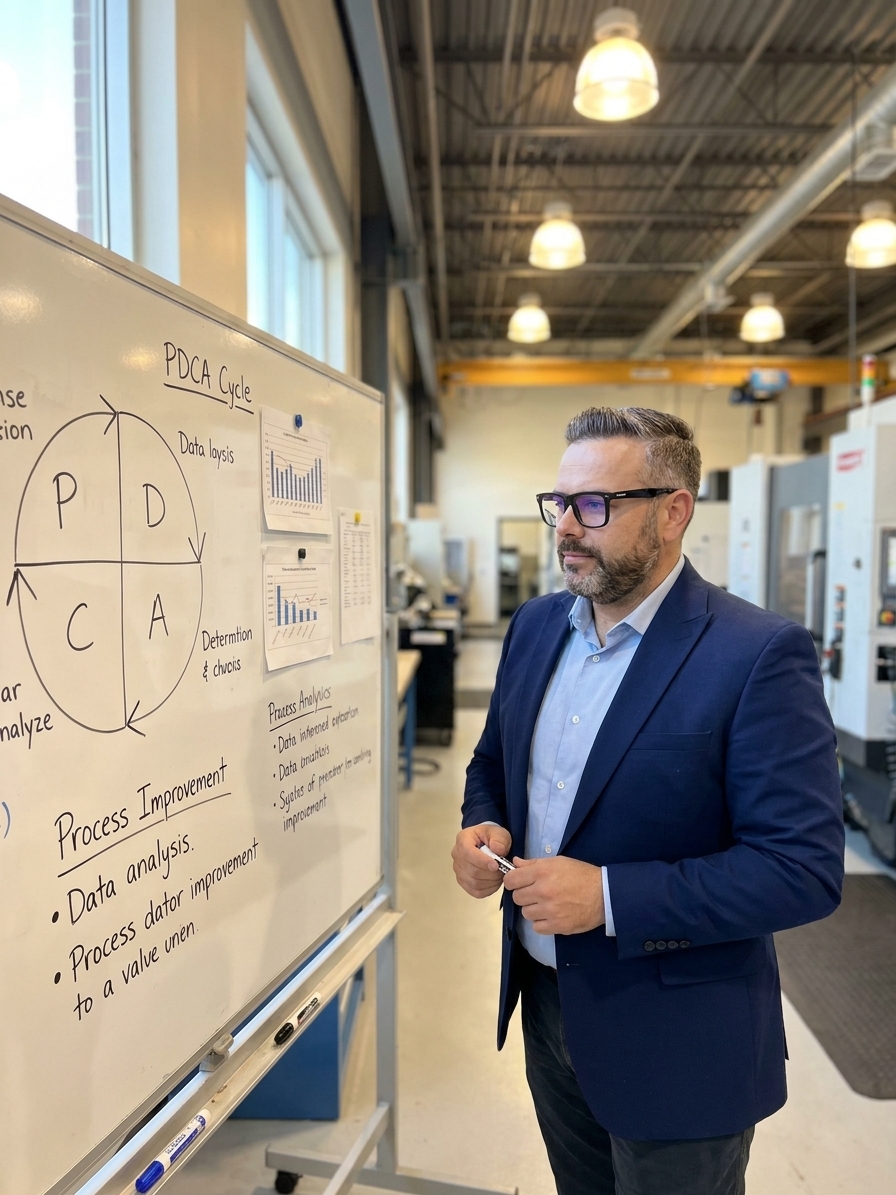
Plan-Do-Check-Act is the operating system beneath Toyota's production system and the metabolism of every mature ISO 9001 and IATF 16949 quality management system. Yet most organisations treat PDCA as a finite project tool. They pull it off the shelf when defects spike, implement a fix, and return to routine operations. The arrow from Act points to a trophy case, not back to Plan. The process, lacking an engine, rolls backward.
Consider a common scenario at automotive suppliers. A quality team spends months overhauling a critical welding process, driving defects down from 2,300 PPM to 180 PPM. The customer sends a congratulatory letter. Management celebrates. Nine months later, the defect rate climbs back to 1,800 PPM. This happens not because of equipment failure, but because the team treated improvement as a destination rather than a continuous loop.
The power of PDCA is not in any individual cycle. It is in the compounding effect of thousands of iterations over time. If your organisation only runs PDCA reactively to solve crises, your quality system is fundamentally broken. Building a culture where the wheel spins daily at the shop-floor level is the only mechanism that prevents regression.
Plan: The Step Everyone Rushes Through
Planning is where improvement begins, and where most improvement fails. The failure happens not because teams skip planning entirely, but because they perform a parody of it. They brainstorm solutions and pick the most plausible option without establishing a factual baseline. Real planning demands grasping the current condition with hard data, not opinions.
Teams must define the specific gap between the current condition and the target condition. A vague aspiration like 'we need fewer rejects' is useless. A measurable gap like 'we are at 180 PPM and must reach 50 PPM by Q3' gives the team a definitive boundary. From there, you must analyse root causes using tools like 8D or 5-Whys before proposing any solutions.
A plan in PDCA is a scientific hypothesis. It states: 'If we change X, then Y will improve because of Z.' I have supervised process teams that spent three full weeks mapping workflows, collecting baseline data, and identifying three distinct root causes before touching the production line. Executive leadership grew impatient, but those three weeks of rigorous planning eliminated months of trial-and-error firefighting. Planning is not delay; it is speed paid for up front.
Do: Running Controlled Experiments
In most manufacturing environments, 'Do' translates to 'implement the solution immediately'. Teams roll out changes full-scale across all shifts, cross their fingers, and hope for the best. In proper PDCA, 'Do' means running a controlled experiment. You test the countermeasure on a single cell, during one shift, with one product family, where the cost of being wrong is manageable.
The Japanese lean community often calls this 'try-storming'. Instead of debating what might work in a conference room, you test it small, fast, and cheap. You simulate a new layout with tape on the floor. You run a new inspection protocol on twenty parts, not twenty thousand. The objective is not to prove your plan was right. The objective is to discover what your plan missed.

I once observed an electronics manufacturer plan a change to their wave soldering profile. The hypothesis was solid and the data was rigorous. However, in the first hour of the small-scale trial, intensive inspection caught a thermal shock event that caused a component to crack invisibly. Had they gone straight to full production, they would have shipped defective units for weeks. The controlled trial prevented a catastrophic field failure.
Check: Where Honesty Lives
The Check step—sometimes translated as Study—demands that you compare actual results against the expected results and ask the most uncomfortable question in quality management: Were we right? Things often improve for reasons completely unrelated to your countermeasure. Regression to the mean, seasonal variation, or the Hawthorne effect can all mimic genuine process improvement.
You must determine if changing X actually caused Y to improve because of Z. If you do not understand why something worked, you cannot replicate or sustain it. Real Check means analysing the data with statistical rigour. You cannot simply eyeball a trend line and declare victory. You must verify whether the change is statistically significant, whether variation has actually decreased, and whether the improvement justifies the operational cost.
Defining a Rigorous Check Phase
Examining what failed in your experiment is equally critical. Every trial produces unexpected results. Some countermeasures create new bottlenecks. Others reveal latent problems that were always there but hidden. The organisations that excel at Check are the ones where a team can safely admit their hypothesis was incorrect without fear of punitive action from management.
Act: Standardisation and the Next Baseline
Act is where sustainability is born or dies. If the experiment succeeded, you must standardise the new method. This means updating work instructions, retraining operators, changing process FMEA documentation, and locking the new standard into your audit checklist. In too many companies, standardisation is code for 'we are done thinking about this process'. In PDCA, standardisation is the foundation for the next round of experimentation.
The new standard is not the ceiling. It is the new floor, and the cycle starts again.
If the experiment failed or partially succeeded, you do not discard the learning. You adjust the hypothesis, refine the countermeasure, and start the cycle from Plan. Every cycle that fails to produce the desired result still produces operational knowledge, and that knowledge compounds over time. Toyota's standard work documents are living texts, updated hundreds of times per year on a single production line. Each update is a small PDCA cycle.
Standardisation locks in the improvement so the next experiment starts from a higher baseline. When organisations fail to standardise, the improvement lives only in the heads of the engineers who ran the experiment. When those people move to another project or leave the company, the process drifts back to its old equilibrium within months. Without updated documentation and layered process audits, there is no mechanism to hold the gain.
Operational Failure Modes of PDCA
Understanding the four steps is the easy part. Making PDCA function inside a living, pressured organisation is where execution fails. The most common failure mode is skipping Plan entirely. The organisation acts on a gut feeling or the highest-paid person's opinion, implementing solutions without root cause analysis. The result is a solution searching for a problem, which ultimately yields a coincidence that looks like success until the crisis returns.
Another systemic failure is running PDCA exclusively at the executive level. Senior leaders run macro-cycles for strategic KPIs, but the shop floor runs on intuition and tribal habit. The most powerful PDCA cycles happen at the point of production. They are executed by team leaders and operators who see micro-problems that executive dashboards never capture. If the workforce is not actively running cycles, the system is paralysed.
Reactive Projects vs. Continuous Cycles
What teams do
- Treat improvement as a finite project with a start and end date.
- Implement changes full-scale across all shifts simultaneously.
- Eyeball trend lines and declare victory after a short period.
- Stop spinning the cycle once the target metric is achieved.
What works
- Treat improvement as an infinite loop of hypothesis and testing.
- Run small-scale experiments to discover what the plan missed.
- Validate results against statistical significance and sustained variation reduction.
- Standardise the new floor and immediately identify the next gap.
Building a Continuous Improvement Engine
To make PDCA the default operating mode, leadership must model the behaviour. Resist the urge to jump to solutions during the next quality escape. Plan deliberately with data, experiment small, check rigorously, and standardise carefully. Build cycle reviews into the daily management system. Stand-up meetings must transition from status reports to inquiries: What did we try? What did we learn? What will we try next?
If your organisation punishes failed experiments, your PDCA cycle is broken. A team that ran a clean trial and disproved their hypothesis generated more useful engineering data than a team that guessed correctly but cannot explain why. Management must celebrate the learning, not just the successful result. Psychological safety at the shop-floor level is the prerequisite for honest data.
Stop measuring only the results of your improvement projects. Start measuring the cycling itself. Track how many PDCA cycles ran this month, how fast they are turning, and how many operators are actively participating. The velocity of organisational learning—not the brilliance of a single isolated fix—is the true metric that predicts your long-term trajectory.
A single PDCA cycle might reduce scrap by 15%. Running a disciplined cycle every two weeks across a hundred production cells generates thousands of micro-improvements annually. Most adjustments will be tiny—a fixture shifted two millimetres, a checklist reworded for clarity. Individually, they save seconds. Collectively, they build a production system that refuses to drift backward. The congratulatory letters will eventually stop, but the cycle keeps spinning.