A PPAP package passes on the first submission. Cpk values approach 2.0 across critical characteristics. Internal scrap rates sit at historic lows. Yet the customer escalates a complaint that your technical team cannot decode because the product is not defective — it simply prioritises the wrong things. The engineering group optimised for dimensional precision while the customer valued tactile feedback and installation speed.
This is not a rare outlier. Across two decades in automotive and aerospace, I have seen plants with world-class process capability lose business because their specifications never mapped to customer value. The defect never appears in an 8D report because, technically, nothing is out of specification. The gap between what the customer values and what engineering delivers is where margin leaks and loyalty erodes.
Quality Function Deployment closes that gap through a structured deployment sequence. But the methodology fails when organisations treat it as a brainstorming exercise rather than a phased implementation with clear ownership and exit criteria. The sequence — customer voice, engineering translation, part deployment, process planning, production control — only works when each phase is signed off before the next begins.
Phase One: Capturing and Weighting the Voice of the Customer
Ownership of Phase One sits with sales or product management — the people who speak to customers directly. Their job is not to interpret but to collect. They gather verbatim statements from interviews, warranty databases, lost-order analyses, complaint logs, and field returns. A customer saying "the latch feels flimsy" or "it takes too long to install" is raw data. It must not be cleaned up into engineering language at this stage.
Once collected, each requirement gets a weight. The weighting must reflect actual customer priority, not internal assumptions. If warranty data shows that 40% of complaints relate to installation difficulty, that requirement carries a proportionally higher weight than a cosmetic preference mentioned once in a survey. The output of this phase is a prioritised list of customer needs in the customer's own words.
The exit criterion is brutal but necessary: every requirement must have a documented source and a defensible weight. If the team cannot answer "where did this come from and why does it matter this much," the phase is not complete. Proceeding with unverified inputs corrupts every downstream translation. A house built on unweighted or assumed priorities will produce a relationship matrix that looks rigorous but encodes guesses.
Phase Two: The Translation Matrix and the Roof

Phase Two is where engineering takes ownership. The team converts prioritised customer needs into measurable engineering characteristics — the HOWs. A customer who wants something that "feels solid" might translate into a specific torsional stiffness target, a material density range, or a dimensional fit class. Each WHAT gets mapped against each HOW in the relationship matrix, rated as strong, moderate, weak, or no relationship.
The correlation matrix — the roof of the House of Quality — is the mechanism that separates QFD from a simple requirements checklist. It maps how engineering characteristics interact. Increasing tensile strength may reduce elongation. Tightening a surface finish tolerance may extend cycle time. These trade-offs exist whether you document them or not. The roof forces the team to surface them before tooling is cut, not during a launch crisis.
I have audited plants where the engineering team discovered a fundamental material trade-off three weeks into PPAP because nobody had mapped the correlations during design. The cost of that late discovery — retooling, resubmission, delayed launch — dwarfed the cost of the QFD sessions they skipped. The exit criterion for Phase Two is a completed matrix with all trade-offs documented and resolved, signed off by both engineering and quality leadership.
The Four-Phase QFD Deployment Chain
- 01Product PlanningCustomer needs weighted and translated into prioritised engineering characteristics. Owner: Sales/Product.
- 02Part DeploymentEngineering characteristics converted to part specs — dimensions, tolerances, material properties. Owner: Design Engineering.
- 03Process PlanningPart specs translated to process parameters — machine settings, tooling, process conditions. Owner: Manufacturing Engineering.
- 04Production PlanningProcess parameters converted to production controls — inspections, control plans, work instructions. Owner: Quality.
Phase Three: Cascading Engineering Characteristics Into Part Specifications
Design engineering owns Phase Three. The prioritised engineering characteristics from the House of Quality become specific part specifications: dimensions with tolerances, material grades, surface roughness values, and functional test limits. This is where the abstract meets the concrete — where "torsional stiffness target X" becomes a wall thickness, a material selection, and a geometric tolerance on a drawing.
The discipline here is maintaining the traceability link. Every dimension and tolerance on the part drawing must connect back to an engineering characteristic that connects back to a weighted customer requirement. If a specification exists that cannot be traced through the chain, it is either a legacy carryover from a previous product or an engineer's personal preference. Neither survives scrutiny in a properly run QFD process.
This is where organisations encounter the specification echo chamber. Specifications inherited from previous products, copied from industry standards, or dictated by the most senior engineer in the room are the default state of most design processes. Phase Three breaks that cycle by requiring every specification to justify its existence through a documented link to a customer need. The exit criterion is a complete part specification set with full backward traceability to the House of Quality.
Manufacturing engineering should participate in the Phase Three review even though design owns the output. A tolerance that looks correct on paper may be impractical to hold consistently with the available process. Catching that conflict here — before the drawing is released — prevents the costly loop of revision, resubmission, and tooling rework that follows a tolerance assignment the process cannot sustain.
Phase Four: From Part Specifications to Process Parameters
Manufacturing engineering takes ownership in Phase Four. Part specifications become process parameters: injection moulding temperatures and pressures, machining feeds and speeds, torque values, curing times, tooling configurations. Each parameter must be set to produce the part specification consistently and within the tolerance band defined in Phase Three. This is where the PFMEA and process flow diagrams tie directly into the QFD chain.
The critical question at this stage is capability. Can the process, with these parameters, reliably hold the tolerance? If the answer is uncertain, a capability study must run before the parameters are locked. Setting a process parameter that produces parts at Cpk 0.8 against a tolerance derived from a high-importance customer requirement is not a production problem — it is a QFD failure that should have been caught when the engineering characteristic was first assigned its target value.
The exit criterion for Phase Four is a validated process parameter set, demonstrated through a preliminary capability run, that meets the tolerance requirements traced back through the chain. Manufacturing engineering signs off, quality verifies the capability data, and the parameters are documented in the control plan. No parameter should enter production control without this validation gate.
In 20 years of building quality systems, I have never seen a tool that humbles engineers faster than a properly built House of Quality.
Phase Five: Converting Process Parameters Into Production Controls
Quality engineering owns the final phase. Validated process parameters become production controls: control plan entries, measurement systems, inspection frequencies, statistical process control limits, reaction plans, and standard work instructions. This is the phase that makes the chain auditable. When an auditor asks why you inspect a particular characteristic at a particular frequency, your answer traces through four phases to a customer's exact words.
The control plan is where most organisations lose the thread. They create a generic control plan from a template, carry over inspection points from a previous product, and add a few dimensional checks. A QFD-driven control plan is different. It prioritises inspection and control resources based on the importance weighting established in Phase One. Characteristics linked to high-weight customer requirements get tighter control limits, higher inspection frequencies, and more rigorous reaction plans.
MSA — measurement system analysis — must validate that the inspection methods assigned to high-importance characteristics are statistically capable of detecting the variation that matters. A gauge with a high per cent study variation against a critical-to-customer characteristic undermines the entire deployment chain. The exit criterion is a control plan with full traceability, validated measurement systems, and documented reaction plans for every high-priority control point.
Traceability Layers in a Completed QFD Deployment
- Production ControlsInspection frequencies, SPC limits, reaction plans — proven against customer priorities.
- Process ParametersMachine settings validated through capability runs to hold part specifications.
- Part SpecificationsDimensions and tolerances traced to engineering characteristics, not inherited from legacy.
- Engineering CharacteristicsTechnical parameters mapped to weighted customer requirements via the relationship matrix.
- Customer RequirementsVerbatim needs with documented sources and defensible importance weightings.
Organisational Conditions That Determine Sequence Success
The sequence fails not because the methodology is flawed but because the organisational conditions cannot sustain it. Phase One requires sales and marketing to spend hours in a room with engineering. Phase Two requires engineers to accept that their preferred technical approach might conflict with customer priorities. Phase Four requires manufacturing to admit that a chosen process cannot hold a tolerance. Each phase demands honesty that departmental silos and power dynamics actively suppress.
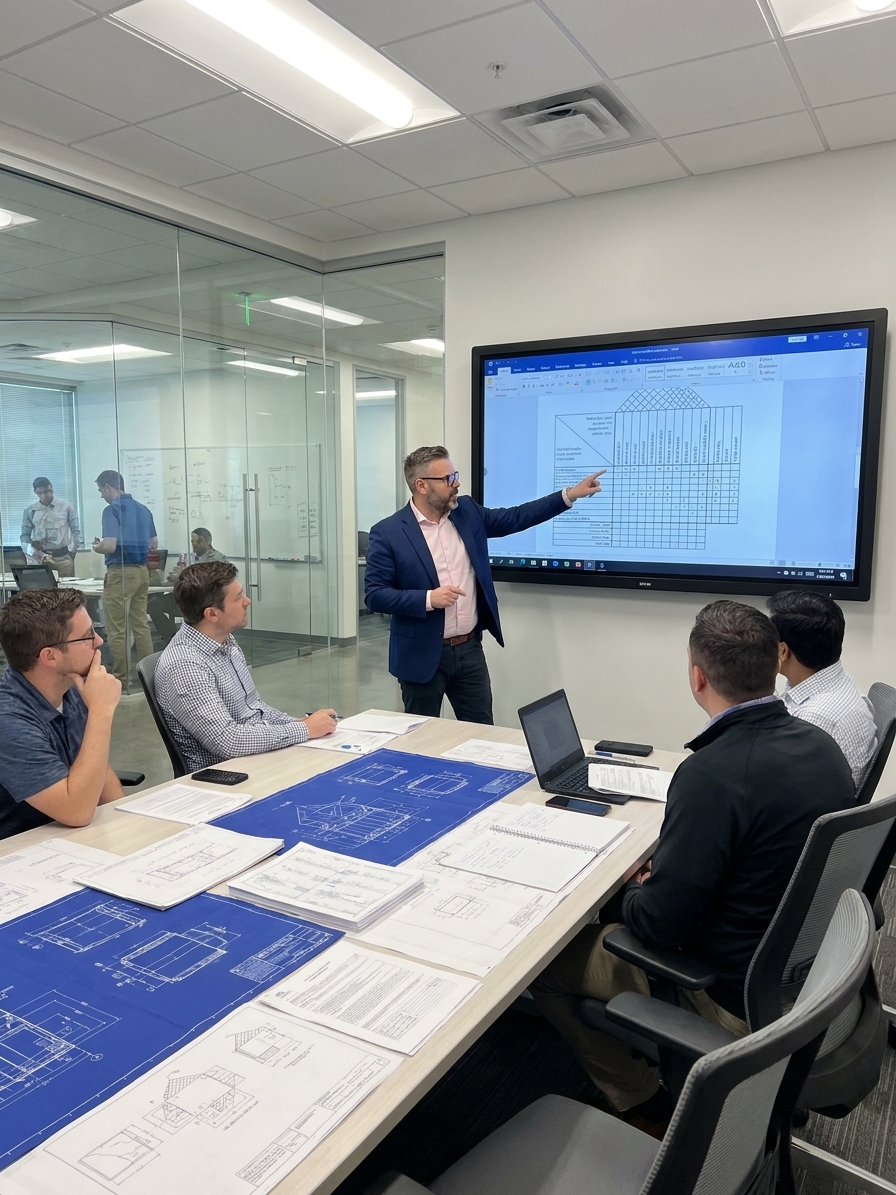
Cross-functional attendance is non-negotiable. A team of five to eight people is the sweet spot — large enough to carry the necessary perspectives, small enough to reach decisions. One person from sales with direct customer contact, two or three design engineers, one manufacturing engineer, one quality engineer, and a facilitator who understands the methodology. Teams without sales representation produce matrices built on engineering assumptions about what customers want.
Start with a single product line — ideally one where internal metrics look strong but customer feedback has been mixed. That discrepancy between your Cpk values and the customer's satisfaction score is the exact translation failure QFD was designed to expose. Run Phase One and Phase Two first. Do not attempt the full four-phase deployment until the organisation has learned to trust the matrix and respect the exit criteria.
The final discipline is maintaining the chain after launch. When a scope change arrives mid-program — and it will — the QFD documentation tells you exactly which downstream controls are affected. A change to an engineering characteristic propagates through part specifications, process parameters, and production controls in a visible, traceable path. Without it, the change becomes another isolated decision that breaks the chain and reintroduces the exact failure mode QFD was built to prevent.