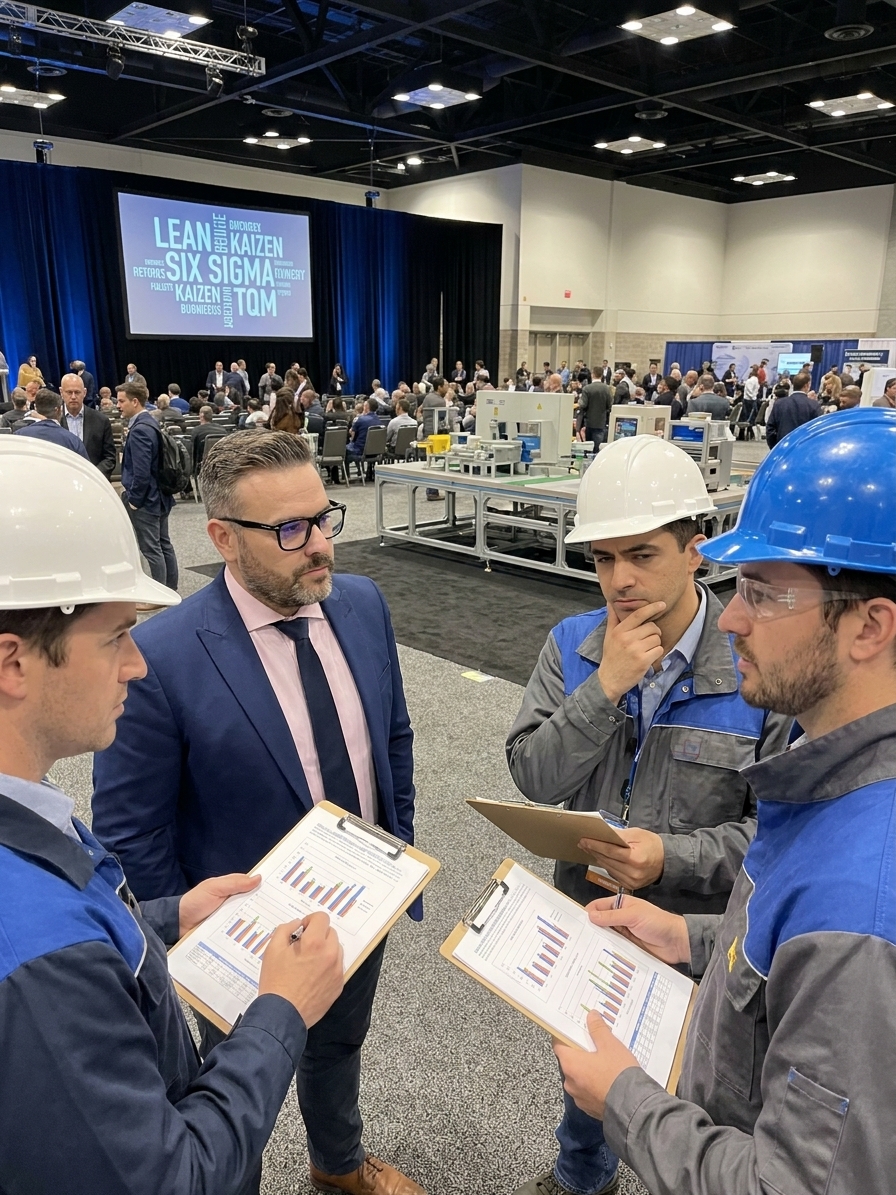
Every manufacturing conference features a keynote speaker describing a dramatic quality transformation. They implemented Six Sigma. They deployed statistical process control across every line. They achieved a defect rate that reads like a statistical impossibility. Sitting in the audience, your vice president of operations leans over and whispers that your organization needs to do exactly that.
By Monday morning, there is a mandate. By next quarter, there is a budget. By the end of the year, there is a program with a name, a logo, and a steering committee. What there never is, however, is a serious engineering discussion about whether this particular methodology makes sense for your actual products, your specific process capability, or your current constraints.
This is the bandwagon effect in manufacturing quality. I have spent decades auditing plants across automotive and aerospace, and I have watched this cognitive bias quietly become one of the most expensive operational forces in the industry. It replaces the hard work of root cause analysis with the cosmetic work of adoption, leaving you with a complex bureaucracy that actively obscures your real defects.
The Anatomy of a Misaligned Adoption
The bandwagon effect drives the adoption of standards and tools not because they have been analytically selected to solve a specific problem, but because industry leaders have endorsed them. The logic sounds reasonable on the surface: if a world-class OEM uses this method, adopting it will make us world-class. The fatal flaw is that this logic skips the crucial step of mapping the original context to the current operational reality.
A misaligned adoption follows a predictable lifecycle. It begins with a senior leader attending a conference or sitting through a vendor presentation. They return energized by a specific metric, usually a percentage reduction in scrap or lead time. That number feels rigorous, even though it is almost certainly a cherry-picked data point from a carefully selected time window, stripped of all operational nuance.
Leadership announces the initiative, allocates a budget, and hires the consultant who gave the original presentation. Training sessions are scheduled, software is purchased, and checklists multiply. The apparatus of the new methodology is constructed with admirable speed. Then reality hits: the tool requires data inputs the plant lacks the infrastructure to collect, and the new checklists do not map to actual failure modes.
The Lifecycle of a Bandwagon Adoption
- 01ExposureLeadership hears a cherry-picked success metric at a conference or vendor pitch.
- 02MandateBudget is allocated and a branded program is launched without a contextual gap analysis.
- 03DeploymentTraining and software roll out, constructing the administrative apparatus of the methodology.
- 04TheatreThe program generates compliance metrics instead of quality improvements to justify its own existence.
- 05Next BandwagonThe cycle restarts as the old program is quietly absorbed into the 'continuous improvement culture'.

Mismatching Statistical Tools to Production Reality
Six Sigma was developed by Motorola for high-volume, highly repetitive manufacturing processes where rigorous statistical analysis could meaningfully reduce variation. It was phenomenally effective in that specific context. Then the bandwagon effect took hold, driving low-volume and high-mix manufacturers to adopt the framework simply because it was the dominant industry topic of the moment.
I have reviewed facilities that trained Black Belts and calculated sigma levels for processes that did not have enough data points to make the mathematics meaningful. Organizations spent heavily on certification programs and statistical software licenses to monitor custom-engineered products running in batches of fifty units. Statistical process control based on normal distribution assumptions simply cannot give you actionable intelligence when you lack the volume to stabilize the baseline.
These operations would have been far better served by deploying a well-structured PFMEA, rigorous first-article inspection protocols, and robust operator instructions. But a bespoke engineering approach tailored to a high-mix environment does not carry the same administrative prestige as a Black Belt certification. The organization prioritized the appearance of statistical rigor over actual process control, leaving real failure modes unaddressed while engineers maintained spreadsheets.
ISO 9001 as a Proxy for Process Competence
ISO 9001 and IATF 16949 certifications have become prerequisites for doing business in the automotive and aerospace supply chains. The standards themselves, when properly implemented against the process approach, provide an excellent framework for quality management. However, the bandwagon effect frequently turns certification into the primary goal rather than a byproduct of good process control.
Too many organizations pursue certification purely because their customers demand it on the supplier scorecard. Consultants are brought in to fast-track the process, building documentation architectures specifically designed to satisfy the auditor rather than to control the actual production floor. Quality manuals become immaculate works of fiction that describe how the plant should operate in theory.
The result is an organization that is certified but not fundamentally competent. The procedures are perfectly documented. The internal audit records are maintained. Yet the actual quality of the product, measured in scrap rates and customer PPM, remains entirely unchanged. The certificate hangs in the lobby while the corrective action system silently drowns in unaddressed 8D reports.
Industry 4.0 FOMO and Data Theatre
The current bandwagon is digital transformation. Every manufacturer feels the intense pressure to implement IoT sensors, machine learning algorithms, and predictive analytics. The fear of missing out on the latest industrial revolution drives capital expenditure projects that completely bypass standard engineering justification protocols.
A high-volume automotive press shop generating continuous data streams can absolutely use machine learning to predict tool wear and optimize die maintenance. But a precision machining job shop producing small batches of custom components will struggle to extract value from a six-figure analytics platform. Without the volume to train the algorithms or the disciplined data infrastructure to feed them, the technology simply generates alerts nobody has time to action.
The bandwagon effect prevents the honest capability assessment required before investing in smart manufacturing. Plants buy the software platform first, then desperately try to find a use case for it. Dashboards multiply across the facility, displaying real-time data on massive screens that nobody looks at, while operators on the floor still lack basic measurement system analysis on their gauges.
Bandwagon Adoption vs. Deliberate Engineering
What Bandwagon Teams Do
- Buy the software platform before defining the data requirements.
- Implement SPC on low-volume, high-mix custom parts.
- Train Black Belts to manage documentation instead of process variation.
- Measure compliance with the new program to prove its value.
What Effective Teams Do
- Conduct Measurement System Analysis (MSA) before buying sensors.
- Use robust PFMEA and first-article inspection for custom runs.
- Deploy engineers to investigate 8D root causes on the floor.
- Track defect rates, Cpk, and customer PPM to prove value.
The Hidden Costs of Borrowed Systems
The financial cost of bandwagon adoptions is high, but the hidden operational costs are far more destructive. The most expensive aspect of a misaligned quality initiative is not the consultant fees or the software licenses; it is the opportunity cost. Every engineering hour spent building a pointless compliance matrix is an hour not spent investigating actual defects, optimizing cycle times, or mentoring operators on the floor.
The most expensive thing about a bad quality initiative isn't what it costs — it's what it prevents you from doing instead.
Borrowed systems also breed deep organizational cynicism. When operators and engineers survive multiple bandwagon cycles that produced zero actual improvement, they develop a hardened immunity to quality initiatives. When leadership finally announces a genuinely necessary change, the organizational response is resignation and eye-rolling. You only get a few chances to launch credible process improvements. Bandwagon adoptions burn that capital.
Furthermore, every adopted methodology adds layers of administrative complexity. Over time, the facility accumulates a patchwork of fragmented systems: remnants of Lean, disconnected Six Sigma project trackers, abandoned TPM boards, and digital dashboards from the failed Industry 4.0 push. None are fully implemented, all require maintenance, and the resulting quality management system becomes a labyrinth that exhausts your staff.
Building Context Over Copying Tools
Resisting the bandwagon effect does not mean ignoring industry advancements. It means adopting deliberately rather than reflexively. Start with a rigorous definition of your specific problems. Clearly map your top three quality challenges, the data you actually possess regarding them, and the countermeasures you have already attempted. If you cannot answer these questions with hard data, you are not ready to evaluate a new methodology.
Evaluate tool fit based on operational constraints, not industry prestige. Assess whether a methodology aligns with your actual production volume and mix. Verify whether you have the measurement system stability and the engineering talent required to sustain it. Run a tightly controlled pilot in one manufacturing cell before committing capital. If the methodology does not produce a measurable improvement in first-pass yield or Cpk within that specific context, stop the deployment immediately.
Organizations that achieve genuine world-class quality do not get there by copying someone else's framework wholesale. They get there by deeply understanding their own process capability, honestly confronting their specific failure modes, and incrementally building hybrid quality systems uniquely suited to their operations. The quality system that will work for you is the one designed for your reality, not the one designed for the company that gave the keynote.