In 1765, the philosopher Denis Diderot received a scarlet dressing gown far finer than anything he owned. The gown was exquisite, but it made his existing desk, tapestries, and chairs suddenly look shabby. One by one, he replaced everything in his study to match the elegance of the new gown, spending far beyond his means. The new item changed his standard of comparison, making previously adequate things feel intolerable.
Quality organizations do this constantly. We call it modernization, optimization, or continuous improvement. But the pattern is identical to Diderot’s spiral: one legitimate upgrade creates a cascade of changes that were never needed, never justified, and never questioned. The new standard is set, and the baseline equipment suddenly becomes a perceived risk.
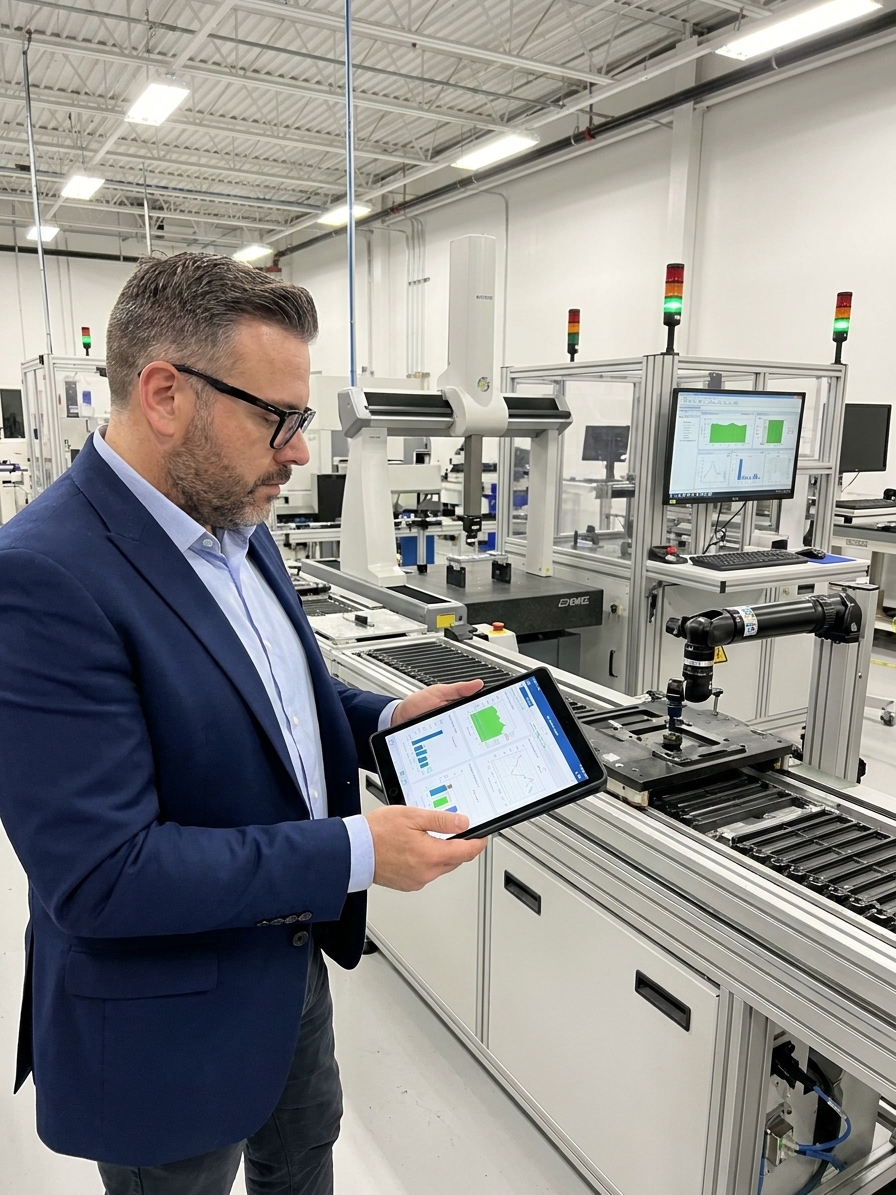
I have audited plants where a justified CMM investment on Line 3 triggered capital requests to overhaul Lines 1, 2, and 4. The older machines performed within tolerance and hit their OEE targets, but they looked old next to the new equipment. That visual mismatch cost the plant hundreds of thousands of euros in unnecessary capital expenditure and months of engineering focus.
The Anatomy of an Upgrade Spiral
A Diderot spiral in manufacturing follows a predictable path. It begins with a legitimate upgrade. A plant identifies a genuine quality gap, such as a legacy gauge lacking the resolution to verify a tighter customer tolerance. The investment is justified by a clear Cpk deficit, the ROI is documented, and the new equipment is installed. This initial action is sound quality engineering.
The problem starts during Phase 2: the comparison shift. Managers and engineers tour the updated cell, walk past adjacent lines, and suddenly view perfectly capable equipment as a liability. The language shifts from 'meeting specification' to phrases like 'standardization' and 'risk mitigation.' A capital request is drafted citing consistency, but the real driver is visual mismatch, not process inadequacy.
The final stage is scope expansion. If new measurement machines are approved, the software must be standardized. If the software changes, the MSA studies require retraining. If training changes, the PFMEA and work instructions must be rewritten. Six months and vast sums later, the defect rate remains unchanged, but the budget is decimated. Everything following the original upgrade was pure Diderot.
Why Quality Teams Are Highly Susceptible
The Diderot Effect is uniquely dangerous in quality management because professionals are trained to eliminate variation and seek standardization. Under IATF 16949 and ISO 9001, standardized processes are a virtue. But standardization means operating to a documented, controlled method. It does not mean hardware uniformity. A process yielding 99.5% conforming parts does not require replacement simply because a neighbouring line achieves 99.9% with newer tech.
If the agreed customer specification is a 99% yield via PPAP, both lines are fully capable. The difference between 99.5% and 99.9% is completely invisible to the customer but highly visible to your capital budget. Chasing metric uniformity across disparate processes is a trap. It replaces the pursuit of conformance with the pursuit of aesthetic perfection.
New technology is equally seductive. AI-powered visual inspection, automated SPC dashboards, and predictive analytics platforms are powerful tools. However, adding AI inspection to a robust process that already achieves zero defects through well-designed poka-yoke is not improvement. It is the Diderot Effect wearing a digital disguise. The technology adds maintenance complexity without reducing the actual defect rate.
Performance Gaps vs. Aesthetic Upgrades
Justified Performance Upgrade
- Existing Cpk falls below 1.33 for a new customer tolerance
- Customer rejection rate exceeds the agreed PPAP threshold
- MSA studies show existing gauge R&R is unacceptable
- New product introduction requires unmet measurement capability
Diderot Cascade Trigger
- Requesting matching equipment to 'standardize the line'
- Replacing a manual check because an automated cell 'looks outdated'
- Migrating stable data to new SPC software for visual uniformity
- Rewriting functional work instructions because the format varies
The Real Cost of Unnecessary Standardization
The financial cost of an unnecessary upgrade is obvious, but the hidden operational costs cause more damage. The most severe consequence is attention drain. Every hour your engineering team spends justifying, implementing, and validating unnecessary equipment is an hour not spent solving actual quality problems like resolving supplier 8D root causes or reducing scrap on a struggling process.
Unnecessary change also induces fatigue. Organizations can absorb only a limited amount of change before operators and staff stop caring. When every tool, system, and work instruction is simultaneously updated, improvement itself becomes noise. When a genuinely critical AS9100 procedural change is introduced, it gets lost in a sea of irrelevant administrative updates. People cannot distinguish the vital from the cosmetic.
Furthermore, aggressive modernization destroys institutional process knowledge. The experienced inspector who can detect a subtle surface defect by sound or touch is replaced by a machine that flags everything except that specific anomaly. A legacy work instruction refined over a decade of operator feedback is discarded for a generic template. The Diderot Effect does not merely upgrade tools; it erases hard-won, undocumented process wisdom.
Breaking the Cascade With a Change Gate
Preventing the spiral requires discipline, not complexity. The primary defence is anchoring every proposed change to specific customer requirements. Before approving any capital request, ask if the upgrade addresses a specification the plant is currently failing. If the current system produces conforming output and satisfies the PPAP requirements, the burden of proof must fall heavily on the proposed upgrade, not the status quo.
Looking inadequate and being inadequate are two entirely different things.
Organizations must implement a formal 'Diderot Check' within their engineering change management process. For every proposed improvement, the sponsor must answer a 'Why Now?' rule. The sponsor must explain why the change is needed immediately, using data. If the only justification is that a recent upgrade on another line makes this one look old, the change request is denied before it reaches the capital committee.
The 'Why Now?' Change Validation Flow
- 01Identify the triggerDetermine if the request stems from a customer rejection or observing a recent line upgrade.
- 02Demand evidence of inadequacyRequire specific Cpk, OEE, or MSA data proving the current system fails to meet specification.
- 03Isolate aesthetic changesFlag requests driven by visual standardization rather than measurable defect reduction.
- 04Protect proven legacy systemsLock stable, capable processes from replacement unless customer requirements explicitly change.
Protecting Functional Legacy Systems
Not everything old needs replacing. Some processes have been refined over decades to a state of near-perfection. Replacing them because they look dated next to a newly optimized cell is the purest manifestation of the Diderot Effect. Quality leaders must aggressively protect functional legacy systems that consistently deliver conforming parts.
Create a specific category in your QMS for proven legacy processes. These are processes that exceed all IATF 16949 or AS9100 requirements, boast stable Cpk data over extended periods, and are fully understood by the operators running them. Instead of targeting these processes for modernization, flag them for strict protection. Make the engineering team build a case for why they should remain untouched, not why they require upgrading.
A handwritten SPC chart maintained by an experienced operator who understands every plotted data point holds more value than a real-time digital dashboard that nobody monitors. Train your team to distinguish between changes that improve outcomes and changes that merely improve appearances. Both might have a place in the plant, but they require entirely different justifications and must be funded from entirely separate budgets.
The Quality Leader's Responsibility
Quality leaders are uniquely positioned to either trigger or prevent cascades. Every decision you make regarding equipment, tools, and standards sets a reference point. Your team will compare everything else against that benchmark. When you approve an upgrade, explicitly state the narrow problem it solves and what it does not solve to prevent scope creep.
Be deliberate with your language. When introducing a new software platform, explain that it is being adopted for a specific high-risk process, not as a universal standard. When benchmarking against a Tier 1 automotive supplier, remind your team that a 5,000-employee plant with a massive quality budget operates in a different reality than a 200-person job shop. Copying their inspection technology does not elevate your capability; it over-leverages your finances.
Model the discipline you expect from your team. When you tour a production line and notice the equipment is older than the cell you just upgraded, resist the urge to comment. Ask about the defect rate instead. If the output meets specification and the scrap rate is within target, the equipment is fine. Your silence protects the organization from the exact comparison spiral you are trying to prevent.