Your engineering team spent months designing a product with tight tolerances and premium materials. The DFMEA ran to forty pages. The PPAP sailed through on the first submission. Cpk values approached 2.0. Then the customer called — not to congratulate you, but to say the product was not what they needed.
Not defective. Not out of specification. Just wrong. Wrong priorities, wrong trade-offs, wrong definition of good. Your engineers optimized for dimensional accuracy when the customer cared about surface finish. You hit every internal target and missed the only scorecard that mattered. The product met every clause of a specification that never aligned with customer value.
This is not a rare event. It is the most common quality failure in manufacturing, and it never appears in a defect report because technically nothing is defective. The gap between what the customer values and what engineering delivers is where margin leaks, loyalty erodes, and warranty costs accumulate. Quality Function Deployment was built to close that gap.
The Translation Problem Every Manufacturer Has
Customers speak in the language of needs and frustrations. They say they want something that feels solid, lasts for years, or installs without effort. These are emotional, qualitative statements rooted in user experience. Engineering speaks in tolerances, material grades, surface roughness values, and cycle times. The distance between these two languages is where most design failures are born.
Most organizations attempt to bridge this gap through informal translation. A sales representative takes notes during a customer visit. A product manager writes a requirements document. An engineer reads the document and makes assumptions about what the words mean. By the time the specification reaches the design team, the customer's voice has passed through so many filters that the original signal is barely recognizable.
QFD replaces this telephone game with a structured, systematic methodology. It translates customer voice into engineering requirements, engineering requirements into part characteristics, part characteristics into process parameters, and process parameters into production controls. Four translations, one unbroken chain, zero guesswork. I have audited plants where the only connection between the production line and the customer was a dusty specification sheet — QFD builds the connective tissue that sheet represents.
Inside the House of Quality
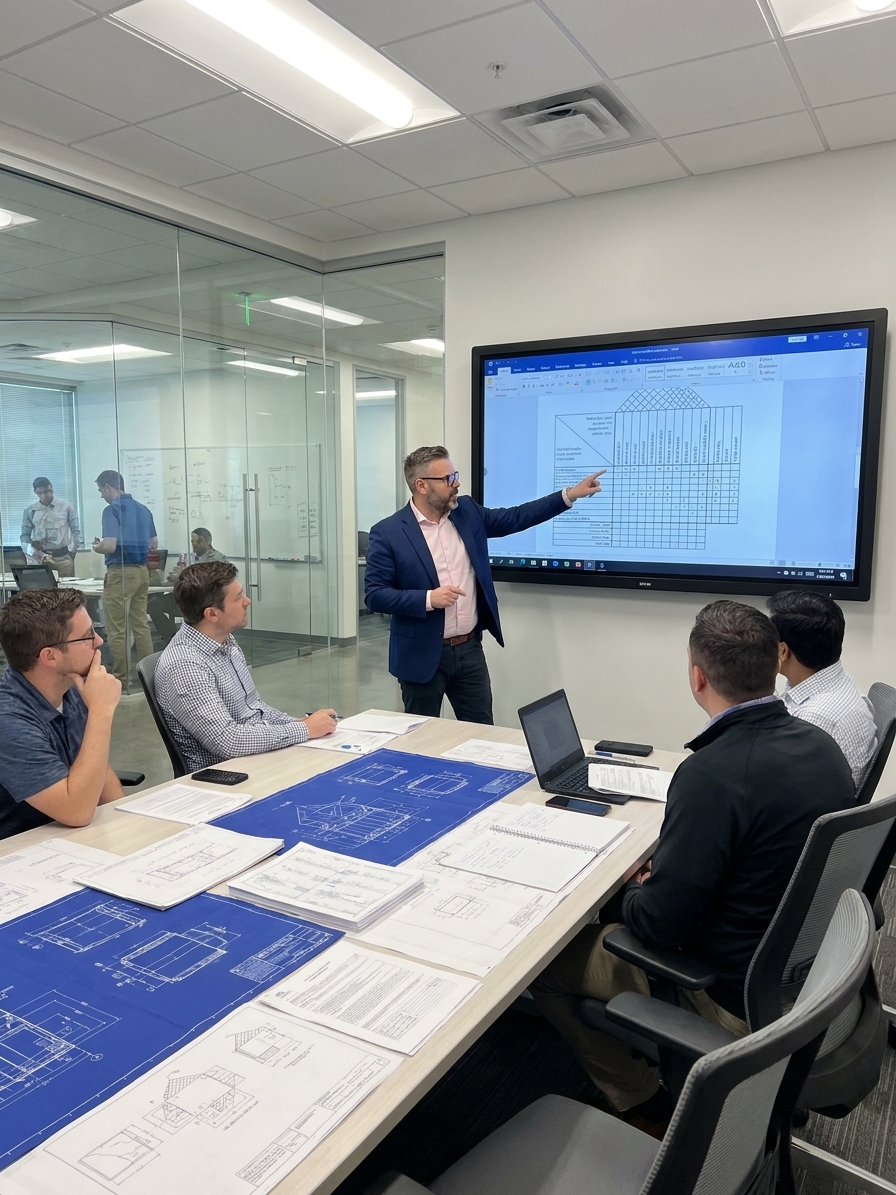
The central tool of QFD is the House of Quality, a matrix that looks intimidating the first time you see it and becomes indispensable once you understand it. It earned its name because the correlation matrix on top forms a triangular roof, making the whole structure resemble a house. Each section of the matrix forces a specific conversation that most organizations skip.
The left wall holds the customer requirements — the WHATs. These are gathered through interviews, warranty data, surveys, and direct observation, not engineering interpretations. Each requirement is weighted by importance according to what the customer values, not what engineering assumes matters. The ceiling holds the engineering characteristics — the HOWs. These are measurable technical parameters your team can design and control.

The main room is the relationship matrix, where translation actually happens. For each intersection of a customer requirement and an engineering characteristic, the team evaluates the strength of the relationship as strong, medium, weak, or none. A high-importance customer requirement with a strong link to a specific parameter tells you exactly where to concentrate design effort and resources.
The roof is the correlation matrix, where engineering characteristics either support or conflict with each other. Increasing tensile strength might decrease ductility. Improving surface finish might extend cycle time. The roof forces you to acknowledge trade-offs explicitly and resolve them during design rather than discovering them during production launch.
The Four-Phase QFD Deployment Chain
- 01Phase 1 — Product PlanningCustomer requirements translated into prioritised engineering characteristics with target values.
- 02Phase 2 — Part DeploymentEngineering characteristics translated into part specifications: dimensions, tolerances, material properties.
- 03Phase 3 — Process PlanningPart specifications translated into process parameters: machine settings, tooling configurations, process conditions.
- 04Phase 4 — Production PlanningProcess parameters translated into production controls: inspections, control charts, standard work instructions.
What QFD Prevents at the Design Stage
Organizations that skip QFD suffer from a specific set of recurring failures. The first is over-engineering the wrong features. Talented engineers will optimize everything given the chance, but optimization is expensive. Without a weighted map of customer priorities, resources get distributed based on engineering judgment rather than customer value. You end up with world-class performance on characteristics nobody notices.
The inverse problem is under-engineering critical features. Because nobody systematically mapped requirements to characteristics, the customer's top priority receives the same design attention as their twentieth. Not because anyone was negligent — because nobody had a map. The relationship matrix surfaces these invisible priorities and forces the team to allocate effort proportional to customer importance.
Then there is the specification echo chamber. Without QFD, specifications are inherited from previous products, copied from industry standards, or set by the most senior engineer in the room. They become self-referential: these are the specs because these have always been the specs. QFD breaks this cycle by forcing every specification to earn its place through a direct, documented link to a customer requirement.
Informal Translation vs Structured QFD
What teams do without QFD
- Sales rep notes passed through multiple filters before reaching design
- Specifications inherited from previous products or industry defaults
- Trade-offs discovered during production when tooling is already built
- Engineering effort distributed by internal judgment, not customer weight
What QFD forces
- Customer requirements recorded in their own words, weighted by importance
- Every specification traced to a documented customer need
- Trade-offs surfaced in the correlation matrix before any steel is cut
- Design resources allocated proportionally to customer value
Why Engineering Organisations Resist QFD
Building a proper House of Quality takes days, sometimes weeks, of cross-functional team time. In an environment where everyone is stretched thin, that investment feels extravagant. What most organizations fail to calculate is the cost of not doing it — the redesigns, production delays, customer complaints, and warranty claims that result from designing the wrong product faster.
QFD also demands cross-functional collaboration that most organizations cannot sustain. Marketing, engineering, manufacturing, and quality must sit in the same room, speak each other's languages, and reach consensus. Departmental silos, competing priorities, and power dynamics all conspire against this. QFD exposes these organizational fractures by requiring them to heal.
Then there is the discomfort. Competitive benchmarking reveals that your competitor outperforms you on the requirements that matter most. The correlation matrix shows that your preferred engineering approach creates conflicts. The importance weighting reveals that the feature your team is most proud of ranks near the bottom of customer priorities. QFD holds up a mirror, and many organizations would rather not look.
In 20 years of building quality systems, I have never seen a tool that humbles engineers faster than a properly built House of Quality.
Starting QFD on a Real Product Line
You do not need to deploy all four phases on day one. Start with Phase 1 on a single product line — ideally one where customer feedback has been mixed despite strong internal metrics. That discrepancy between your quality scores and the customer's experience is exactly the translation failure QFD was designed to expose and fix.
Assemble a team of five to eight people. Include one person from sales or marketing with direct customer contact, two or three engineers who understand the product's technical characteristics, one manufacturing representative who knows the process, and one quality professional who can facilitate the methodology. Smaller teams lack the perspective; larger teams stall in debate.
Gather customer requirements from every available source: complaint databases, warranty data, sales feedback, lost-order analyses, competitive reviews, and direct interviews. Do not edit or interpret. Record the customer's exact words. Then enter the engineering characteristics your team can control, fill in the relationship matrix, and let the math reveal where your priorities should sit.
The matrix will surface uncomfortable truths in the first session. That is its job. A well-built House of Quality will show you within hours what months of meetings and hundreds of engineering hours failed to reveal: where your design effort aligns with customer value and where it does not.
The Discipline of Documented Traceability
The deeper value of QFD is not the matrix itself but the discipline it imposes. It forces your organization to admit that engineering judgment, no matter how sophisticated, is not a substitute for understanding what the customer actually values. It replaces opinions with evidence and assumptions with structured analysis. Every production control decision in Phase 4 can be traced back through the chain to a specific customer requirement.
This traceability matters during audits, during design reviews, and during the inevitable scope changes that occur mid-program. When a customer asks why a particular tolerance was chosen or why a process parameter was set at a specific value, your team can point to the documented chain — customer requirement, engineering characteristic, part specification, process parameter, production control — without relying on memory or tribal knowledge.
Most quality failures are not failures of execution but failures of understanding. QFD is the methodology that ensures you are building the right thing, not just building the thing right. Your customer already told you what they need. The question is whether your organization has the discipline to listen, translate accurately, and deploy thoroughly enough to deliver it.