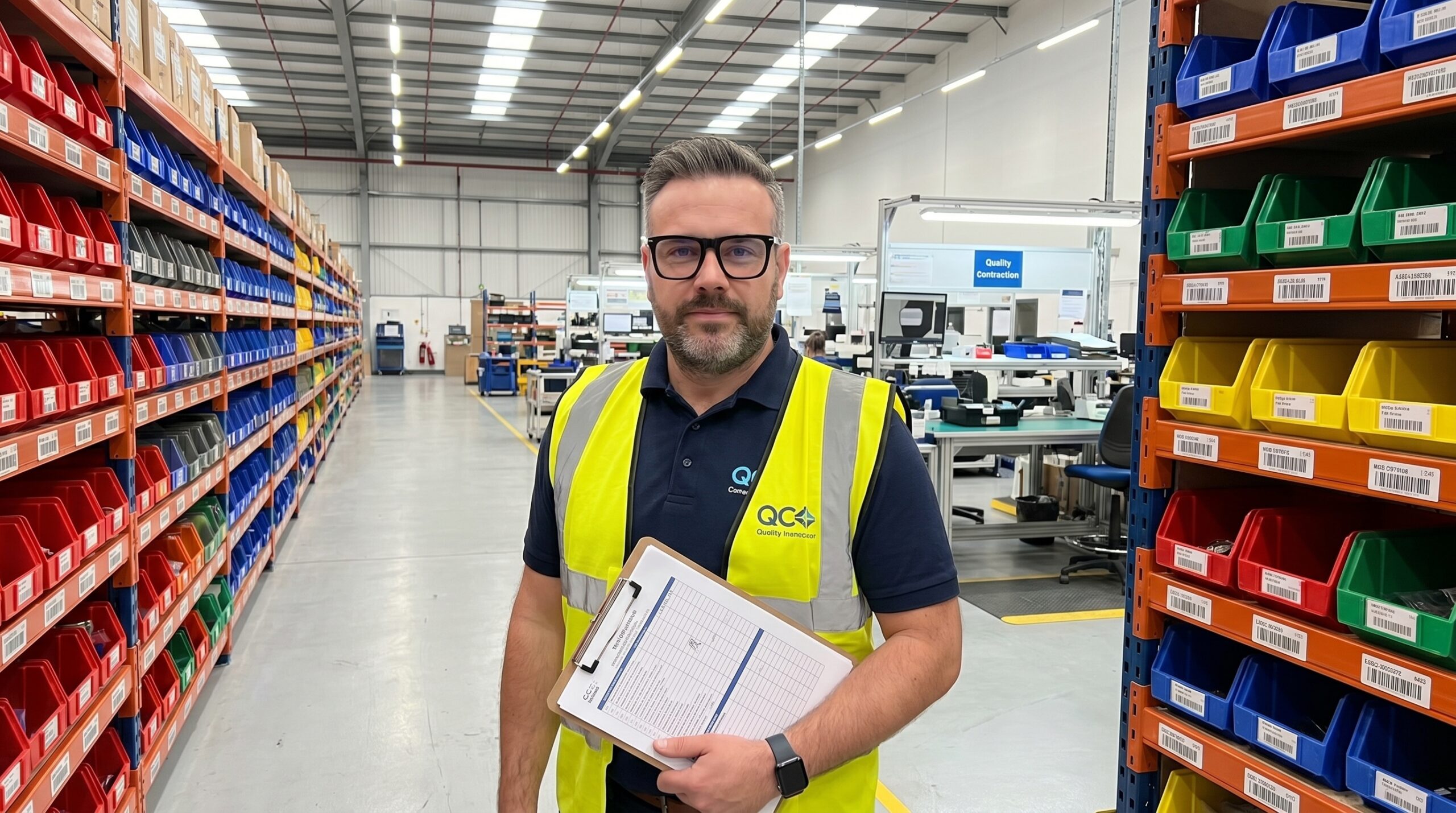
A customer discovers mixed components in a sealed container. Parts from two production runs, carrying different revision levels, sit side by side in the same bin. Both passed incoming inspection. Both carry the same part number on their labels. Only one conforms to the customer's current build specifications.
The supplier must quarantine 14,000 parts across three warehouses, suspend shipments for eleven days, and deploy a sorting team to the customer's facility. The root cause is mundane: a warehouse operator combined two partial containers to save space. The parts looked identical, the labels were close enough, and the system trusted the shelf.
I have investigated this exact pattern across automotive and aerospace plants. Inventory segregation is the most underestimated quality risk in production. It operates silently between your incoming inspection and your final shipment, and when it fails, it destroys the validity of every control plan you have written. If your parts are mixed, your Cpk data is meaningless.
What Inventory Segregation Actually Controls
Most plants treat segregation as simple physical separation: conforming parts in one area, nonconforming in another. True quality inventory segregation is the entire architecture of controls, identifications, and barriers that guarantees every component's status is verifiable from receipt through production to shipment.
IATF 16949 and AS9100 both require traceability and product preservation, but they do not specify the exact physical mechanisms. That is left to the organization. The result is often a system that relies on visual checks and manual label updates. Those are precisely the controls that fail under production pressure.
Effective segregation means material is uniquely identified by lot and revision, physically separated by quality status with hard boundaries, and controlled at every handoff. If your system allows an operator to combine lots without a system block, your segregation is advisory, not enforced.
The Seven Failure Modes in Material Handling
After auditing dozens of segregation failures, I have identified seven recurring patterns. Each represents a gap between what the ERP assumes and what actually happens on the floor.
Visual deception is the most common. Two components share external geometry but have different internal specifications. When your only segregation method is color-coded bins, you are one faded label away from a mix. The fix is physical impossibility: containers that physically cannot fit on the wrong shelf, or IT interlocks that block the transaction.
Status drift occurs when a part is flagged in the system but the physical container is never moved. Approved material ends up sitting in a nonconforming zone. The best operations solve this with electronic status locking. The container cannot be picked or consumed until the ERP reflects the correct, verified status.

How Traceability Collapses in Practice
The partial container trap is the one that catches suppliers during PPAP submissions. A container with 47 parts left is combined with another holding 63 to free up floor space. The two represent different heat numbers. The moment they combine, traceability is destroyed. If a defect emerges later, you must recall everything because you can no longer isolate the batch.
FIFO failures are equally dangerous but harder to detect. Older material sits behind newer stock on a shelf. The specification changes via an engineering revision while the older material waits. When the old material is finally pulled, it is nonconforming, not because it degraded, but because the drawing updated around it.
Then there is phantom inventory. The ERP says 2,400 pieces are in location A-14. The physical count is 1,800. The missing 600 might be sitting on an unlabeled cart in the rework area, quietly losing their identity. Cycle counting must verify status and revision alongside quantity, or the audit provides false assurance.
The Partial Container Failure Chain
- 01Partial Quantities IdentifiedTwo open containers of the same part number but different lots are identified by warehouse staff.
- 02Physical CombinationContents are poured into a single bin to reclaim floor space, destroying lot separation.
- 03System Blind SpotERP records the merged quantity but cannot map individual parts back to their original heat or batch numbers.
- 04Forced Total RecallA subsequent defect discovery requires scrapping or sorting the entire merged quantity because the suspect batch cannot be isolated.
Return Flows and the Digital Disconnect
Customer returns are a weak link in any segregation system. Defective parts returned for analysis, excess inventory returned for credit, and field-failure investigation units all arrive at the same dock. They receive the same processing as forward production material. Nonconforming field returns end up on shelves next to conforming stock.
Return flows demand their own receiving protocol, distinct identification tags, and physical quarantine zones completely separate from production material. If your returned goods share any physical space with production stock, you have an active vulnerability that will eventually trigger a customer escape.
Underlying all of this is the digital-physical disconnect. The warehouse management system logs a pick from Bin C, but the operator physically pulled from Bin D. Multiplied across a hundred transactions per shift, the digital model diverges from physical reality. The fix is closed-loop verification: every system record validated against physical reality at defined intervals.
If your system relies on human perfection to catch errors, your segregation system is advisory, not functional.
Architectural Principles for Enforced Segregation
The core principle of effective segregation is making wrong actions impossible rather than merely forbidden. Training operators to check labels is necessary but insufficient. The question a quality leader must ask is what happens when someone forgets. If the answer is a defect escapes, the system relies on human perfection.
Robust systems catch errors through the process itself. Barcode verification at every transaction, weight checks on critical containers, physical barriers that prevent cross-contamination of lots, and electronic interlocks that halt consumption when the revision level does not match the work order. These are the mechanisms that enforce compliance when training fails.
You must also segregate by risk, not by convenience. A commodity fastener does not require the same control as a safety-critical braking component. Define segregation levels in your control plan based on risk, and allocate physical barriers and verification effort accordingly. A one-size-fits-all approach is either too expensive for low-risk items or dangerously loose for high-risk ones.
Advisory Controls vs Enforced Controls
Advisory Controls
- Colour-coded bins relying on visual checks
- Labels requiring manual updates during status changes
- Training operators to never combine partial containers
- General cycle counts verifying only quantities
Enforced Controls
- Physically incompatible container types per status
- Electronic status locking blocking ERP transactions
- Weight-check interlocks rejecting mixed lots
- Audits verifying part, status, revision, and location
Designing for the Worst Production Day
Traditional inventory audits ask whether the quantity matches the system record. Quality inventory audits ask whether you have the right part, in the right status, in the right location, traceable to the right source. The second question is harder to answer, but it is the only one that prevents segregation failures.
Your segregation system works perfectly on a calm Tuesday with full staffing and experienced operators. Segregation failures do not happen on calm days. They happen during end-of-month overtime pushes, during shift changes, and during new employee onboarding. You must design your verification steps and physical barriers for the worst day, not the best one.
Implementing a robust system requires real investment in infrastructure, scanning technology, and discipline. A mid-size operation might spend significantly to implement proper zoning and electronic locking. Compare that against the cost of a single line shutdown at an OEM because a supplier shipped mixed parts. The math justifies itself instantly.
Walk your warehouse this week without a clipboard. Look for partial containers, mixed labels, and status ambiguities. Pick your five highest-risk components and trace them from receiving to shipping. The transition points where material changes hands are where your segregation will break down. Fix those nodes first, and enforce the fix with hardware, not just procedures.