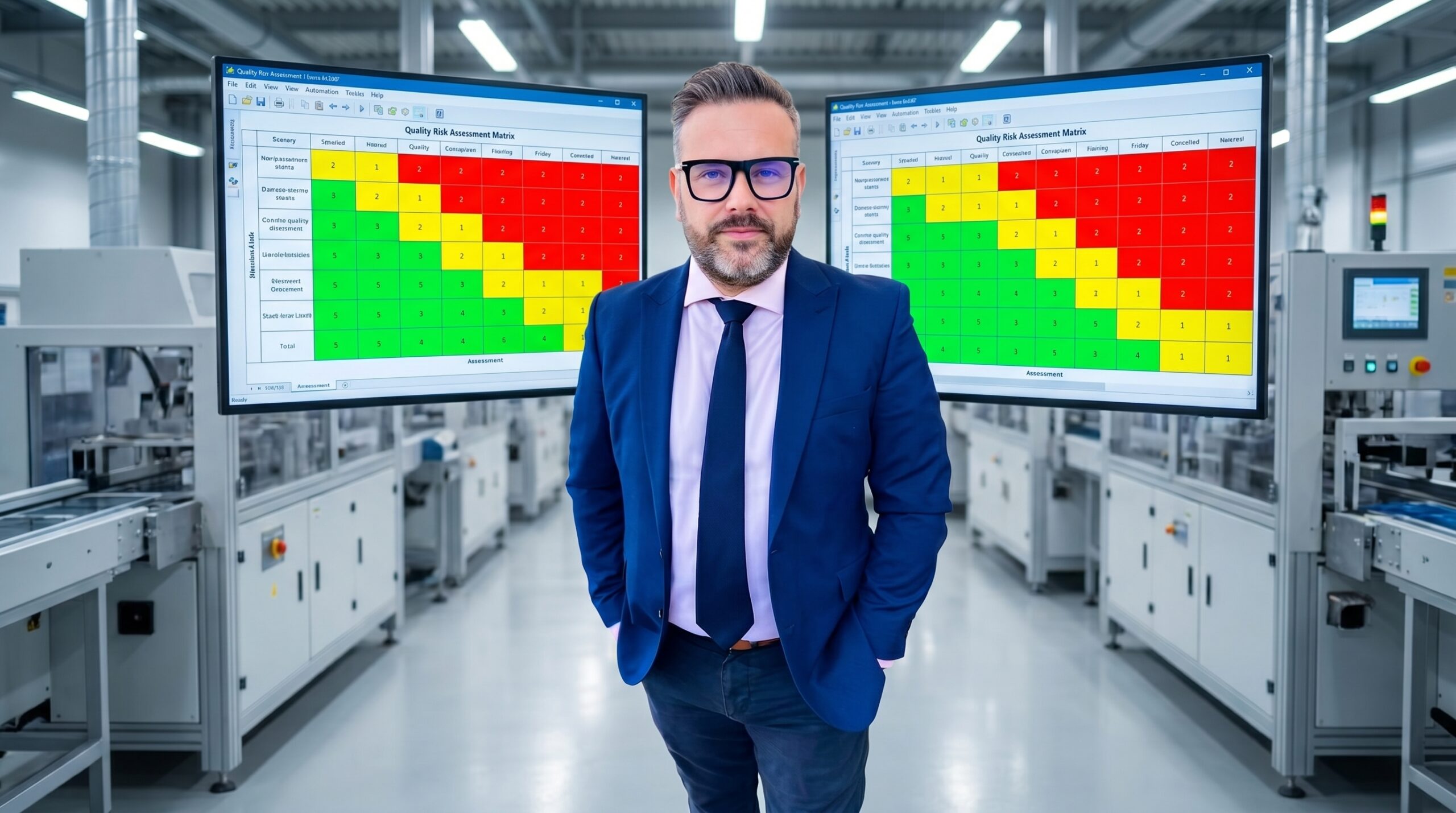
Quality Risk Management (QRM) is not a matrix you laminate for the wall. It is a systematic approach to identifying, assessing, and controlling risks before they disrupt production. The framework forces a proactive shift: replacing the reactive question of what happened with the far more powerful question of what could happen. Organisations that master this transition build resilience.
The cost of reactive quality management is steep. When a defect passes through a production line undetected for weeks, the resulting escalation costs multiply across warranty claims, expedited shipping, and customer line-down penalties. A single systematic failure mode can easily exceed millions in containment costs, consuming profit margins and damaging customer trust permanently.
I have audited plants where highly capable engineering teams were completely blindsided by systematic failures. The root cause was never a lack of data on the shop floor. The failure occurred because nobody had been given the framework, or the institutional permission, to ask what would happen if a process variable drifted.
The Risk Register as Institutional Honesty
Every solid QRM implementation begins with a document that most organisations find uncomfortable to create: the risk register. This living catalogue lists potential failures, their causes, their consequences, the severity of those consequences, the probability of occurrence, and the detectability of the failure before it reaches the customer.
The register forces cross-functional teams to confront known vulnerabilities. When engineering, production, and quality personnel sit down together, they uncover risks that everyone privately knew but never formally documented. Single-source suppliers without sub-tier audits, or calibration cycles misaligned with high-frequency tool usage, suddenly become visible priorities rather than background anxieties.
These risks exist whether you document them or not. Writing them down is what separates a quality-driven organisation from one that is merely one bad shift away from a critical failure. The act of documentation transforms vague operational anxiety into actionable management data.
Assessing Risk: Severity, Occurrence, and Detection
Risk assessment evaluates potential failures across three dimensions: severity, occurrence, and detection. Multiplying these factors generates a Risk Priority Number (RPN) that helps management decide where to focus finite improvement resources. While no single number captures every nuance of process risk, the RPN provides a common language for comparing radically different failure modes.
Severity measures the consequence of failure. A cosmetic scratch on a hidden bracket carries low severity; a structural failure in a braking system carries maximum severity. This is the dimension organisations can least afford to miscalculate, as underestimating severity directly endangers the end user and guarantees severe commercial escalation.
Detection evaluates the probability of catching a defect before it leaves the facility. This is where organisations most commonly overestimate their capabilities. Assuming an inspection step works flawlessly simply because it exists on a control plan provides a false sense of security that is more dangerous than having no check at all.
| Risk Factor | Assessment Criteria | Common Organisational Trap |
|---|---|---|
| Severity | Impact on safety, function, and regulatory compliance. | Downgrading severity to make a metric look artificially tolerable. |
| Occurrence | Historical frequency based on actual process capability data. | Relying on theoretical limits rather than historical scrap rates. |
| Detection | Reliability of current controls in catching the specific defect. | Overestimating manual inspection consistency during long shifts. |
Designing Controls That Actually Work
Once risks are identified and assessed, organisations must implement controls. Risk control operates on a strict hierarchy. The primary goal is always elimination: changing the design or process so the failure mode becomes physically impossible. This is the Poka-Yoke principle applied at the engineering level, removing human error from the equation entirely.
If elimination is technically or commercially impossible, the focus shifts to reduction. Process capability must be improved to lower the probability of occurrence, or automated controls must be added to increase the probability of detection. This is where the vast majority of practical quality engineering work resides, in the incremental effort of making processes slightly more robust.
The most effective controls are built directly into the process rather than bolted on as operational afterthoughts. A mechanical fixture that physically prevents the misorientation of a part is a fundamentally superior control to a work instruction merely asking the operator to ensure correct orientation.
A check that is performed inconsistently, or lacks the sensitivity to detect the failure at hand, is more dangerous than no check at all.
Maintaining the Cadence of Risk Review
Most QRM implementations fail at the review stage. The team conducts the initial assessment, implements controls, and then files the documentation away. The risk register gathers dust while new suppliers are introduced, customer requirements evolve, and manufacturing processes drift. The documented risk picture quickly becomes obsolete.
Effective QRM requires a strict cadence of periodic and trigger-based reviews. Periodic reviews of the register should occur quarterly or semi-annually depending on the pace of operational change. Trigger-based reviews must happen automatically whenever a new product is launched, a process is altered, or a field failure reveals a previously underestimated hazard.
Every field failure or internal nonconformance must be treated as a data gift that feeds back into the register. Post-failure reviews ensure that corrective actions address root causes within the system, rather than merely treating the immediate symptoms. The register must function as a living document, managed with the same discipline as a production schedule.
Integrating QRM Across the Quality System
Quality Risk Management does not operate in isolation; it forms the connective tissue for the entire quality management system. When an auditor reviews an FMEA, they are examining the documented output of the QRM process. Control plans are simply the operational expression of the risk decisions previously made by the engineering team.
This integration must be explicit. APQP processes must embed risk thinking at every gate, and CAPA systems must loop verified root causes directly back into the central risk register. Without this closed-loop feedback mechanism, organisations end up solving the same problems repeatedly while the underlying risk profile remains unchanged.
The QRM Integration Cycle
- 01Risk IdentificationBrainstorming potential failure modes with cross-functional teams.
- 02AssessmentScoring severity, occurrence, and detection to establish priorities.
- 03Control DesignImplementing Poka-Yoke, error-proofing, or upgraded inspection protocols.
- 04Trigger ReviewUpdating the risk register whenever a process changes or a failure occurs.
Scaling QRM for Real-World Complexity
A common objection to formal risk management is that it sounds too heavy for everyday use. Plant managers argue that small operations cannot afford a full-time risk management program. This fundamentally misses the point. QRM is designed to scale directly to the complexity and criticality of the situation at hand.
For a minor change to a low-risk process, a thirty-minute brainstorming session with a flip chart is entirely sufficient. The team identifies the primary risks, agrees on straightforward controls, documents the decision, and resumes production. For a new product launch in a safety-critical application, a full cross-functional FMEA requiring weeks of analysis is the appropriate response.
The governing principle is proportionality. Effort must match the risk. A lightweight assessment on a low-stakes process is infinitely better than no assessment at all. Starting small builds the institutional muscle and prepares the team for the rigorous demands of future high-stakes product launches.