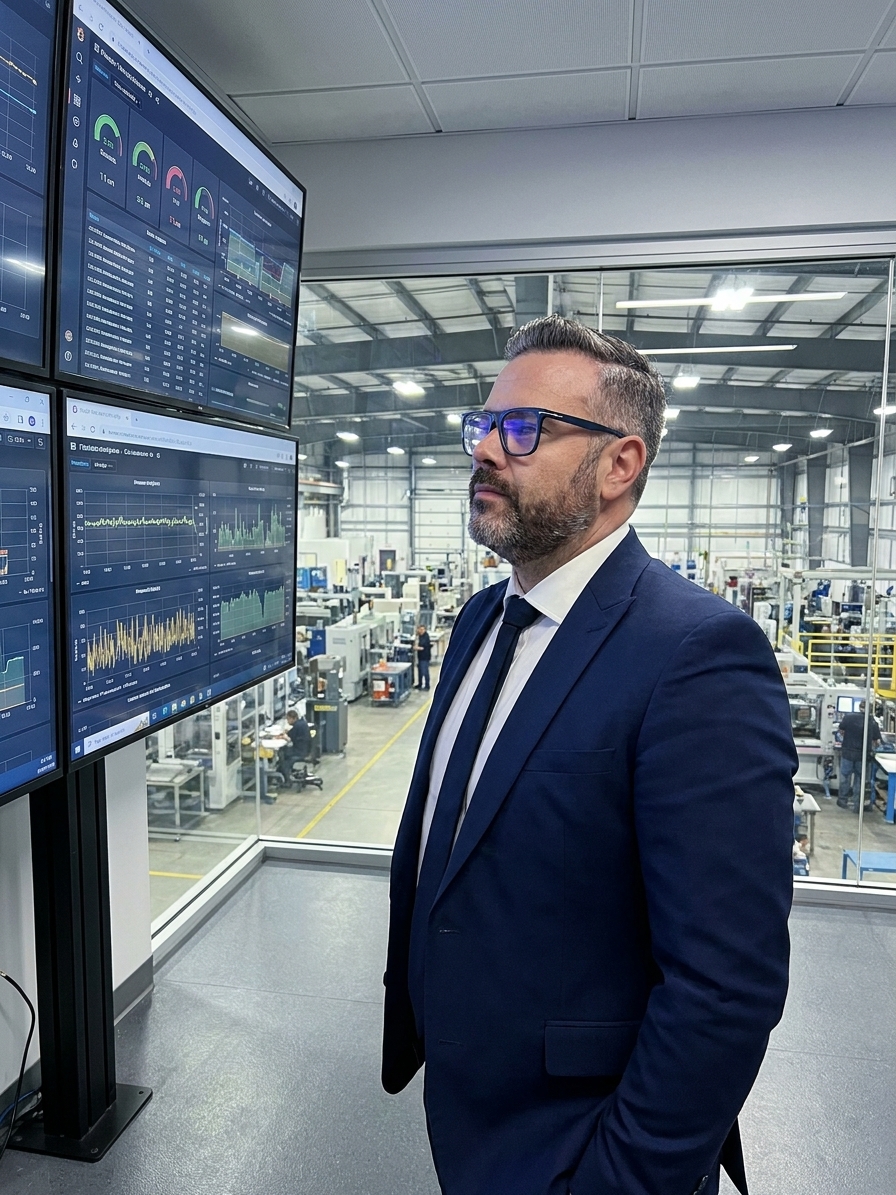
A plant manager's dashboard displayed twelve KPIs in neat green boxes. For fourteen consecutive months, OEE sat at 94%, First Pass Yield at 98.7%, and customer complaints at zero. The plant was performing beautifully by every visible metric. Then a major customer returned 40,000 fuel injector assemblies.
Every single unit passed every single test. The defect stemmed from a subtle interaction between the surface finish specification, a new cleaning solvent introduced by a supplier without a PPAP update, and a temperature fluctuation in the customer's assembly environment outside the range modeled during APQP. The defect was invisible to the dashboard because the dashboard monitored twelve variables. The process contained four hundred.
The investigation took eleven weeks. The corrective action took six months. The customer moved their next program to a competitor. The quality system did not fail; it did exactly what it was designed to do. The system monitored twelve variables with precision, but it possessed less variety than the problems it was intended to control.
The Mathematical Constraint Behind Quality Surprises
In 1956, the psychiatrist and cyberneticist W. Ross Ashby articulated a principle that governs process control, immune systems, and organizational design: the Law of Requisite Variety. The law states that for a system to maintain stability, the variety of its control mechanisms must equal or exceed the variety of the disturbances it faces. Variety is simply the number of possible states a system can occupy.
A light switch has two states. A CNC machine with seventeen adjustable parameters has millions of possible states. A global supply chain has effectively infinite variety. The law is ruthlessly mathematical. If your quality system distinguishes between ten defect categories but your process generates five hundred failure modes, you will miss things. The deficit is structural, not a failure of personnel or tools.
I have audited plants where brilliant engineering teams were defeated by this mathematics. PFMEA teams sit in conference rooms and list obvious failure modes, assigning severity and occurrence ratings. But a typical automotive component has dozens of input variables: material properties, tool wear states, environmental conditions, supplier variations. These variables combine. The actual number of failure modes is closer to twelve thousand than the twelve listed on the FMEA.

When Control Plans Create Blind Spots
Control plans are designed to focus attention. They tell inspectors what to check, operators what to monitor, and engineers what to track. This focus is valuable, but it is also a deliberate reduction of variety. Selecting twenty characteristics to monitor means implicitly deciding to ignore the other four hundred variables.
Most of the time, this strategy works. The unmonitored variables are stable, controlled by other mechanisms, or irrelevant. But the gap between 'most of the time' and 'all of the time' is where field failures and recalls live. The simplification that makes the control plan manageable is the exact same simplification that allows unexpected interactions to pass undetected through the entire value chain.
Audits suffer from the same structural limitation. An ISO 9001 audit checks conformity. A VDA 6.3 process audit evaluates specific elements against defined questions. These tools sample reality. They make informed judgments, but they cannot examine every possible state the system can occupy. When the simplification aligns with reality, the audit provides confidence. When it diverges, the audit provides false confidence.
Approaches to Process Variety
Adding metrics (low impact)
- Monitors the specific variable that already caused a failure
- Creates dashboards with fifty or sixty isolated KPIs
- Generates data faster than the organisation can process it
- Builds false confidence that the structural gap is closed
Building variety (high impact)
- Increases the system's capacity to respond to unknown disturbances
- Deploys cross-functional teams to approach problems from new angles
- Uses anomaly detection to flag shifts outside predefined limits
- Captures learning from every 8D report to build institutional memory
The Failure of Simply Adding Metrics
The most common reaction to a quality surprise is adding a new metric, inspection point, or KPI. The plant with twelve green boxes creates a thirteenth box for the specific variable that caused the recall. This feels logical, but adding one metric to twelve does not meaningfully increase control variety when the process contains four hundred relevant variables.
This reaction creates an illusion of progress. The team feels reassured because they addressed the issue that already happened. They have not addressed the structural variety gap that allowed the failure to emerge undetected. Organizations that pursue this path eventually build dashboards with a hundred metrics. Each addition made sense in isolation. Together, they create a monitoring system so dense that nobody can synthesize the data into actionable intelligence.
The second common response is attempting to simplify the process itself. Standardizing inputs, locking parameters, and removing sources of variation reduces the number of states to monitor. Toyota's standard work and poka-yoke devices are fundamentally about reducing process variety so quality control becomes manageable. Design for Manufacturing and Assembly (DFMA) reduces failure modes by reducing part counts and interfaces.
Simplification has hard limits. You cannot standardize away customer demand variability. You cannot poka-yoke a supplier's internal process changes. The pursuit of simplicity is valuable, but the global supply chain is not simple. Pretending otherwise leaves an organization vulnerable to the exact interactions it chose not to model.
Designing Systemic Variety for Complex Processes
The correct response to a variety gap is increasing the quality system's capacity to handle disturbances it cannot predict. Instead of trying to monitor every variable or eliminate every source of variation, build a system with sufficient internal variety to react. Cross-functional problem-solving is the fastest way to achieve this.
A quality engineer with access to twenty years of resolved failure modes has more variety than the best statistical algorithm.
A team comprising a materials scientist, a process engineer, a quality technician, and a supply chain specialist has more variety than a team of five process engineers. When an unexpected problem emerges, this diversity of perspective allows the team to generate more hypotheses and identify root causes faster. Layered process audits operate on the same principle: operators, supervisors, engineers, and managers auditing across different shifts create a portfolio of perspectives no single audit can replicate.
Modern analytics provide technological variety amplification. Traditional SPC monitors specific variables against fixed control limits. Real-time anomaly detection monitors the overall pattern of process behavior, flagging deviations that do not correspond to any predefined failure mode. The system detects that something has changed even when it cannot immediately identify the specific variable responsible.
Supplier development outperforms incoming inspection for the same reason. Incoming inspection adds variety at your receiving dock. Supplier development builds variety directly into the source. When you help suppliers build capable quality systems, you increase the total response capacity of the supply chain rather than simply adding another filter at your door.
Mapping the Structural Variety Gap
Running a variety gap diagnostic takes two hours and reveals more about systemic resilience than any standard compliance audit. The exercise requires mapping both the process variety and the control variety for a single critical process, then comparing the two honestly.
Variety Gap Diagnostic Sequence
- 01Map process varietyList every input variable, parameter, environmental factor, and external influence, including unmonitored supplier changes.
- 02Map control varietyList every mechanism for detecting variation, including formal SPC charts and informal operator experience.
- 03Identify the gapThe difference between the two maps is the operational space where unforeseen quality escapes originate.
- 04Design compensating controlsBuild escalation triggers and cross-functional response protocols rather than attempting infinite inspection.
When mapping process variety, do not limit the scope to what appears on the control plan. Include the variables nobody tracks: seasonal humidity shifts, upstream machine replacements, and subtle changes in logistical routing. The goal is to acknowledge the true complexity of the system, not to validate the existing documentation.
When mapping control variety, include informal mechanisms. Operator intuition and supervisor judgment are real control mechanisms. The objective is to understand the total detection capacity of the current system. The gap between these two maps is the exact space where your next major quality surprise will originate.
Treating Response Capacity as a Strategic Asset
The fuel injector plant did something unusual after their recall. Instead of adding a thirteenth KPI box, they scrapped the dashboard. They installed a process behavior platform that monitored 340 variables in real time, establishing normal behavioral patterns and flagging deviations without requiring predefined failure thresholds.
They instituted weekly cross-functional reviews where operators, quality engineers, and supply chain coordinators discussed what was changing in the process — not what was out of specification, but what was different. They built a direct communication channel requiring their top fifteen suppliers to notify them of any process change, material substitution, or facility modification before implementation, not after the fact.
The variety of their quality system increased by an order of magnitude. They did not achieve this by adding inspections. They achieved it by designing a system capable of responding to complexity rather than pretending complexity did not exist. The plant subsequently ran over two and a half years without a customer escape.
Organizations with high-variety quality systems take on complex programs with demanding customers because they possess the response capacity to handle inevitable surprises. Organizations with low-variety systems remain limited to simpler work, and they remain vulnerable to the unexpected even in stable environments. The Law of Requisite Variety is not a suggestion; it is a mathematical constraint that operates whether you acknowledge it or not.