Most manufacturing plants operate in a permanent state of firefighting. A supplier misses a delivery, a critical dimension drifts out of tolerance, or a certification audit uncovers a systemic nonconformity. The quality team scrambles, writes an 8D report under extreme time pressure, and applies a containment action. They close the deviation, breathe out, and wait for the next crisis to hit. This reactive loop is expensive, demoralising, and entirely predictable.
Standardised risk management is not about predicting the future with absolute certainty. It is about building systematic preparation into your quality management system. ISO 9001 and IATF 16949 both mandate risk-based thinking, but auditors routinely see companies treat this clause as a paperwork exercise. They fill out a risk register once a year during the management review and file it away.
Genuine risk-based thinking means you know exactly what threatens your processes, when those threats are likely to materialise, and what preventive action you will take to neutralise them. Having implemented and transitioned quality systems at a major aerospace manufacturer, SNOP, and WITTE Automotive, I have seen how shifting from annual compliance to continuous risk monitoring transforms factory performance and permanently eliminates the operational firefighting mentality.
Building a Risk Management Process That Prevents Failures
An ineffective risk programme shares common symptoms across all industries. The risk register is updated annually just to satisfy the auditor. Formal risk assessments are only triggered after a major customer complaint. Mitigation plans exist strictly on paper, without allocated resources or ownership. Crisis management becomes the default operational mode for handling supplier failures and internal defects.
Effective risk management is a continuous operational journey, not an isolated annual event. When building a greenfield QA/QC department for a 900+ employee automotive plant, I transitioned the team away from a static annual review. We implemented monthly cross-functional risk assessments, risk-based audit planning every quarter, mandatory preventive actions for all critical PFMEA failure modes, and a live risk dashboard for the senior management team.
The operational shift was immediate. By forcing the team to assess emerging risks continuously rather than retrospectively, we slashed the internal lead time for identifying and resolving process threats down to a matter of weeks. The key components are straightforward: map potential failure modes, score them accurately, design targeted preventive controls, monitor process data in real time, and feed all findings back into the continuous improvement loop.
The Continuous Risk Management Cycle
- 01IdentificationExtract failure modes from PFMEA, historical 8Ds, and internal audit findings.
- 02ScoringEvaluate probability, severity, and detectability using standard FMEA scales.
- 03PreventionAssign engineered controls and preventive actions to high-risk failure modes.
- 04MonitoringTrack leading indicators and process drift on a live dashboard before defects occur.
- 05ImprovementUpdate the risk register and refine controls based on actual performance data.
The Risk Assessment Matrix: Driving Prioritisation
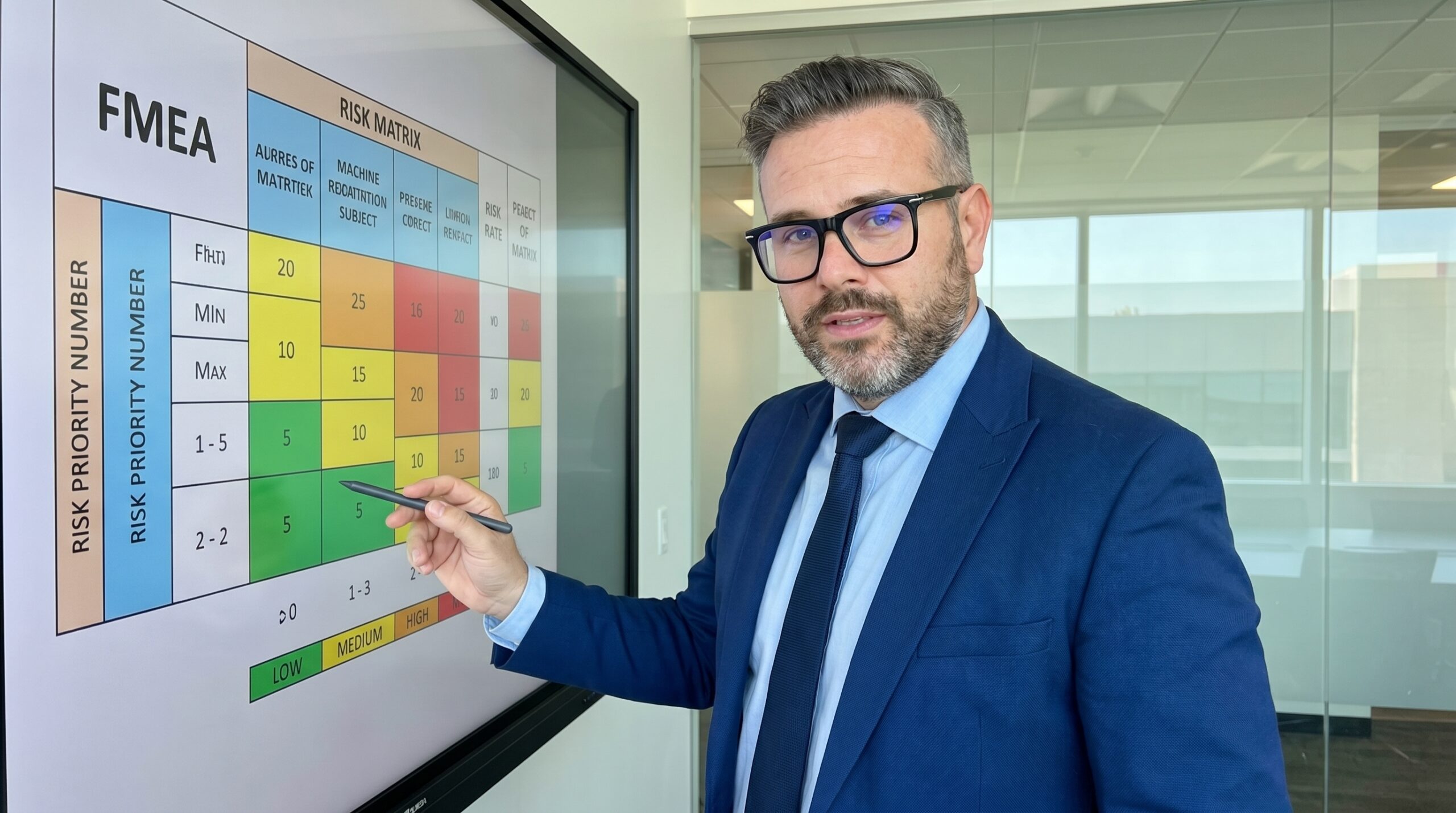
You cannot dedicate the same engineering resources to every threat. Quality teams must differentiate between a catastrophic safety failure and a minor cosmetic defect. A structured Risk Assessment Matrix is the mechanism that forces objective prioritisation. It visualises failure modes based on their probability of occurrence and the severity of their impact.

Critical risks — high probability and high severity — demand immediate containment and engineered process changes. Important risks, such as medium probability and high impact, require robust action plans within thirty days. Moderate risks need active monitoring through statistical process control. Minor risks can be consciously accepted and reviewed annually. Scoring forces management to allocate quality resources based on data, not internal politics.
I applied this matrix to a complex automotive supply chain to categorise forty-five production suppliers. The exercise identified five critical suppliers, fifteen important suppliers, and twenty-five minor suppliers. We immediately redirected our engineering bandwidth, dedicating eighty percent of our supplier development time to the critical few. The minor suppliers received only five percent of our attention, and throughput stability improved dramatically as a result.
Risk-Based Audit Planning: Eliminating Inefficiency
Most internal audit programmes waste valuable resources. Quality departments audit every single process with the same frequency, regardless of stability or risk. This one-size-fits-all approach drains engineering hours and produces shallow inspections of highly volatile processes. It is a primary reason why IATF 16949 and AS9100 require organisations to adopt risk-based audit planning.
Risk-based planning means you audit critical, high-impact processes far more frequently than stable ones. In a factory transition, we stopped auditing everything uniformly. We identified our volatile paint shop and critical bottlenecks, auditing those processes every single month. Important supporting processes moved to a quarterly audit cycle. Stable, low-risk administrative processes were audited just once a year.
The measurable outcome was significant. Focusing audit time strictly on volatile processes drastically reduced nonconformities because we caught systemic failures earlier. Audit-related costs dropped because we stopped paying engineers to review inherently stable systems. Audit effectiveness multiplied because the findings generated actionable improvements rather than administrative box-ticking.
| Risk Level | Audit Frequency | Management Action |
|---|---|---|
| Critical (High Probability, High Impact) | Monthly | Immediate engineered controls, weekly KPI review |
| Important (Medium Probability, High Impact) | Quarterly | Targeted action plans with 30-day deadlines |
| Moderate (Low Probability, High Impact) | Bi-annually | Active monitoring via SPC and process dashboards |
| Minor (Low Probability, Low Impact) | Annually | Acceptance with documented management review |
Supplier Risk Management: Extending Your QMS Boundaries
Your supplier is a direct extension of your own quality management system. Their process failures become your production line stops, and their documentation gaps become your certification nonconformities. If a critical supplier struggles with dimensional capability, you cannot simply ignore the problem and rely on incoming inspection to catch the defects.
A supplier's process failure is your production stop. Their quality risk is your operational reality.
I inherited a critical supplier exhibiting severe warning signs: high employee turnover, consistent delivery delays, and quality metrics hovering below seventy percent. The standard reactive approach would have been to issue corrective action requests, dock their parts, and eventually source an alternative. Instead, we launched a structured supplier intervention plan.
We implemented intensive weekly monitoring on their critical-to-quality dimensions and established a joint quality council that met monthly. We deployed our own engineers to support the supplier's implementation of statistical process control and PFMEA. Within six months, the supplier stabilised. Delayed deliveries dropped to zero, and their outgoing quality metrics exceeded ninety percent, securing the supply chain without the massive cost of re-sourcing.
Embedding a Risk Management Culture Across the Organisation
Risk management frameworks fail without cultural adoption. On the shop floor, risk assessment is frequently viewed as an administrative burden imposed by the quality department. Operators and production supervisors often default to thinking that risk identification is exclusively the job of the quality engineer, leading to a dangerous disconnect between the floor and the QMS.
Toxic organisational behaviour actively undermines prevention. When operators hide minor process deviations to avoid management confrontation, the window for preventive action closes permanently. You must train every employee on what risk-based thinking actually means for their specific workstation. If an operator spots a machine vibrating abnormally, they must feel empowered to stop the line and log the observation.
Cultural transformation requires visible operational changes. Implement weekly risk reporting in tier meetings, and actively recognise operators who identify potential failure modes before they escalate. When shop floor teams see that their proactive observations directly trigger preventive maintenance or process changes, they stop viewing risk management as an administrative chore and start owning the process stability themselves.
Implementation: A Six-Month Transformation Plan
Transitioning a reactive plant to a predictive system requires a disciplined, phased approach. Trying to implement a comprehensive risk transformation overnight will overwhelm the organisation and guarantee failure. The process must be structured logically, starting with data mapping and progressing through to live monitoring.
Months one and two demand rigorous assessment. Map all critical processes, review historical 8D reports, and build an accurate Risk Assessment Matrix. Define your KPIs clearly — measure the number of preventive actions implemented, the success rate of those mitigations, and overall risk awareness across the team. Without baseline metrics, you cannot prove the financial return of the transformation to senior management.
By months three and four, transition into active deployment. Implement the live risk register, launch your risk-based audit schedule, and complete deep-dive risk assessments on all critical Tier 1 suppliers. By months five and six, you should launch the management risk dashboard and complete comprehensive awareness training across all operational shifts. The dashboard is what ultimately drives continuous improvement long after the initial implementation push.
Key Metrics for a Predictive Quality System