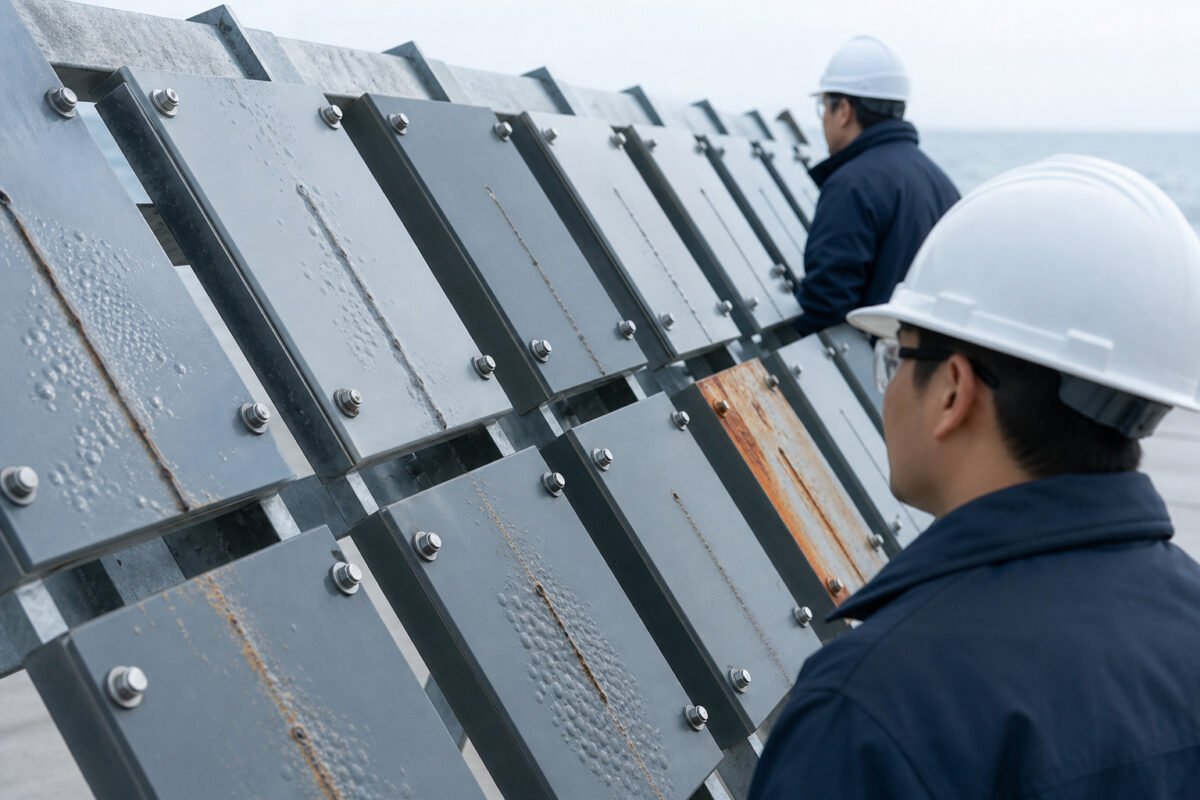
ASTM B117 defines a controlled corrosive environment: 5% sodium chloride solution atomised at 35 °C, collected at one to two millilitres per eighty square centimetres per hour, with chamber pH held within specification. ISO 9227 covers the same neutral salt spray (NSS) and adds acetic acid (AASS) and copper-accelerated (CASS) variants. Nowhere in the text of any of these standards is there a claim that the test reproduces service exposure. B117 is explicit that it makes no prediction of corrosion behaviour in service.
Read the annexes of the cyclic tests built on top of these methods — ASTM G85, ISO 11997, VDA 233-102, SAE J2334 — and you find the same repeated warning: salt spray hours cannot be converted to years of exposure. Across two decades in automotive and aerospace quality, I have sat through dozens of customer disputes where one side held a 480-hour NSS result as proof of five-year durability. It is not, and no standard supports the claim. The standards define a test; the interpretation is entirely on us, and that is where the trouble starts.
How the Chemistry Diverges From Reality
A neutral salt fog delivers chloride ions at constant humidity and temperature, continuously. Real atmospheric corrosion is nothing like that. Steel on a vehicle body experiences wet-dry cycling, where the drying phase concentrates chlorides at the surface and drives electrochemistry in ways a constant fog cannot. Pollutants such as SO₂, NOx, ammonium compounds and deposited dust change the electrolyte composition entirely. Marine chlorides, de-icing salts and industrial atmospheres produce three different corrosion regimes; B117 treats them identically.
The failure modes diverge too. Continuous condensation keeps zinc phosphate conversion coatings and certain organic pretreatments saturated, which can either accelerate or suppress corrosion relative to field conditions depending on the coating system. Filiform corrosion on aluminium and painted substrates barely registers in a neutral fog but flourishes under outdoor humidity cycling. Pitting chemistry on stainless steels depends on the specific chloride concentration and on drying events the chamber never produces.
When I compare a chamber coupon against a returned field part from the same production lot, the corrosion morphology often looks like it came from different planets. That observation alone should end any argument about direct equivalence, yet hour-count requirements survive in drawings because nobody is required to reconcile the two.

The Pass/Fail Gate That Should Not Exist
Here is the pattern repeated across the industry: a drawing note specifies 720 hours NSS with no red rust, the supplier designs the coating stack to pass exactly that, the part ships, and everyone believes corrosion performance has been demonstrated. What has actually been demonstrated is survival of 720 hours in a chamber. The coating may be optimised for the artificial environment — thick, flexible topcoats that excel in constant fog — while performing poorly against stone chipping and cyclic wet-dry attack on the road.
The gate also creates perverse incentives. I have audited coating processes where the supplier added wax plugs to crevices purely to survive the chamber test — plugs that trap moisture in service and make corrosion worse. Conversely, genuinely robust systems such as zinc-rich primers with sacrificial behaviour can show early cosmetic white rust in NSS yet outperform conventional systems in the field by a wide margin. A blunt pass/fail criterion on the wrong test rejects the better engineering solution.
When the test becomes the requirement rather than the requirement becoming the requirement, the organisation optimises for the chamber and hopes the customer drives something resembling one. This is not a supplier problem or an OEM problem; it is a specification problem, and it is copied forward revision after revision.
What Field Correlation Work Actually Shows
Comprehensive published correlation data linking B117 hours to service life is scarce, and what exists is uncomfortable. SAE J2334 was developed precisely because the automotive body-corrosion community recognised that NSS did not rank materials correctly against known field performance on vehicle underbodies; the cyclic test was tuned against actual corrosion of panels mounted on vehicles. VDA 621-415 and its successor VDA 233-102 came from the same frustration in the German industry, calibrated against real damage patterns on cars exposed to winter road salts.
What these cyclic tests demonstrate, indirectly, is the failure of the simpler test they replaced. Where head-to-head comparisons have been run — panels exposed at outdoor sites such as coastal marine stations alongside chamber exposure — rank-order agreement with B117 has been poor enough that experienced corrosion engineers treat it as a screening tool at best. Within a single coating family, held to identical substrate preparation, salt spray can offer rough comparative information. Across different coating technologies, substrates or mechanisms, it can invert the ranking outright.
The inversion of rankings is the whole game: it is why the sophisticated specifications moved to cyclic protocols with dry phases, humidity phases and salt application steps.
Salt spray versus cyclic testing
Continuous salt fog (B117, NSS)
- Constant wetness, no drying phase
- Chloride-only electrolyte
- Screening within one coating family
- Ranking can invert across technologies
Cyclic tests (VDA 233-102, SAE J2334)
- Wet-dry transitions concentrate chlorides
- Calibrated against panels on vehicles
- Separates coating families meaningfully
- Standard method for body-corrosion validation
Running Salt Spray Properly: What to Measure and Check
If you are going to use the test, use it correctly. Verify the chamber before and during every run: fog collection rate at a minimum of two collection points, solution concentration confirmed by density or titration (1.0255 to 1.040 specific gravity for 5% NaCl), pH between 6.5 and 7.2, and chamber temperature logged continuously. In supplier audits I regularly find chambers running hot, collection vessels empty, or collected solution at the wrong pH because somebody topped up with tap water instead of distilled. A poorly controlled chamber is worse than no test, because it carries the authority of a document.
On the specimens, define acceptance before you run. Assess scribed creepback per ASTM D1654 — measure creepage from the scribe in millimetres, lifting the coating with a spatula as the standard requires, not by eyeballing blister width. Rate blistering per ASTM D714 (size and density) and rusting per ASTM D610 using the pictorial standards. Record the substrate edge condition separately from the face; edges and pierced holes fail first and tell you about coating coverage, not corrosion resistance.
Photograph parts at defined intervals rather than only at the end, because the progression pattern carries more information than the final state. Always include a control panel of known behaviour — a bare steel coupon that must show rust within the first day confirms the chamber is aggressive. Without that control, a clean result is ambiguous: it may mean a good coating or a dead chamber.
A defensible salt spray run
- 01Verify the chamberTwo collection points, 6.5-7.2 pH, density-checked solution, logged temperature
- 02Insert controlsBare steel coupon must rust within 24 h or the run is void
- 03Define acceptance firstCreepback in mm per D1654, blistering per D714, rust per D610
- 04Record progressionPhotograph at intervals, edges assessed separately from faces
- 05Report honestlyState the result as chamber survival, never as service-life prediction
Building a Defensible Position on Corrosion Validation
Treat B117 as one data point among several, never as the gate. Combine it with a cyclic corrosion test appropriate to the mechanism you are defending against — VDA 233-102 or SAE J2334 for automotive body applications, ASTM G85 A3 for marine-adjacent hardware — plus electrochemical methods where they fit. Electrochemical impedance spectroscopy gives you coating barrier quality long before anything is visually observable; a good EIS sweep tells you things salt spray cannot.
Where the stakes justify it, run outdoor exposure panels at a site matching the target climate — marine for coastal products, industrial-urban for that atmosphere — and treat the cyclic chamber as the intermediate check inside your development loop. Establish the correlation for your own specific system: same substrate, same pretreatment, same coating, panels alongside production parts. The correlation you can defend is the one you built yourself on your own product family.
Borrowing a conversion factor from a paper written about a different coating system on a different alloy is how organisations end up surprised by warranty claims. If your customer mandates a pass/fail salt spray hour count, comply and document it — but run the cyclic test in parallel, quietly, so that when field data arrives you have something to compare it against.
The Institutional Problem Behind the Unverified Test
The deeper issue is that verifying correlation is expensive and unglamorous, while quoting a chamber result is cheap and looks rigorous on a PPAP-style submission or a supplier scorecard. Nobody in the chain — the coating supplier, the tier one, the OEM corrosion engineer three departments away — owns the question of whether the number means anything. I have seen customer specifications inherited from drawings decades old, hour counts copied forward through revision after revision, with no living person able to explain the original rationale. That is not engineering; that is folklore with a standard number attached.
Fixing it requires someone to ask, out loud, what failure mode the test is meant to predict and what field evidence exists that it does. In my experience the question embarrasses people, because the honest answer is usually none. Ask it anyway. Propose a cyclic test, propose outdoor exposure panels on the next programme, propose measuring creepback properly instead of declaring no red rust at an arbitrary hour count.
The corrosion test that predicts nothing is not the fault of ASTM B117 — the standard never promised. The fault lies with an industry that used a fog chamber as a crystal ball and never once checked whether the crystal worked.