It was 09:00 on a Monday. I was sitting in a conference room at WITTE Automotive with a project manager who was staring at a Gantt chart two years in the making. The plan covered 20 task lines and the coordination of over 100 employees. After months of execution, the delivery date had slipped by a quarter. He looked at the schedule and admitted what the chart could not hide: they could not deliver.
The project was too large, too rigid, and too dependent on a predictable environment that manufacturing never provides. A Gantt chart is a static representation of a future that does not exist. When reality deviates, the chart offers no mechanism for realignment. I told the team we needed to abandon the phase-gate approach and implement Scrum. The reaction was immediate scepticism. Scrum, in their view, was a software engineering tool with no place on an assembly line.
But a manufacturing launch is a project subject to the same volatility as software development. Scrum succeeds precisely because it acknowledges uncertainty. Instead of betting everything on a two-year prediction, it breaks the scope into short, measurable intervals. It forces the team to learn during the process, adapt to physical constraints, and deliver verified increments of value. The framework does not care whether your output is code or machined parts; it cares about disciplined execution.
Mapping Scrum Mechanics to the Production Floor
To make Scrum work in a physical production environment, you must translate its terminology into operational reality. The Product Backlog is not a list of software features. It is the master list of operational requirements: producing 10,000 parts, reducing process waste by 30 percent, standardising work instructions, and completing operator training. Every item must have an assigned value and a strict priority.
The Sprint Backlog represents the specific, executable tasks the team commits to completing within a two- to four-week window. A sprint is not a period of open-ended work; it is a locked timebox that must produce a functional increment. For a manufacturing line, an increment might be a fully validated standard work procedure or a completed 5S reorganisation of a specific cell.
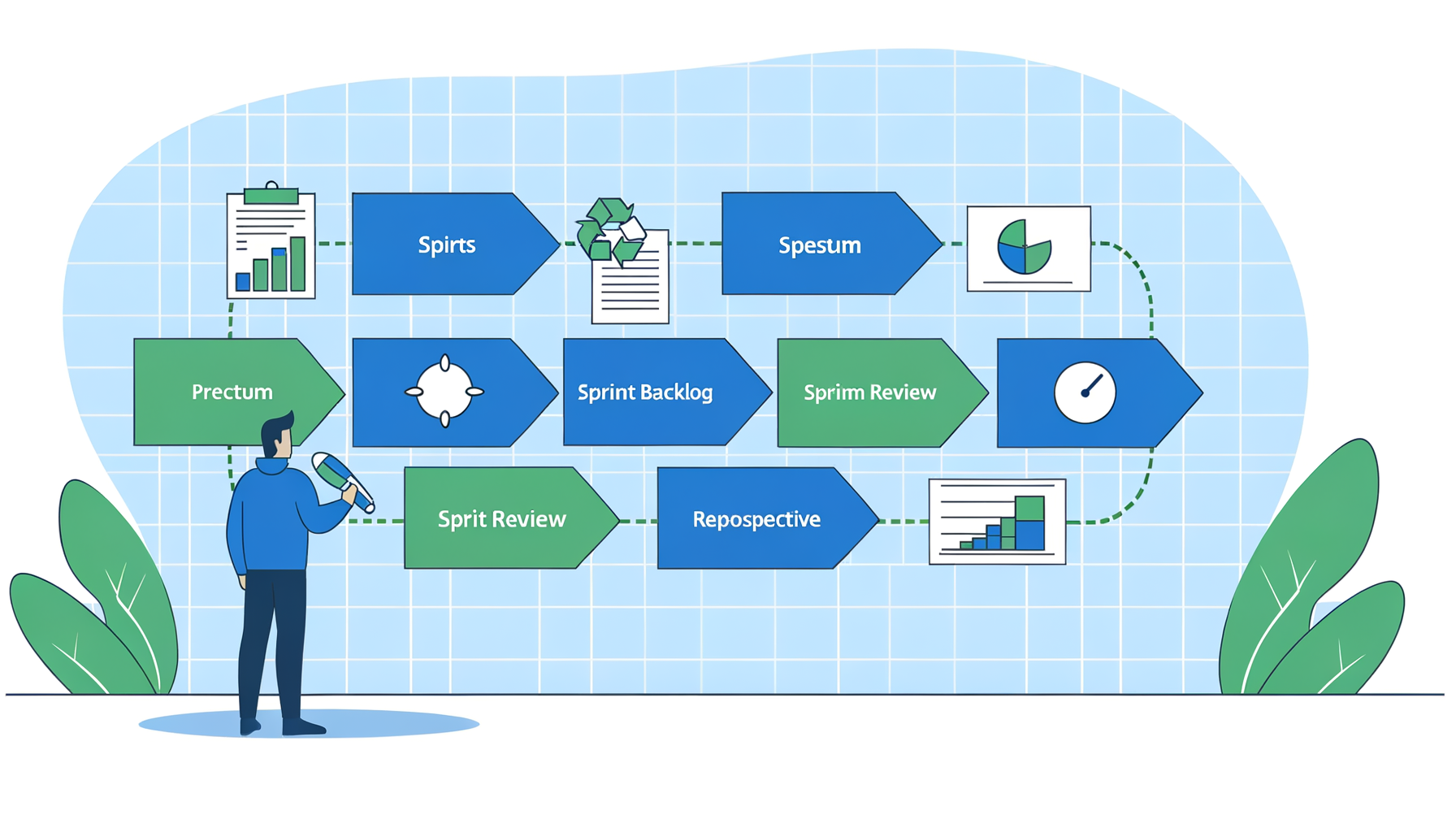
The Manufacturing Sprint Cycle
- 01Backlog DefinitionPrioritise operational targets like part volumes, waste reduction, and standardised work.
- 02Sprint ExecutionA locked two- to four-week timebox dedicated to specific line improvements or training.
- 03Review and FeedbackStakeholders physically inspect the line changes and validate the delivered increment.
- 04Retrospective AdaptationIdentify process failures from the previous weeks and adjust the upcoming backlog.
The mechanics demand daily accountability. The Daily Scrum is a 15-minute stand-up held at the line, not in a conference room. Every team member answers three questions: what they completed yesterday, what they will execute today, and what blocker is preventing progress. This ritual eliminates the information silos that typically delay manufacturing problem-solving by days or weeks.
First Sprint: Confronting Reality on the Line
Before the first sprint began, the team was nervous. Two weeks felt insufficient to accomplish anything meaningful on a production line. This is a standard objection from teams accustomed to massive, slow-moving project plans. Scrum forces small iterations to deliver verified value rapidly and expose blockers immediately.

The first sprint delivered hard results. Work instructions on Line 1 were completed to 100 percent. Line 2 implemented 5S to a 95 percent completion rate. A Kaizen pilot launched on Line 3, and the first 20 operators finished their training. The short timebox forced absolute focus. However, the sprint also exposed systemic issues. Communication between the separate lines was intermittent, and the initial backlog was overloaded with low-priority tasks.
The end-of-sprint retrospective is where the actual management work happens. We assessed what failed. Some operators remained sceptical of the new system, and the overloaded backlog diluted our engineering focus. To correct this, we reduced the next sprint backlog, established direct communication channels between line leads, and mandated pre-sprint training to ensure operator buy-in.
Iterating Through Waste Reduction and Productivity
Sprint two targeted a specific operational metric: a 15 percent waste reduction on Line 2. The focused effort yielded a 17 percent reduction. Because we had applied the communication fixes from the previous retrospective, Daily Scrums became 20 percent more efficient, and the newly engaged operators submitted 35 Kaizen ideas.
Success breeds new operational problems. The team generated too many Kaizen ideas to evaluate properly. Daily Scrums occasionally exceeded the 15-minute limit, and poorly defined backlog items caused confusion on the floor. The retrospective corrected these deviations. We implemented a physical Kaizen board to visually prioritise ideas, enforced a strict 15-minute timebox on stand-ups, and introduced clearer user stories for backlog tasks.
Static Planning vs Iterative Delivery
Phase-Gate Planning
- Predicts a stable environment two years in advance.
- Delays problem detection until milestone reviews.
- Isolates teams by function and communication frequency.
- Measures success by adherence to the original schedule.
Sprint Execution
- Adapts to physical constraints in two-week intervals.
- Exposes blockers during the daily 15-minute stand-up.
- Forces cross-functional alignment at the point of execution.
- Measures success by verified increments and waste reduction.
By the third sprint, the system was maturing. We aimed for a 25 percent productivity increase on Line 1 and achieved 28 percent. The Kaizen board allowed us to systematically implement 20 of the 35 previously generated ideas. We timeboxed our meetings and kept the team motivated through visible, incremental wins.
However, late stakeholder feedback began threatening our momentum, and some user stories were still too large to process within a single sprint. The retrospectives drove us to schedule stakeholder meetings before the sprint began, break user stories into smaller operational tasks, and cap Sprint Reviews at 30 minutes.
Scaling from Mechanisms to Culture
By the fourth sprint, we scaled the methodology across all five production lines. Kaizen was fully implemented. Average productivity across the plant increased by 22 percent. Process waste dropped by 18 percent, and Net Promoter Score shifted from negative five to positive thirteen.
Scrum is not a project management tool; it is an operational mechanism that forces a culture of daily accountability.
The framework's power relies on three foundational pillars: transparency, inspection, and adaptation. Everyone knows the sprint goals, the current blockers, and the actual output. Every two to four weeks, the team inspects the physical results against the target. If the process failed to deliver, the team adapts the mechanics. It replaces rigid bureaucracy with visible accountability.
I have applied this exact iterative logic across highly regulated and heavy industries. In traditional steel manufacturing at ArcelorMittal, we used eight sprints to reduce machine setup times by 75 percent, cutting a four-hour changeover down to one hour and generating substantial annual savings. In aerospace at a major aerospace manufacturer, a longer sprint cycle reduced development time by 45 percent and engineering defects by 60 percent. The environment changes; the mechanism does not.
The Calculated Outcomes of Iterative Delivery
After six sprints at WITTE Automotive, the data eliminated all arguments regarding the validity of agile methodology in a physical production environment. The plant had undergone a structural shift in how it processed work, managed engineering changes, and responded to customer demands.
| Metric | Baseline Issue | Post-Implementation Result |
|---|---|---|
| Average Productivity | Stagnant output, missed milestones | +22% across all lines |
| Process Waste | High material and time losses | -18% average reduction |
| Internal Lead Time | Extended order-to-delivery cycle | -35% cycle reduction |
| Customer Satisfaction | Net Promoter Score (NPS) at -5 | NPS shifted to +13 |
| Operator Morale | Passive engagement, high fluctuation | +40% engagement, -30% fluctuation |
The most critical outcome was not the waste reduction or the productivity gain. The operational culture changed. Operators stopped waiting for top-down engineering fixes and began actively participating in problem-solving. The retrospectives taught them that identifying a blocker was rewarded, not penalised. They brought actionable ideas to every Daily Scrum because the short sprint cycle proved that their input would be tested and implemented within weeks, not years.
Prerequisites for Implementation
To implement Scrum on a production floor, you must first abandon the assumption that you can accurately predict a complex manufacturing launch. You must build a prioritised Product Backlog based on operational targets, then aggressively restrict the Sprint Backlog to what a team can physically deliver in a two-week window. If the backlog is overloaded, the team will fail, and the methodology will be blamed.
Discipline at the Daily Scrum is non-negotiable. It must start on time, it must be held at the point of execution, and it must be capped at 15 minutes. If a problem requires deeper analysis, it is taken offline. Sprint Reviews must physically demonstrate the increment, whether that is a new trolley layout, a revised torque sequence, or a updated PFMEA.
Finally, the Sprint Retrospective is the engine of the entire framework. If your team is not honestly identifying what failed and immediately adjusting the process for the next sprint, you are simply executing a phase-gate project in shorter increments. Quality and delivery are not functions of luck; they are the result of systematic, measurable, and adaptable engineering.