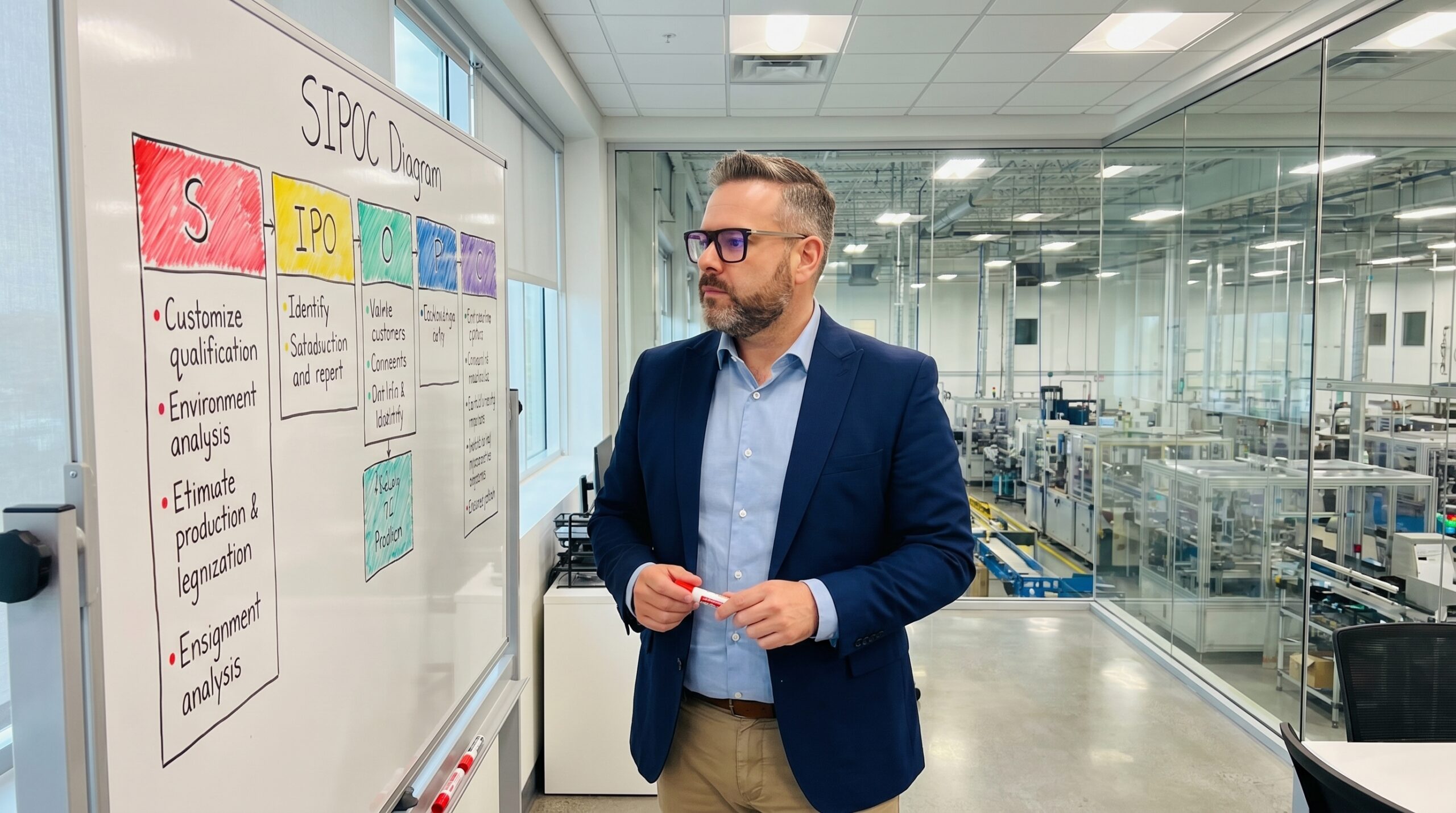
You are standing at a whiteboard with engineers, operators, and a supply chain manager, facing a customer complaint that has recurred for three straight months. Everyone has a different theory. The supplier blames your process. Production blames the incoming material. Quality points to an incomplete specification. You need a mechanism to consolidate these perspectives into a single, verifiable picture.
You do not need a fifty-slide presentation or a Value Stream Map that takes three weeks to build. You need a rapid, structured view of the entire process—from the supplier's dock to the customer's line—that every function in the room can understand and challenge within minutes.
This is the exact scenario where you deploy a SIPOC. It forces a diverse team to agree on process boundaries before you attempt to measure, improve, or troubleshoot anything. Without this foundational agreement, any subsequent root cause analysis is built on contested ground.
What a SIPOC Actually Does to a Team
SIPOC stands for Suppliers, Inputs, Process, Outputs, and Customers. Originating from the Define phase of the Six Sigma DMAIC cycle, it maps a process across five dimensions. The tool's apparent simplicity is deceptive. Its real function is to force consensus on where a process begins and ends.
When you build a SIPOC, you force the team to differentiate between what is an actual input and what is merely an environmental assumption. You separate the true customer—the entity that receives and relies on the output—from passive observers. This distinction is critical for IATF 16949 and AS9100 audits, where unclear ownership of interfaces is a major nonconformance waiting to happen.
If you skip this alignment, your team cannot solve problems effectively. They will be measuring and optimising entirely different processes while speaking over each other. SIPOC establishes the shared vocabulary required for collaborative problem-solving.

Building the Map: Start in the Middle
Always start with the Process column. Write down the name of the process and map six to eight macro-steps. You do not need a detailed flowchart here; you need the skeletal structure of the operation. If you map twenty steps, you are doing a detailed process analysis, not a SIPOC.
Next, define the Outputs. List everything the process produces. This includes the physical product, but it must also encompass the documentation, manufacturing data, and by-products like scrap or regrind. Teams routinely discover unmanaged outputs during this step that directly cause downstream quality issues.
Finally, map the Inputs and trace them back to the Suppliers. Distinguish between tangible inputs like raw materials and intangible ones like operator competency or parameter sheets. This is where teams find the broken links—such as a critical material being supplied without any agreed-upon technical specification.
The SIPOC Generation Sequence
- 011. ProcessMap 6-8 macro-steps to establish the operational skeleton.
- 022. OutputsList every result, including data, documents, and by-products.
- 033. CustomersIdentify every internal and external recipient of those outputs.
- 044. InputsDefine the materials, tools, specs, and competencies required.
- 055. SuppliersTrace every input to its source to assign accountability.
Breaking Down Silo Mentalities
One of SIPOC's greatest strengths is its ability to dismantle departmental silos. When cross-functional teams map a process together, underlying assumptions are exposed. Quality engineers see the daily constraints of production. Production learns why engineering needs rigid specifications. Purchasing realises that sourcing the cheapest material directly destabilises the manufacturing input.
I have audited plants where three departments had three completely different definitions of 'material specification.' Purchasing looked at the price per kilogram. Production evaluated processing behaviour. Quality relied on the certificate of conformance. Without a shared map, these conflicting definitions guarantee nonconformances.
In one automotive project, a two-hour SIPOC workshop resolved this exact disconnect. The team established a unified specification and secured the supplier's signature on the updated requirements. Within three months, incoming inspection nonconformances dropped significantly. The resolution was not technical; it was structural alignment.
Siloed vs. Mapped Process Understanding
Siloed Approach
- Departments argue over who owns the defect.
- Specifications are interpreted differently by each function.
- Cheapest suppliers are chosen without process input.
- Root cause analysis stalls at departmental borders.
SIPOC-Aligned Approach
- The team visualises the end-to-end value stream.
- A single, unified specification governs the material.
- Suppliers are vetted based on input criticality.
- Improvement actions target specific input-output linkages.
Resolving Recurring Field Failures
Consider a scenario common in automotive manufacturing: a recurring dimensional deviation on a moulded component. The natural reaction is to attack the machine settings. The team spends months adjusting parameters, tweaking cycle times, and adding inspection points to no avail. The defect persists because the root cause lies outside the machine.
The problem was not in our machine; it was in an input we had never linked to the output.
When you finally build the SIPOC, the dynamic shifts. By mapping the inputs, you identify an uncontrolled variable. Perhaps the resin supplier is altering the batch consistency of the glass-filled material without notification. This variation in glass fibre content changes the shrinkage rate during moulding, directly causing the dimensional failure.
Implementing tight incoming inspection controls on that specific material trait eliminates the dimensional deviation. One workshop, one diagram, and five columns resolved an issue that months of machine tuning could not fix. That is the operational power of defining process boundaries.
Alignment with ISO 9001 and Industry 4.0
SIPOC is not just a quality tool; it is a direct mechanism for meeting ISO 9001 requirements. Clause 4.1 and 4.2 demand a clear understanding of the organisational context and interested parties. A SIPOC demonstrates this understanding to an auditor on a single page, replacing paragraphs of text with a clear visual interface.
Furthermore, Clause 8.1 requires the definition of process criteria and resource assurance. Mapping inputs inherently secures the necessary resources, while mapping outputs establishes the criteria for successful delivery. It translates abstract management system requirements into actionable process steps.
This tool remains entirely relevant in the era of Industry 4.0. IoT sensors, ERPs, and predictive analytics generate massive amounts of data, but data without context is just noise. A SIPOC provides that context. It links the live MES data to the specific customer requirement it impacts. Even a fully digitalised Quality Management System relies on these fundamental supplier-to-customer linkages to function.
Facilitating the Workshop and Avoiding Traps
A successful SIPOC takes roughly two hours. Invite five to eight key stakeholders. Start with the process steps, then move to outputs and customers, and finally map the inputs and suppliers. Conclude by validating the map against operational reality and marking any unspecified inputs in red as immediate improvement opportunities.
The most frequent failure mode is scope creep. Teams often try to turn the SIPOC into a detailed flowchart. If you have more than eight process steps, you are operating at the wrong altitude. You must restrict the view to the macro level to maintain the necessary systemic perspective.
Never ignore human inputs. Competency, training, and even environmental conditions like humidity control are critical inputs. If you exclude them, your process map has blind spots. The map must reflect the true operational reality, not just the mechanical steps documented in the procedure.
Finally, never build a SIPOC alone in your office. A single-person SIPOC is just one opinion. The strength of the tool lies in the collective intelligence of the cross-functional team. The friction generated during the workshop is exactly what exposes the hidden variations and assumptions that cause quality escapes.