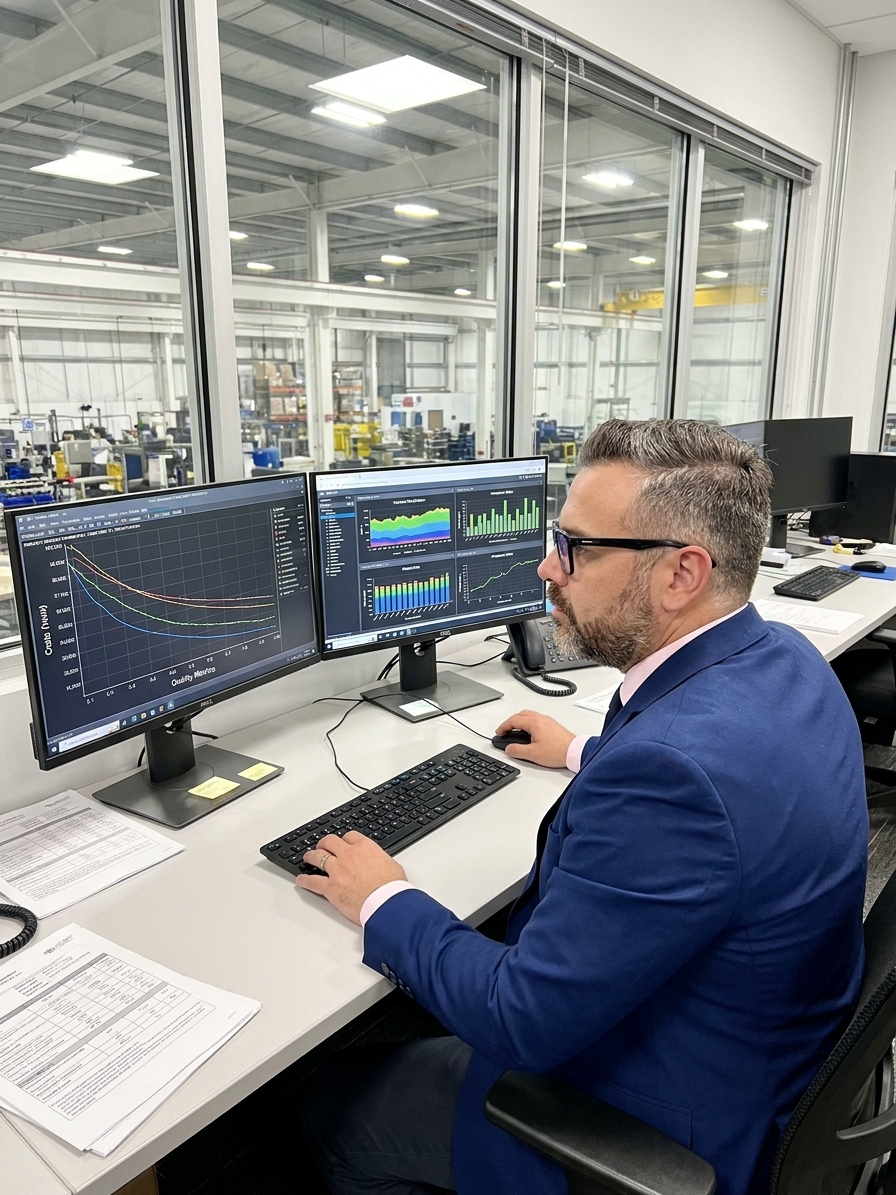
An enterprise quality management software platform fails to deploy correctly. Eighteen months in, customisation costs have tripled, operators have built elaborate workarounds to bypass it entirely, and defect rates have actually increased because attention shifted from prevention to debugging. The quality team maintains parallel processes in the new platform and old spreadsheets just to keep the line running. When a newly hired engineer asks whether they should cut their losses and revert to targeted improvements, the VP's response is immediate: they have already invested heavily, and they will not throw that away.
The VP did not argue the system was working. He did not present data supporting continued investment. He cited prior expenditure as justification for future spending. That is the sunk cost fallacy in its purest form, and in manufacturing and quality management, it is one of the most expensive cognitive biases an organisation will encounter.
The sunk cost fallacy is the tendency to continue investing resources into a failing decision simply because you have already invested in it, regardless of whether future returns justify the additional cost. The past investment cannot be recovered. Rational decision-making demands that you evaluate only future costs and future benefits. But loss aversion, documented by Daniel Kahneman and Amos Tversky, means that abandoning a multi-million-dollar investment feels roughly twice as painful as the pleasure of gaining equivalent value. So organisations double down. They escalate commitment because stopping requires admitting the original decision was wrong.
In quality engineering, this bias is not a psychological curiosity. It is a structural force that distorts technology investments, constrains process improvement, perpetuates failing inspection systems, and locks organisations into obsolete quality paradigms long after the evidence has turned against them. I have audited plants where the most dangerous quality failure was not a nonconformance on the floor — it was the management committee refusing to abandon a system everyone knew was broken.
The anatomy of sunk cost escalation
Sunk cost escalation in quality organisations follows a predictable, five-phase pattern. It begins with an optimistic investment: a new eQMS, inspection technology, or methodology is approved based on incomplete information and strong optimism bias. The business case looks compelling, champions emerge, and implementation starts with genuine enthusiasm. Nobody defines what failure would look like.
Reality intervenes in phase two. Implementation takes longer than expected, customisation requirements multiply, and integration with existing IATF 16949 or AS9100 processes falters. Early results miss projections. But these warning signs are interpreted as temporary setbacks — problems to be solved with more investment, more training, more customisation. The organisation has not failed yet. It is merely experiencing growing pains.
By phase three, rationalisation sets in. Poor results are reframed as learning opportunities. Cost overruns become necessary investments in getting it right. User complaints are dismissed as resistance to change rather than legitimate feedback about system design. Quality reports start emphasising positive indicators while burying negative ones. The narrative shifts from questioning whether the system works to asking how to force it to work.
Phase four is where careers distort judgement. The accumulated investment becomes so large that abandoning it would require public acknowledgment of failure. Reputations are at stake. The decision is no longer about whether the system delivers quality value — it is about whether the champions can afford to admit it does not. The organisation invests more, not because data supports it, but because the alternative is too painful. By phase five, the entrenchment is complete: workarounds become standardised, parallel processes become permanent, and the sunk cost becomes an immovable organisational fixture.
The five-phase escalation cycle
- 01Optimistic investmentIncomplete data and strong business case drive approval. No failure conditions are defined.
- 02Emerging gapIntegration delays and cost overruns are reframed as normal implementation challenges.
- 03RationalisationPoor results become learning opportunities. Negative indicators are downplayed in reporting.
- 04Escalation of commitmentCareers and reputations are tied to the investment. Data no longer drives the decision.
- 05EntrenchmentWorkarounds become standard procedure. Parallel processes are permanent. Nobody has authority to stop.
Where sunk costs hide in quality organisations
The fallacy operates far beyond software implementations. It locks organisations into inspection equipment that should have been retired years ago. I have seen a manufacturer keep a coordinate measuring machine running for three years past its useful life because the original investment was substantial. Calibration requirements had become so complex that the machine was offline more than it was operational. Newer CMMs offered superior accuracy with simpler maintenance, but replacing the existing unit meant admitting the original investment had underperformed.
The organisation spent heavily on calibration, repairs, and downtime before maintenance costs finally exceeded replacement cost. The total waste exceeded the original purchase price, all driven by the inability to walk away from a prior investment. The accounting showed the machine was an asset. The production floor knew it was a liability.
The same pattern traps methodology investments. A medical device manufacturer implemented Six Sigma across all production lines and saw strong initial results. But as the product mix shifted toward high-mix, low-volume production, statistical process control lost leverage. Further projects produced diminishing returns. The data was clear, but the organisation had invested so heavily in infrastructure — certified black belts, project tracking systems, executive dashboards — that scaling back felt like regression. They kept launching projects that consumed resources without delivering proportional value.
Supplier relationships fall into the same trap. A tier-one automotive supplier sourced a critical subassembly from the same vendor for twelve years. Over time, the vendor's defect rate drifted upward. Each quarter brought a new corrective action plan under IATF 16949, and each quarter the defect rate improved slightly before drifting back. The cost of incoming inspection, sorting, and rework far exceeded what qualifying a new vendor would cost. But the relationship itself had become a sunk cost. Starting over felt like abandoning a decade of investment, so they kept correcting, inspecting, and reworking.
Why intelligent organisations stay trapped
The sunk cost fallacy is not a failure of intelligence. It is a failure of decision architecture. Loss aversion makes the pain of abandoning an investment feel roughly twice as intense as the pleasure of an equivalent gain. This asymmetry is wired into human cognition and does not disappear when individuals move into organisational roles. The CFO who would never accept a negative-NPV project somehow approves continued spending on a failing system because the prior investment feels different from future cost.
Self-justification creates a structural conflict of interest. The people who championed the original investment are often the same people who must decide whether to continue. Admitting failure threatens their credibility and authority. Independent review becomes impossible because the reviewers are the champions.
Social proof reinforces commitment. When an organisation has invested heavily and publicly in a system or methodology, abandoning it signals to the market, to competitors, and to employees that the organisation made a mistake. Most organisations would rather lose money quietly than admit error publicly. Combined with organisational inertia — where continuation is the default and stopping requires an active decision, a confrontation, and a sign-off — the trap closes.
Ambiguity of failure provides the final layer of cover. Quality investments rarely fail catastrophically. They underperform incrementally. The system works, sort of. The methodology helps, somewhat. This ambiguity makes it easy to rationalise continued investment because the situation is never so clearly bad that the decision to quit becomes obvious. The system does not explode. It just bleeds.
Quality investments rarely fail catastrophically. They underperform incrementally, and the ambiguity makes it easy to rationalise continued spending.
The mathematical case for walking away
The mathematics of sunk costs are unambiguous. Consider a quality management system that cost several million to implement and requires substantial annual maintenance, customisation, and operational overhead. A replacement system would cost roughly half as much to implement and significantly less to maintain annually. The existing system delivers modest quality value in reduced defects and improved throughput. The replacement would deliver more than double that value.
The rational analysis evaluates only future cash flows. The original implementation cost does not appear anywhere in the calculation because it cannot be recovered. It is irrelevant to the decision. The only question is whether the future value justifies the future cost. On those grounds, the replacement wins decisively.
Yet organisations routinely choose to keep the existing system, citing the prior investment as the reason. They are making a quantifiable error every year because acknowledging the loss of the original investment feels worse than quietly absorbing ongoing losses indefinitely. Over five years, that compounds into a figure far larger than the write-off they were trying to avoid.
The replacement decision: future flows only
Decision architecture that breaks the cycle
Organisations that resist the sunk cost fallacy share specific structural practices. The first is kill criteria established before investment. Before approving any quality system, technology, or vendor relationship, they define measurable conditions that would trigger discontinuation. The criteria are written in advance, before anyone is emotionally invested in the outcome. If the system has not improved Cpk by a defined margin within six months, the organisation reverts. No debate, no escalation, no rationalisation.
The second practice is separating decision-makers from champions. The people who championed an investment cannot be the sole judges of whether to continue. Independent review panels evaluate quality investments without the psychological burden of having to admit their own mistakes. This is not punishment. It is recognition that loss aversion makes self-assessment structurally unreliable.
The third practice is zero-based quality reviews. Once per year, evaluate every quality system, process, and investment as if making the decision for the first time. Ask: if we did not already have this system, would we choose to invest in it today, given what we now know? If the answer is no, the historical investment is irrelevant. This approach flushes out entrenched underperformance that has become invisible through familiarity.
The fourth practice is making the cost of continuation visible. Sunk cost thinking thrives when ongoing costs are hidden in operational budgets and spread across departments. Track the total annual cost of underperforming quality investments. Compare it to the one-time cost of replacement. Present these numbers in plain language: the organisation is spending a specific amount per year to maintain a system that a replacement would cost a fraction of to implement. Every year of delay has a quantifiable price.
Default continuation vs. structured kill criteria
What organisations typically do
- Approve investment with success metrics but no failure thresholds
- Interpret every setback as a temporary implementation challenge
- Allow champions to judge their own project's continuation
- Spread ongoing costs across departments where they become invisible
What breaks the cycle
- Define measurable kill criteria before the investment is approved
- Require independent review panels for continuation decisions
- Conduct annual zero-based reviews of every quality system and process
- Track and present the total cost of continuation against replacement cost
Identity entrapment and the courage to start over
The most insidious form of sunk cost entrapment is not financial. It is identity-based. When an organisation has invested years in a particular quality philosophy — whether Six Sigma, Total Quality Management, Lean, or another framework — the methodology becomes part of the organisational identity. Engineers introduce themselves by their belt colour. Job postings list certifications as requirements. Audit protocols are built around the methodology's language and structure. The quality system and the organisation's sense of itself become inseparable.
Walking away then requires more than a financial decision. It demands an identity shift. It means redefining what quality means in the organisation, recertifying people, rewriting procedures, and re-educating auditors. It means admitting that the framework that defined your quality identity for a decade may no longer be the right framework for your current production reality.
Organisations that manage this transition well treat quality methodology as a tool, not an identity. They adopt frameworks pragmatically — using what works, discarding what does not, and switching tools when the job changes. They invest in quality thinking, not quality brands. They train people in principles, not rituals.
Every quality organisation has at least one sunk cost trap: a system that should be replaced, a vendor that should be changed, a methodology that should be retired, a CMM that should be scrapped. The past investment is gone. It cannot be recovered. The only question that matters is whether the future value justifies the future cost. If the answer points away from what you have already built, walking away is not failure. It is the most rational decision your quality organisation will make.