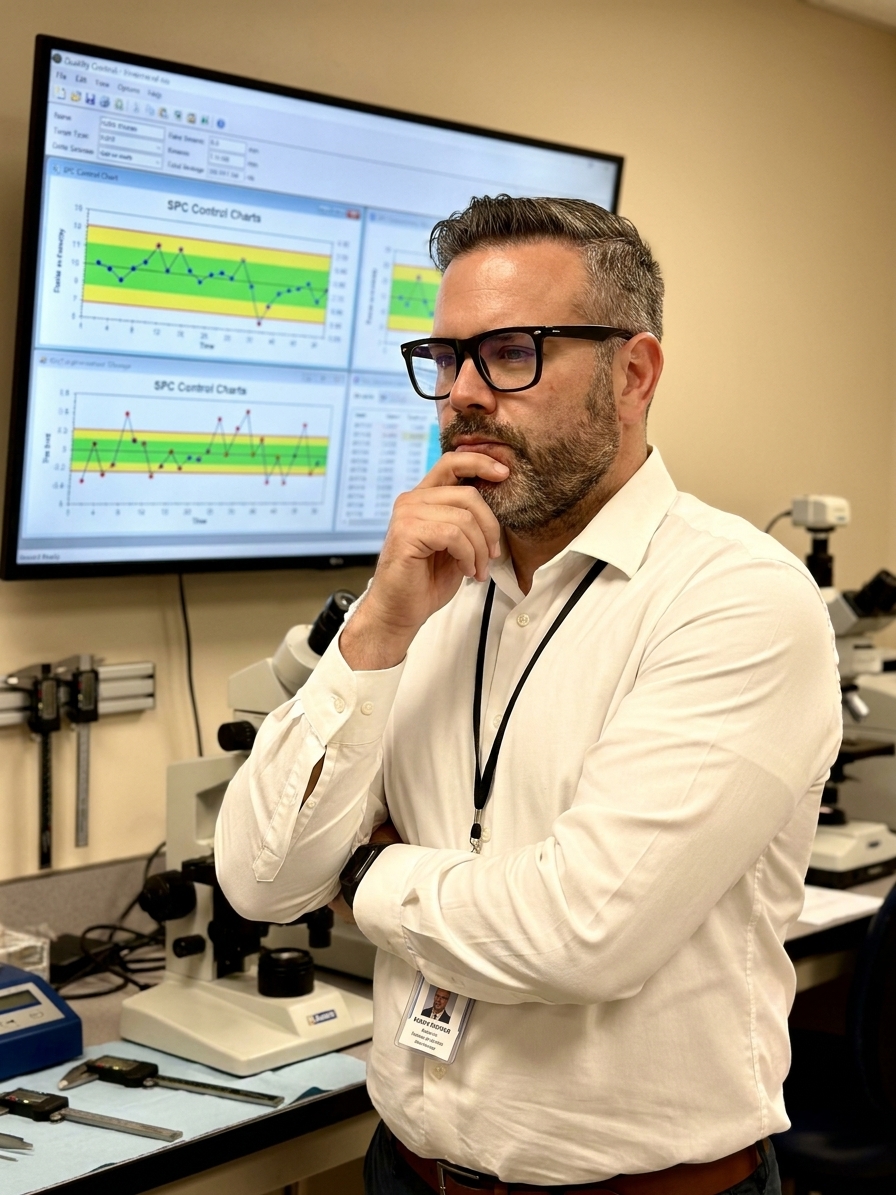
An inspector reviews forty-seven parts in a morning shift. Each check takes roughly six seconds: read the dimension, verify against the specification, stamp the traveller, repeat. By part thirty-eight, the rhythm is fully automatic. Part thirty-nine is out of tolerance by 0.03mm. The inspector stamps it approved. This is not a failure of competence or motivation. It is a failure of cognitive architecture.
Daniel Kahneman's framework of dual-process thinking maps directly onto the factory floor. System 1 is fast, intuitive, and handles pattern matching. System 2 is slow, analytical, and handles deliberate calculation. System 1 conserves mental energy. It takes over whenever the brain recognizes a routine pattern, releasing analytical resources for genuine emergencies. The brain evolved to optimize for efficiency.
Quality inspection creates a unique cognitive trap. The inspector sees hundreds of conforming parts. System 1 learns that the default answer is pass. It builds a model: the part looks like the previous part, therefore approve. A borderline defect looks visually identical to a conforming part. There is no alarm bell to trigger System 2 engagement. So System 1 handles it.
How System 1 Penetrates the Entire Quality Function
If this cognitive trap only affected bench inspectors, the solution would be simple. But System 1 thinking permeates every level of a quality organization. In 8D root cause analysis, teams frequently arrive at operator error within minutes. System 1 recognizes the pattern: a human made a mistake, the defect occurred, the human caused the defect. System 2 would ask why the PFMEA failed to prevent the error, or what systemic conditions made the failure inevitable.
During supplier selection audits under IATF 16949, procurement teams evaluate a new facility and decide within ten minutes that it is a quality operation. System 1 reads visual proxies: clean floors under 5S, organized toolboards, confident management. These are indicators of discipline, not evidence of process capability. System 2 would demand PPAP documentation, Cpk data, and corrective action history. Instead, System 1 makes the call, and System 2 is used to justify it.
In corrective action validation, a CAPA is closed because the defect rate dropped after implementation. System 1 sees a temporal correlation and infers causation. System 2 would ask whether normal statistical variation caused the drop, or whether the sample size is sufficient to prove effectiveness. The CAPA closes, the auditor signs off, and the genuine root cause remains active.
System 1 versus System 2 in Quality Decisions
System 1 (Fast, Automatic)
- Closes root cause as operator error based on immediate visual evidence
- Approves suppliers based on 5S discipline and facility cleanliness
- Reads a green dashboard and assumes processes are in control
- Approves part thirty-nine because it looks identical to part thirty-eight
System 2 (Slow, Analytical)
- Forces Ishikawa analysis to map systemic failure modes in the PFMEA
- Demands Cpk data, PPAP levels, and historical 8D records before approval
- Questions whether the green threshold is set correctly or missing a metric
- Breaks rhythm with challenge parts to force deliberate measurement
The Perverse Mathematics of Inspection Experience
The better an inspector is at their job, the more vulnerable they become to System 1 failures. An experienced operator has processed thousands of conforming parts. Their brain has been trained to recognize conformity as the default state. The stronger this pattern becomes, the more energy the brain saves by delegating to System 1. A borderline case struggles to trigger System 2 engagement because it does not present a strong enough anomaly.
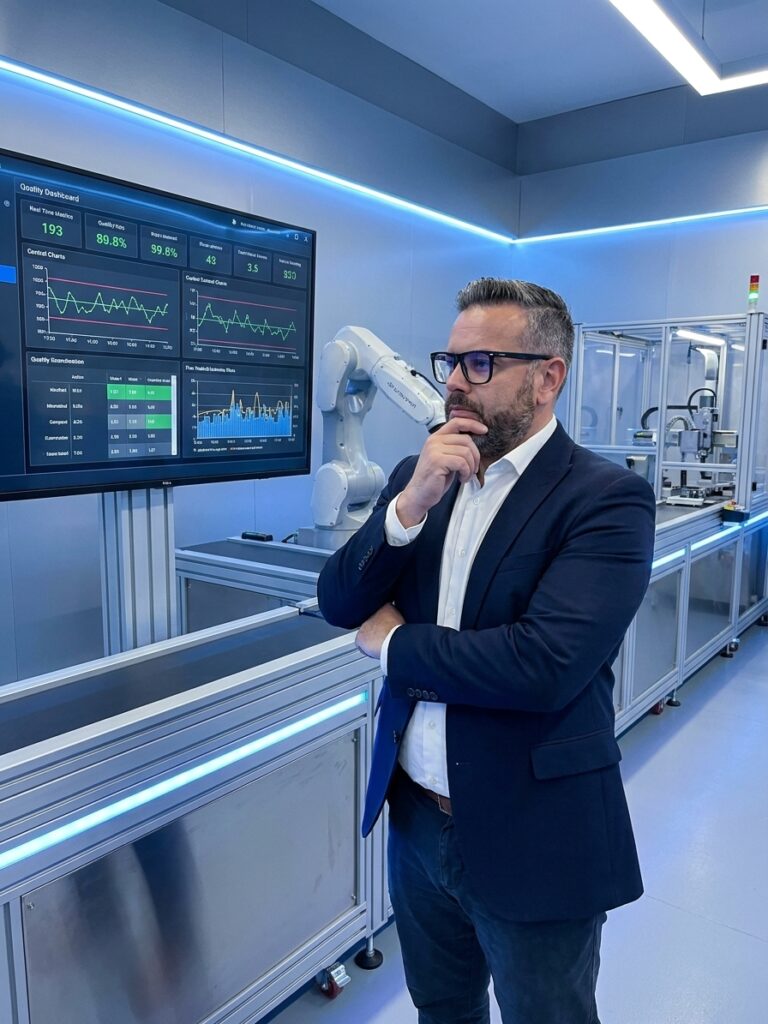
A junior inspector has not yet built these automatic patterns. Every part requires deliberate, conscious attention. The inspection is slower, more methodical, and statistically more likely to catch borderline defects. I have audited automotive plants where a ten-year veteran missed a crack in a brake caliper housing that a six-month trainee caught on her first day. The veteran processed each part in roughly four seconds. The trainee took twelve.
Management had been planning to release the trainee for failing to meet takt time. The veteran was failing precisely because his competence had become fully automatic. The trainee was succeeding because she lacked the experience to let System 1 take control. Efficiency is valuable, but unchecked automatic processing is a direct threat to quality output.
Designing System 2 Interventions for the Factory Floor
Effective organizations do not attempt to eliminate System 1 thinking. They know human cognition does not work that way. Instead, they design structural interventions that leverage System 1 for speed where it is reliable, and force System 2 engagement where the risk of automatic failure is highest.
Interrupting Automatic Processing in Inspection
- 01Pattern InterruptionRotate inspectors between stations or alter inspection sequences to break the rhythm of automatic processing.
- 02Defect SeedingIntroduce known nonconforming parts into the stream and track the detection rate to verify System 2 engagement.
- 03Measurement SeparationAutomate data collection. Present operators with a clear pass or fail indicator to prevent System 1 rounding borderline measurements.
- 04Forced ReflectionEmbed mandatory analytical checkpoints in 8D reports before closing CAPAs or approving process changes.
Separate measurement from judgment. Do not ask inspectors to measure and decide simultaneously. Measurement is a System 2 activity requiring focused attention. Judgment is where System 1 sneaks in, especially when the reading is close to the tolerance limit. Wherever possible, automate the data collection and present the result as a binary indicator. This removes the temptation for System 1 to round a borderline measurement in the direction of approval.
Respect cognitive depletion. System 2 runs on a finite pool of mental energy. Every complex decision, audit finding, and forced analytical moment drains this pool. By the end of an eight-hour shift, System 2 is exhausted, and System 1 is making the majority of the decisions. Schedule critical first-off inspections for the beginning of shifts. Do not schedule root cause analysis or supplier audits for late Friday afternoon.
The Dashboard Trap and Statistical Blindness
Quality dashboards were designed to make data accessible, but they have become System 1 playgrounds. A manager glances at a screen showing green indicators across all OEE and scrap metrics. System 1 registers everything is fine in roughly two hundred milliseconds. The manager moves to the next email.
System 1 did not ask whether the green indicators are measuring the right parameters, whether the Cpk thresholds are set correctly, or whether the absence of a critical metric is the actual concern. System 2 would ask these questions. But System 2 is not triggered by compliance. It is triggered by anomalies.
A dashboard that shows everything as expected is practically designed to keep System 2 asleep.
Organizations that use dashboards effectively embed analytical prompts directly into the interface. They force the question: This process has remained stable for ninety days. Is this statistical control or stagnation? These prompts are deliberate interruptions. They prevent the comfortable glide of automatic processing and force analytical engagement.
The Cost of Unchecked Intuition in Problem Solving
I worked with an aerospace supplier that had a persistent problem with dimensional nonconformances on a turbine blade root. The defect rate spiked, the team investigated, they identified a tooling wear issue, implemented a correction, and the rate dropped. Eighteen months later, the cycle was still repeating. Three different root causes had been identified and corrected. None of them were real.
When we applied systematic System 2 thinking, we ran controlled experiments and analyzed process variables. The actual root cause was a thermal variation in the heat treatment furnace that correlated with ambient temperature changes on the shop floor. System 1 had seen the production schedule, matched it to the defect spikes, and generated a compelling narrative. The team solved the narrative instead of the engineering problem.
The actual engineering fix took four days to implement and validate. The eighteen months of chasing System 1 phantoms cost the company significant capital in scrap, rework, and expedited shipping. Expertise is valuable, but unstructured intuition is a liability in complex manufacturing environments. The best quality professionals respect their instincts enough to know when they must override them with data.
Engineering the Cognitive Environment
Acknowledging System 1 means accepting that experience can create blind spots. The solution is not to fire experienced inspectors or distrust senior engineers. The solution is to build a quality management system that assumes human cognition has structural limitations. You must design procedures that work alongside those limitations rather than relying on willpower to overcome them.
Building this meta-awareness across a plant requires a cultural shift. It means valuing the operator who stops the line to double-check a measurement over the operator who maintains maximum output. It means rewarding the engineering team that takes three days to map a full Ishikawa diagram over the team that closes an 8D report in three hours.
Your ISO 9001 or AS9100 system is not just a set of specifications. It is a cognitive environment. The question is never whether your people will default to System 1 thinking. They will. The question is whether your quality system is engineered to catch them when they do.