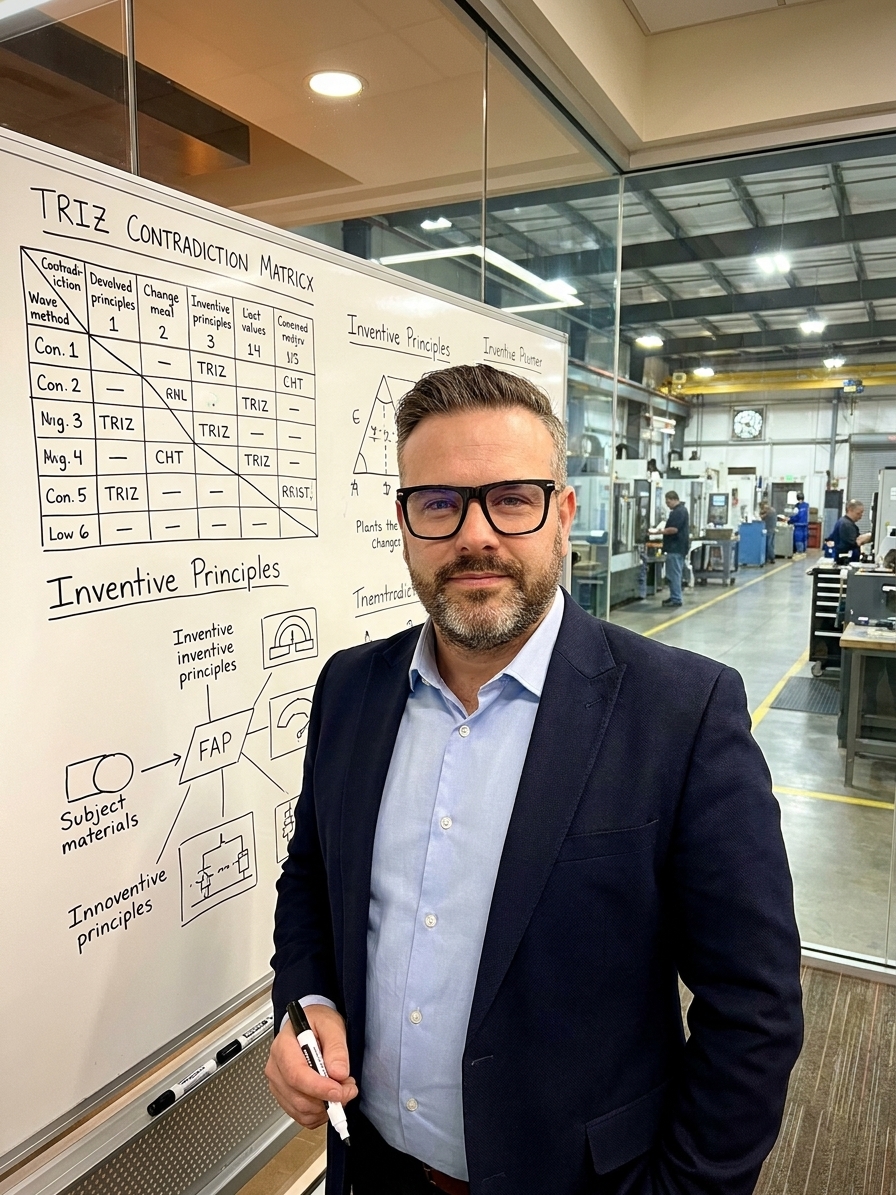
Every quality engineer knows the compromise trap. You need tighter tolerances to eliminate variation, but the cycle time required to achieve them destroys OEE. You need 100% end-of-line inspection to guarantee zero defects, but inspection fatigue introduces its own failure rate. You present these trade-offs to management, and management asks you to find a balance. This is exactly how mediocrity is institutionalised in manufacturing.
Compromises do not produce excellence; they simply distribute loss across different departments. Most quality teams have lived inside this compromise trap for so long that they have forgotten another option exists. It has existed since 1946, when a Soviet patent examiner named Genrich Altshuller began analyzing how real inventors solved problems. He found they did not compromise. They eliminated the contradiction entirely.
Altshuller called his framework TRIZ, a Russian acronym translating to the Theory of Inventive Problem Solving. Over four decades of analyzing patents, he and his team built a systematic methodology for innovation that quality engineering has barely begun to tap. When deployed correctly, TRIZ is an engineering discipline with the same rigour as statistical process control or finite element analysis.
The Core Mechanism: Dissolving Technical Contradictions
TRIZ is not brainstorming, design thinking, or whichever creative framework a consultant recently pitched. It is fundamentally different because it starts from a disruptive premise: your specific problem has already been solved. You just do not know by whom, or in what industry. Altshuller identified 40 inventive principles that appear repeatedly across hundreds of thousands of patents to solve identical types of contradictions.
The core insight is the technical contradiction. A contradiction exists when improving one parameter automatically worsens another. Stronger but heavier. Faster but less accurate. More sensitive but more fragile. Quality engineers navigate these daily. The question is whether you recognize them as solvable engineering problems or accept them as unavoidable physical limits.
TRIZ demands you frame the issue as a contradiction rather than an optimization task. When faced with a strength-versus-weight conflict, conventional engineering seeks the optimal strength-to-weight ratio. This framing locks you inside the trade-off space. TRIZ forces you to ask how to increase strength without adding weight, pushing you outside the compromise entirely.
Optimization vs. Contradiction Resolution
Optimization (Compromise)
- Aims for acceptable balance between competing parameters
- Operates entirely within the existing trade-off space
- Distributes losses across cost, quality, and speed
- Results in incremental, expected performance gains
TRIZ (Elimination)
- Refuses the trade-off and seeks to bypass the constraint
- Applies known inventive principles from global patents
- Eliminates the root cause of the system conflict
- Produces unconventional, breakthrough-level solutions
Mapping the Quality Engineer's Daily Contradictions
Before applying inventive principles, you must map the contradictions that dominate quality engineering. Recognizing them is the prerequisite to dissolving them. The Tolerance Contradiction is the most pervasive: tighter tolerances reduce variation and improve fit, but they drastically increase machining costs and push Cpk requirements into territory where every minor shift becomes a crisis requiring immediate intervention.
The conventional response to tolerance challenges is statistical tolerance analysis, allocating variation budgets across the assembly. But this remains compromise thinking. You are mathematically allocating losses rather than eliminating them mechanically. The same applies to the Inspection Contradiction, where 100% sorting is too slow and inspector fatigue destroys reliability, yet sampling plans deliberately accept a calculated percentage of defect escapes.
We see the same dynamic in materials selection, where demanding simultaneous strength, lightness, and corrosion resistance usually results in picking two attributes and sacrificing the third. Every materials meeting plays out this way. We also see it in standardization, where rigid processes ensure consistency but destroy the flexibility needed for supply chain disruptions or custom variants.
Even operator training falls into this trap. Complex processes demand highly skilled operators, but training is expensive and trained operators frequently leave for better pay. The compromise is to simplify processes, yet simplified workflows cannot handle edge cases, inevitably creating quality escapes. Every one of these contradictions has been solved in some form. TRIZ provides the mechanism to find those solutions systematically.
Applying the 40 Principles to Quality Systems
Let us make TRIZ concrete using Altshuller's principles in a manufacturing context. Consider Principle 1: Segmentation. Instead of one monolithic end-of-line inspection station, segment quality checks into small, distributed in-line sensors. Each verifies one parameter in real time. You dissolve the inspection contradiction by achieving 100% verification without the bottleneck of 100% end-of-line sorting time.
Principle 2, Taking Out, instructs you to remove the harmful part of a process entirely. If heat treatment introduces thermal distortion that downstream machining must correct, eliminate the heat treatment. Switch to a process that induces compressive residual stress during machining itself. You have entirely bypassed the distortion problem rather than allocating tolerance to absorb it.
Principle 10, Preliminary Action, eliminates spring-back in sheet metal forming. Pre-stress, pre-load, or pre-deform components so service loads bring them into the desired state. This removes the need for tighter tolerances or heavier, costlier presses. Principle 17, Another Dimension, suggests moving a critical dimension to an axis immune to thermal expansion, bypassing the contradiction rather than fighting ambient temperature controls.
Principle 35, Parameter Changes, is highly effective for manufacturing. Change the physical state, concentration, or flexibility of the material. Most manufacturing contradictions are actually material-property contradictions in disguise. You do not need a more expensive, stronger steel. You need a localized heat treatment or surface coating that makes the existing material stronger exactly where contact stress occurs.
The Organisational Failure Mode
Despite its power, TRIZ deployment in quality functions usually follows a predictable, disappointing arc. A consultant runs a workshop. Engineers practice on textbook problems and experience genuine excitement when they realize contradictions can be dissolved. The team picks a chronic, real-world problem for a pilot. The resulting conceptual solution requires cross-functional testing and resources the quality team does not control.
The solution goes on a project list. The list goes in a binder. Six months later, TRIZ is remembered as an interesting academic exercise. The next quality escape gets handled the old way: compromising, loosening a tolerance, writing a deviation. The contradiction persists, and everyone accepts it. This is not a failure of the methodology. It is an organizational failure.
You cannot use a tool for eliminating trade-offs if your vocabulary does not include the concept of a trade-off to be eliminated.
This failure happens because TRIZ is deployed as a tool rather than a thinking habit. The 40 principles are not hammers; they are lenses. If you only put on the lenses during a scheduled session, you miss the contradictions embedded in daily engineering decisions. Furthermore, solutions generated by TRIZ often cross functional boundaries. A fix for a quality plan might require a design change that the engineering department rejects because it deviates from standard practice.
The TRIZ Organisational Decay Cycle
- 01Workshop EngagementConsultant trains staff; engineers are energized by the prospect of resolving chronic issues.
- 02Pilot ParalysisA real problem is tackled, but the conceptual solution requires budget or resources outside Quality's control.
- 03Daily FirefightingThe daily reality of containment actions reasserts itself, pushing proactive invention to the background.
- 04Methodology AbandonmentTRIZ is deemed too academic or industry-specific, and the team reverts to standard trade-offs.
Embedding Contradiction Thinking into APQP and 8D
Making TRIZ work requires building it into existing quality processes, not creating a separate initiative. Quality teams need an embedded champion, an insider who has internalized the methodology deeply enough to use it reflexively. When a tolerance debate starts in an Advanced Product Quality Planning (APQP) design review, this person intervenes to map the actual contradiction before the team accepts a compromise.
Do not create a separate TRIZ process. Instead, inject contradiction analysis into your PFMEA. Every high Risk Priority Number (RPN) failure mode likely involves a contradiction that was implicitly accepted. If a process requires incredibly tight temperature controls to prevent degradation, ask whether the parameter itself can be changed via TRIZ rather than simply adding more control charts and alarms to manage it.
Inject TRIZ into your 8D corrective action process. The root cause of many chronic, recurring manufacturing problems is an unresolved technical contradiction. When you reach D5 (Develop Corrective Actions), explicitly map the contradiction before approving a solution that merely adds inspection steps. A true corrective action changes the system to make the failure mode physically or logically impossible.
Start with contradictions that are already causing severe pain. Pick the problem that has generated three engineering changes, two customer complaints, and a heated email chain. Apply inventive principles to that specific issue. When the engineering team sees a chronic problem reframed and resolved, the methodology proves its value far better than any abstract workshop exercise could.
Prevention Through Invention
The connection most quality organizations miss is that TRIZ is the ultimate preventive action. The quality profession is built on prevention—preventive maintenance, Poka-Yoke, risk management. But dominant prevention strategies rely on control: control the inputs, control the process, control the variation. Control is a defensive strategy. It prevents things from deteriorating further.
TRIZ is prevention through invention. It designs the problem out of the system entirely. It moves quality from detection to prevention, and then from prevention to elimination. When you find yourself accepting a trade-off, you have not finished engineering. You have simply stopped early. The contradiction is not an immutable law of physics; it is a signal that a better solution exists.
Quality engineering has always been about rejecting comfortable lies. The lie that inspection produces quality. The lie that compliance generates capability. TRIZ gives us one more lie to reject: the assumption that trade-offs are permanent. They are not permanent. They just feel permanent until you apply the discipline required to dissolve them.