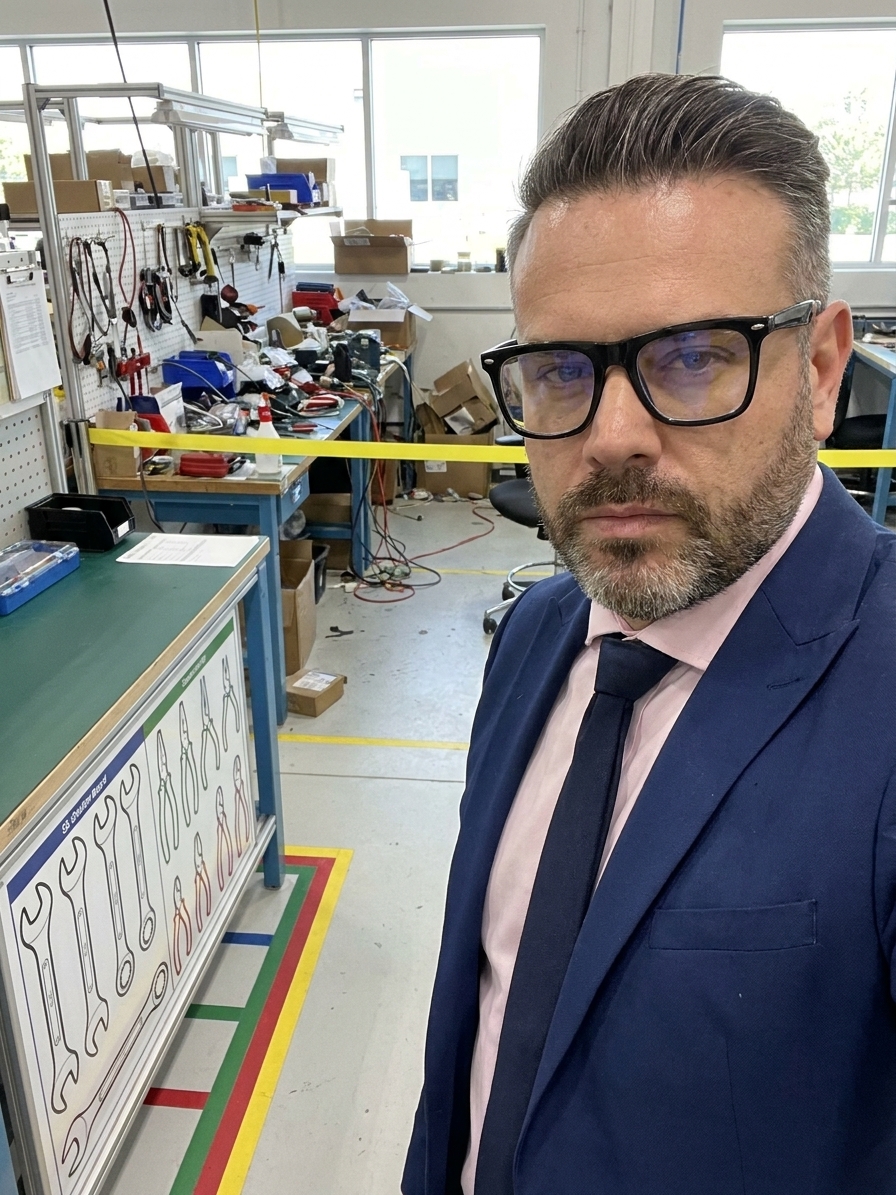
A consultant arrives, delivers an energetic presentation on Japanese manufacturing philosophy, and hands out coloured tape. For two weeks, your factory floor looks like a model facility. Outlines on shelves mark where every tool belongs. Red tags dangle from equipment that should have been removed years ago. A cleaning schedule hangs proudly on the wall, signed by the plant manager.
Sixty days later, the tape is peeling. The red tags are gone, not because items were formally dispositioned, but because people got tired of looking at them. The cleaning schedule has a single signature on it: the one from the launch day. The discipline you were supposed to build became the posters you laminated.
This is not a failure of the methodology. This is what happens when an organisation implements the form without understanding the function. Most training materials describe 5S as five Japanese words and translate them as Sort, Set in Order, Shine, Standardize, and Sustain. Then they tell you to clean your workspace. This translation is technically correct and strategically useless.
5S is not a cleaning programme. It is a workplace diagnostic system designed to make waste visible, make abnormalities obvious, and create the conditions where problems cannot hide. When someone says 'we do 5S every Friday afternoon,' they have fundamentally misunderstood what they are doing. You do not schedule workplace organisation any more than you schedule safety. It is a condition you maintain, not a task you execute.
Sort: Forcing Decisions and Eliminating Ambiguity
Consider the first S, Sort. The purpose is not to throw away old items. The purpose is to force a management decision about every single thing in your workspace: does this belong here? Does it belong somewhere else? Does it belong anywhere? When you defer that decision, when you say 'I might need that someday,' you are not being thrifty. You are allowing ambiguity to accumulate in your environment. Ambiguity is the enemy of quality.
I have audited plants where a CNC machining cell was surrounded by racks of cutting tools. Over five years, they had accumulated 340 different tool holders. Nobody could say which ones were actively used. During a proper Sort event, we asked a simple question: when was each holder last loaded into a machine spindle?
The answer was revealing. Only 47 holders had been used in the last 30 days. Another 23 were used quarterly for specific customer parts. The remaining 270 had not touched a spindle in over a year. That is what Sort exposes. It reveals not whether your shelf is tidy, but whether your operation carries invisible waste that nobody questions.
Set in Order: Engineering Constraints, Not Aesthetics
The second S, Set in Order, gets the most attention because it produces the most satisfying visual results. Shadow boards, colour-coded bins, floor markings, and labelled shelves. Organisations love this phase because it photographs well and creates an immediate illusion of control.
But Set in Order is not about aesthetics. It is about reducing the time between needing something and finding it to zero. If a machine operator walks four steps to retrieve a tool that should be within arm's reach, that is a process design problem, not a housekeeping issue. The layout must reflect the sequence of work.
The tape peels because organisations rely on ongoing human enforcement rather than physical constraint. A tool outline on a pegboard tells you something is missing, but only if someone looks. A spring-loaded tool return physically prevents the tool from being set down and forgotten. You must design the workflow so things naturally return to their location, making it physically difficult to put something in the wrong place.
The Mechanism of Set in Order
Visual enforcement
- Mark where things go with tape and outlines.
- Create a checklist for returning items after use.
- Audit compliance weekly to catch deviations.
- Laminate instructions and post them at the station.
Physical constraint
- Design the workflow so items naturally return.
- Make it physically difficult to use the wrong tool.
- Build the expectation directly into standard work.
- Train operators until the instructions are unnecessary.
Shine: Using Cleaning as an Inspection Process
Seiso, typically translated as Shine or Clean, is where most programmes lose credibility with the workforce. Telling skilled machinists and engineers that they need to sweep the floor is not motivating when they have technical problems to solve. They view it as menial work disconnected from their expertise.
But Shine is not about cleanliness. It is about using the act of cleaning as a structured inspection process. When an operator wipes down a machine, they should be feeling for unusual vibration, looking for oil leaks, checking that guards are aligned, and noticing whether the hydraulic pressure gauge reads normally. Cleaning is the vehicle. Inspection is the cargo.
This distinction changes everything about how you train people and structure standard work. Instead of saying 'clean your workstation before you leave,' you specify: 'During your end-of-shift cleaning, check these five specific points on your equipment and log any abnormalities.' One automotive supplier I advised implemented this exact shift. They went from zero equipment abnormalities detected during cleaning to identifying an average of four early-stage issues per week. They caught bearing wear, hydraulic weeps, and misaligned sensors before those issues caused unplanned downtime. The cleaning did not change. The expectation attached to the cleaning changed.
Standardize: Building the Path of Least Resistance
Seiketsu, Standardize, is where 5S either becomes embedded in the culture or evaporates entirely. It is also the phase most organisations skip. Standardization sounds simple: write a procedure, create a visual standard, and train people to it. But standardization is not about writing documents. It is about creating agreement on the correct way to perform a task, and then making that way the path of least resistance.
Consider what happens in practice during a CNC setup. Three operators on three shifts perform the same task. Each has developed personal habits over the years, and each produces acceptable quality. When you ask them to standardize, you are asking each person to give up something that works for them personally in favour of a shared method. This only succeeds when the shared method is demonstrably better than any individual method.
If your standard is a document written by an engineer who has never run the equipment, it will be ignored on the floor.
The people doing the work must help create the standard. The standard must be treated as a baseline for improvement, not a ceiling. Deviations from the standard must be investigated, not punished. If a qualified person cannot walk into your workspace and correctly identify whether it is in its standard state within ten seconds, your standard is not visual enough. If they can identify the standard but cannot identify what is wrong when it deviates, your standard is not specific enough.
The 10-Second Visual Standard Test
Sustain: The Failure of Lagging Indicators
Shitsuke, Sustain, is listed last, creating the impression that it comes after the other four phases. In reality, sustainment must be designed into every phase from the beginning. By the time you reach Sustain as a formal step, the battle is already won or lost. Sustainment fails when it relies on lagging indicators rather than leadership engagement.
The most common sustainment tool is a 5S audit score posted on a wall. This is a lagging indicator that tells you what already happened. Leading indicators, such as abnormality logs, improvement suggestion counts, and daily start-up checks, tell you what is happening right now. You need both, but most organizations only track the lagging one. They measure compliance instead of engagement.
Leadership treats 5S as delegable. When a plant manager visits the floor and asks about production numbers, OEE, and safety incidents but never asks about workplace organization, the workforce receives a clear message. They learn that 5S is not actually important. Sustainment requires that every leader, at every level, demonstrates attention to the workplace condition. Not by auditing, but by asking questions that show genuine interest and connecting workplace organization directly to operational outcomes.
5S as a Prerequisite for Quality Engineering
For quality professionals, 5S deserves a place in the toolkit alongside PFMEA, control plans, and statistical methods. A disorganized workplace is a direct source of variation. Tools that are misplaced lead to setup errors. Equipment that is not inspected develops hidden failures. Standards that do not exist cannot be followed. These are not housekeeping problems; they are quality problems with workplace origins.
When quality engineers investigate a nonconformance and trace it to root cause using the 8D method, the trail frequently leads back to a workplace condition that 5S was designed to prevent. The wrong tool was used because the right one was missing. The setup varied because there was no documented standard. The defect went undetected because the inspection point was obscured by clutter.
Organizations that launch and abandon 5S programmes pay a price beyond wasted consultant fees. They create cynicism. When leadership announces the next initiative, the workforce has been conditioned to wait it out. Each failed initiative makes the next one harder. Successfully sustaining a 5S programme builds organizational confidence in disciplined change. It proves your team can adopt a new standard, maintain it, and improve it over time, providing the cultural capital required for complex transformations.
Start small. Implement 5S in one cell, one line, or one area, rather than rolling it across the entire plant simultaneously. Demonstrate success in a contained environment where you can learn what works in your specific culture. Expansion should be pull-based: other areas ask to adopt what they see working, rather than having it pushed on them. Integrate the expectations into existing routines, measure inputs, and connect every activity directly to operational outcomes.