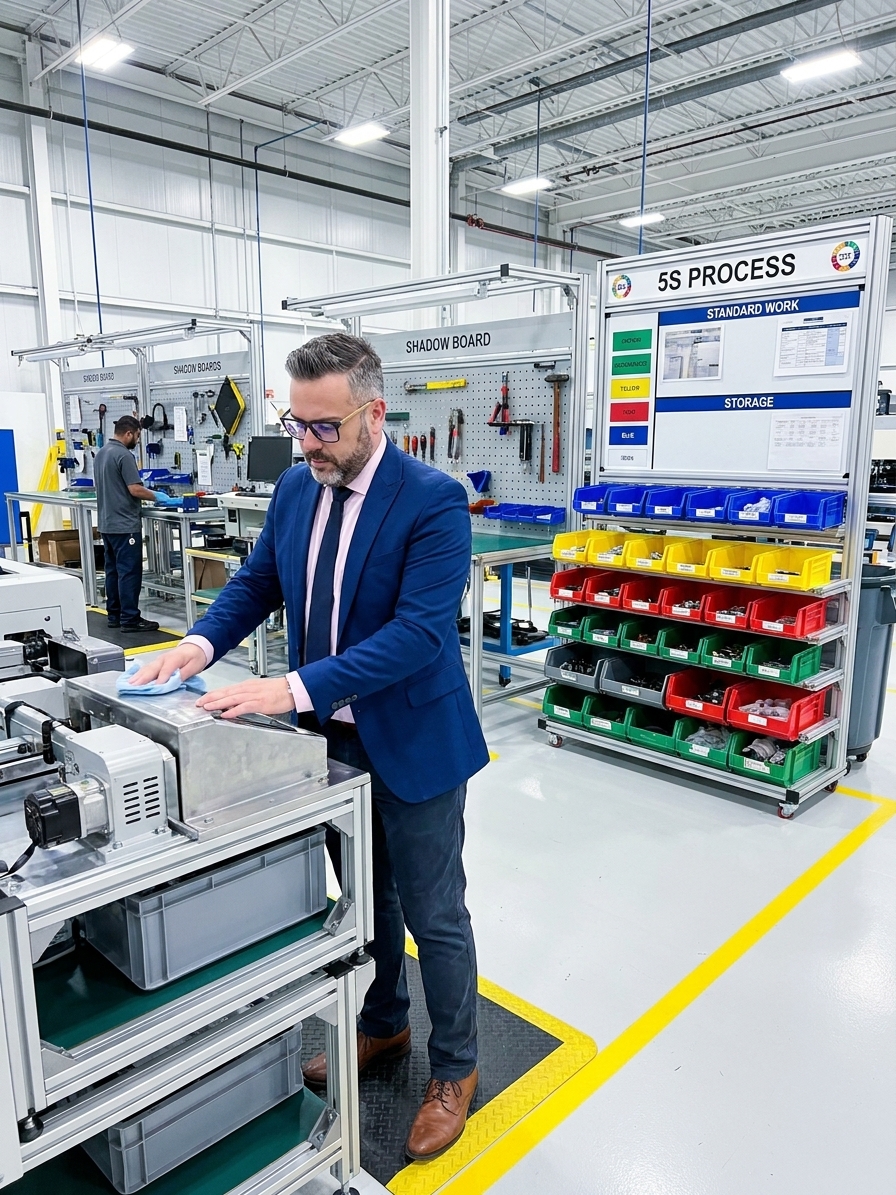
5S was sold as the foundation of lean manufacturing: Sort, Set in Order, Shine, Standardize, Sustain. Five steps requiring zero capital investment, producing immediate visual results. Executives bought it because it was cheap, visible, and generated impressive before-and-after photographs for stakeholder presentations.
But 5S was never about clean floors and labelled shelves. It was designed to build observational discipline, standardisation mindset, and the cultural infrastructure required for continuous improvement. What most plants implement is the shell of the methodology: audit forms, red tags, shadow boards, and monthly scorecards stripped of the substance that gives those tools purpose.
Walk into any factory and ask about their 5S programme. They will show you a board with a score. The score will be good. Walk onto the floor and look for the standardised behaviours that score is supposed to represent. You will find them missing. I have audited plants across automotive and aerospace where the 5S score was excellent and the process discipline was entirely absent.
Recovering the Intent Behind Each Step
Seiri (Sort) is not about throwing away broken chairs. It builds the analytical discipline to distinguish between what is needed and what is not, then having the resolve to remove what serves no purpose. The red-tag process forces a structured conversation about function. Why is this item here? What purpose does it serve? If none, why does it exist?
Seiton (Set in Order) is not about shadow boards. It is engineered accessibility: arranging everything so that the person who needs it can find it, reach it, use it, and return it with minimal cognitive load. The correct question is not where does this go, but what is the optimal location for this item relative to its frequency and sequence of use?
Seiso (Shine) is not cleaning. It is inspection through cleaning, using physical contact with equipment to detect abnormalities, wear, leaks, misalignment, and early signs of failure. Seiketsu (Standardize) makes the first three steps self-sustaining through visual and procedural agreement. Shitsuke (Sustain) is the internalised discipline to maintain the standard when no auditor is present.
Each step builds on the previous one. Sustain without Standardize is impossible. Standardize without Shine is hollow. Shine without Set in Order is inefficient. Set in Order without Sort is decoration. Sort without the rest is a rubbish removal exercise that produces a temporary cosmetic improvement followed by rapid regression to baseline.
How Sort and Set in Order Subvert Themselves
The Sort phase breaks down because unneeded is a political category. The CNC operator who has hoarded tooling for fifteen years does not consider his collection unneeded. The supervisor keeping three redundant gauges has a justification. The maintenance technician storing parts for a decommissioned machine has a story. Red tags are supposed to neutralise this politics through a time-bound removal system. In practice, people remove tags, supervisors override decisions, and critical items occasionally get swept up, creating a crisis that becomes the argument against further sorting.
The result is selective sorting. Broken chairs, expired documents, and empty boxes disappear. Duplicate tools, obsolete inventory, and redundant processes remain. The factory looks cleaner, but the underlying waste (the excess inventory, the unnecessary complexity, the cognitive load of a cluttered environment) stays untouched. The programme declares victory without engaging the real problem.
Set in Order then compounds the failure. Factories spend heavily on foam tool kits, vinyl silhouettes, colour-coded pegboards, and label printers. The visual apparatus of organisation is installed without addressing the core engineering question. Three months later, shadow boards are half-empty because the tools were placed in the wrong location: too far from the point of use, too high to reach, too rigid for the actual workflow. Operators stopped using the board because it added steps without adding value.
Real Set in Order starts with a workflow analysis, not a label maker. It examines what the operator does, in what sequence, with what frequency. It maps natural reach zones. It eliminates, combines, and rearranges before anything is placed. The shadow board is the output of that analysis, not the input to it.
Shine Redefined: Inspection, Not Custodial Work
The most damaging reduction occurs when Shine is translated from inspection through cleaning into cleaning as cleaning. The operator is told to tidy their area at the end of shift. They wipe down the machine, sweep the floor, and go home. They are not told, and not trained, to look for abnormalities while they clean.
Is there oil where there should not be? Is there a vibration that was not there yesterday? Has the swarf pattern changed? Is the surface finish on the part drifting? These are the observations Shine is designed to trigger. Because no one teaches the operator what to look for, the cleaning remains just cleaning. The diagnostic power of the step is lost entirely.
Two Interpretations of Shine
Custodial cleaning
- Delegated to operator at shift end without abnormality criteria
- Focus on visual tidiness: floors swept, surfaces wiped
- No training on what constitutes a detectable defect signal
- Degrades operator role from process diagnostician to janitor
Inspection through cleaning
- Structured checklist of leak, wear, vibration, and finish criteria
- Physical contact used to detect abnormalities and early failures
- Operator trained to identify and escalate process deviation
- Functions as the early warning system for predictive maintenance
Operators spend more time with their machines than anyone else in the organisation. They are the first line of defence against equipment degradation, quality drift, and process failure, but only if they are trained to see what they are looking at. A 5S programme without abnormality detection in the Shine phase has eliminated the early warning system that makes preventive maintenance genuinely preventive.
Standardize and Sustain: Where Programmes Die
Standardization fails because organisations misunderstand what standard means in a lean context. A standard is not a document. It is a visual, physical, and procedural agreement that makes the right way the easy way. The misunderstanding produces documents: long procedures describing how the area should be sorted, organised, and cleaned, stored in binders in offices that operators never enter.
The operator on the floor does not consult the binder. They follow established habits modified by whatever the supervisor said in the last shift meeting. The de facto standard is whatever the most experienced operator does, transmitted through observation, varying from shift to shift. If a standard requires a binder to understand, it is not a standard. It is a wish.
Sustain then completes the decay through audit theatre. A monthly audit produces two predictable outcomes. Scores converge toward the middle because auditors learn that high scores invite scrutiny and low scores create conflict, so everyone gets a three out of five. And audited areas learn to prepare for audit day: a burst of cleaning in the forty-eight hours before auditors arrive, followed by immediate regression to baseline.
You are not measuring your 5S maturity. You are measuring the quality of the theatre your teams produce when auditors approach.
The data from these audits is contaminated by the performance. Trends are meaningless because they reflect preparation effort, not sustained practice. Gap analyses identify nothing because the baseline is artificially inflated. The audit has become a ritual enacted on a schedule, observed by everyone, believed by no one.
What Failed 5S Actually Costs You
The cost of a degraded 5S programme is measured in what it was supposed to enable and did not. When Shine is custodial, you lose your early warning system. Equipment failures that should have been caught at the small leak stage progress to catastrophic failure. Quality drift that should have been detected by an operator noticing something different is detected by a customer filing a nonconformance report or returning a rejected lot.
When Set in Order is decorative, operators spend real time searching for tools, materials, and information. Minutes per shift become hours per month. This time is rarely measured because it is absorbed into the operator's routine, but it is a permanent tax on productivity that no one sees because it has been normalised into the standard work.
| Failure mode | Symptom on the floor | Operational consequence |
|---|---|---|
| Custodial Shine | No abnormality detection during cleaning | Undetected equipment wear reaches failure stage before intervention |
| Decorative Set in Order | Shadow boards placed without workflow analysis | Operators abandon organised storage and revert to informal tool locations |
| Bureaucratic Standardize | Standards exist only in documentation operators never read | Process variation persists across shifts and between individual operators |
| Audit-theatre Sustain | Cleaning spikes before scheduled audits followed by regression | Management decisions based on contaminated data that reflects preparation, not practice |
The deepest cost is cultural erosion. 5S is supposed to be the training ground for continuous improvement, the place where teams learn to observe, analyse, change, and sustain. When 5S is theatre, teams learn that improvement initiatives are performances to be endured, not practices to be internalised. They bring this cynicism to every subsequent programme. Your lean transformation fails not because the tools are wrong, but because your team learned from 5S that the tools are optional.
Building 5S as Invisible Infrastructure
When 5S works, you do not see a 5S programme. You see a workplace where things are where they belong, abnormalities are detected early, and the standard is maintained by people who understand why it exists. There are no 5S boards with scores, no red-tag events, no audit forms. The tools have served their purpose and been retired, or they exist in an embedded form that is part of the daily routine.
Operators can tell you why each item is where it is. They can describe what normal looks like and what they look for when they clean. They can explain the standard because they helped create it, and they maintain it because it makes their work easier. They do not need an auditor to confirm their area is in good shape.
Embedding 5S as Operational Practice
- 01Sort with criteriaDefine need analytically, not politically; enforce red-tag holding periods without override
- 02Engineer accessibilityMap workflow and reach zones before purchasing any storage apparatus or labels
- 03Train abnormality detectionGive operators specific defect signals to look for during cleaning contact with equipment
- 04Make standards visualReplace documented procedures with physical cues that make the correct action obvious
- 05Retire the auditShift from scheduled scoring to daily confirmation embedded in shift start-up routines
This state is achievable. It requires time to do the analysis before implementation, training so operators understand the why behind the what, and patience to let the culture develop over months rather than weeks. Most organisations are not willing to make that investment because the cosmetic version produces faster photographs.
If you want to know whether your 5S programme is real, ask any operator one question: when you clean your machine, what are you looking for? If they answer with specific examples of abnormalities they have detected and reported, your programme is working. If they look at you blankly and say they just clean it, your 5S is theatre. No audit score, no shadow board, and no red-tag event will change that until you go back and teach them what Shine actually means.