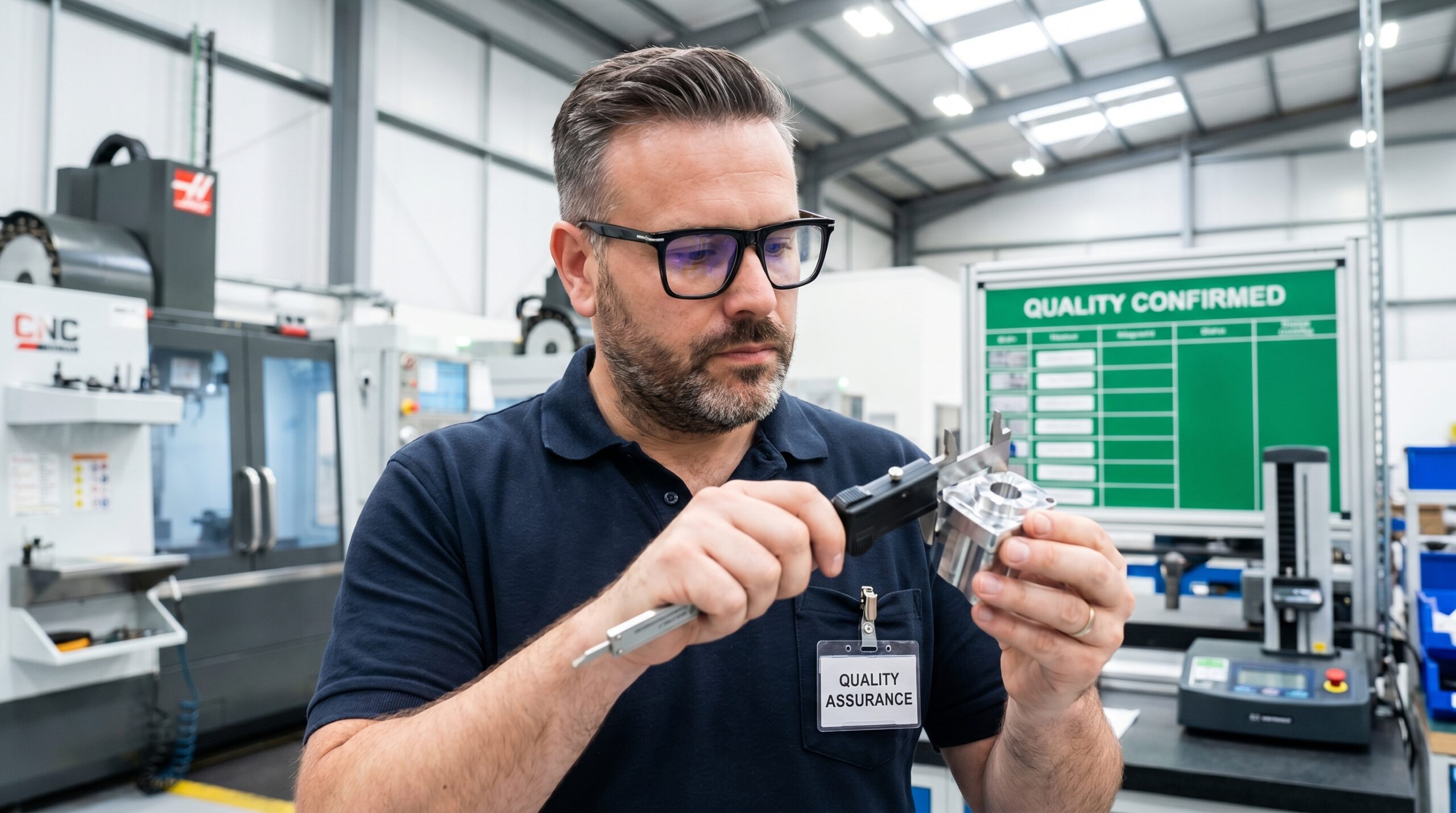
A Tier 1 automotive supplier ships 12,000 machined housings. Within 24 hours, 400 sit in a containment cage at the OEM's receiving dock. The bore diameter is 0.012 mm beyond the upper limit, causing interference fit failures during assembly. The supplier pulls the inspection records. Every part shows conformance. The operator initialed the routing sheet. The final inspector stamped the release form. On paper, the batch is perfect.
The investigation reveals a failure that no standard inspection would have caught. A CMM program was updated two days before the shipment, and the new coordinate system was misaligned by 0.015 mm. The operator noticed slightly different readings but assumed the new program was simply more accurate. The final inspector saw the operator's initials and trusted the judgment. The quality engineer reviewed the batch release, saw two signatures, and moved on.
Nobody confirmed. Everyone assumed. I have audited plants across automotive and aerospace, and this pattern is the most invisible quality failure in manufacturing. It is not a story about broken technology or incompetent operators. It is the breakdown of confirmation—the practice of deliberately testing the load-bearing assumptions your quality system rests on.
Inspection Checks the Product; Confirmation Checks the Checking
Quality confirmation is not inspection. Inspection asks whether a part conforms to specification. Confirmation asks whether the system of knowing is still functioning. The distinction is the difference between catching a defect and preventing the conditions that create it. Confirmation is the meta-layer: the quality system's immune system turned inward to verify its own sensors are still sensing.
Every quality decision rests on a stack of assumptions. The gauge is calibrated. The operator is trained. The fixture is seated. The software is running the correct version. The material certificate matches the actual stock. Each assumption carries weight. Remove one through drift, changeover, or oversight, and the structure collapses. When I transitioned ISO 9001 systems at WITTE Automotive, verifying these foundational assumptions was the prerequisite before any product audit had meaning.
Quality confirmation is the deliberate, scheduled testing of those load-bearing walls. You do not test them because you expect them to fail. You test them because, over time and without attention, they will. A system without confirmation is a system operating on borrowed trust.
Two Different Questions
What inspection asks
- Does this dimension meet specification?
- Is this part acceptable for the customer?
- Did the operator sign the routing sheet?
- Is the measurement within tolerance?
What confirmation asks
- Is the gauge still calibrated and capable?
- Does the reference standard still match reality?
- Did the operator verify the setup before signing?
- Has the measurement system drifted since the last check?
The Hierarchy of Verification
Not everything requires the same level of scrutiny. Effective confirmation operates on a hierarchy based on risk, complexity, and process history. Most manufacturers are strong at the baseline, decent at the second tier, sporadic at the third, and terrified of the fourth. World-class organisations treat all levels as non-negotiable.
Level 1 is self-confirmation. The operator checks their own work against a go/no-go gauge, a torque value, or a boundary sample before passing it along. This catches obvious errors, but only if the operator's reference is still valid. If the boundary sample has degraded or the gauge has drifted, self-confirmation creates false confidence.
Level 2 is cross-confirmation. A second person—a team leader, setup technician, or quality inspector—independently verifies critical parameters. The most effective cross-confirmations come from someone using a different method, a different gauge, or a different observation angle. Level 3 is system confirmation: Gage R&R studies (per the MSA reference manual), capability analyses, and layered process audits catching the invisible drift that turns a robust process into a fragile one.

The Psychology of Routine
Confirmation failures are not primarily technical. They are cognitive. When a person performs a task for the first time, their brain allocates maximum attention. Every reading is scrutinised. The cognitive load is high, and the error rate is relatively low because the operator is actively alert to variation.
After the thousandth repetition, the brain shifts the task from conscious to automatic processing. This is neurologically efficient but dangerous in a quality context. Psychologists call this inattentional blindness. In manufacturing, we call it experience. The seasoned operator who has checked ten thousand parts is statistically less likely to catch a subtle deviation than the new hire who is still in conscious-processing mode.
This is why visual management matters, why boundary samples require scheduled replacement, and why calibration intervals exist. The equipment does not change; the human relationship to the checking process does. Quality confirmation is the structural countermeasure designed to counteract the psychology of routine.
Triggers, Methods, and Evidence
A robust confirmation system requires three elements: predictable triggers, independent methods, and auditable records. Triggers define when to confirm. Setup confirmation happens after every changeover, verifying tooling offsets, program versions, and material identification before the first part is released. First-piece confirmation uses a measurement method independent of the production system. Event-driven confirmation happens after any unplanned interruption—a broken tool, a power fluctuation, a software update.
The method must be different enough from the production check to expose different failure modes. If production uses optical measurement, confirm with contact measurement. If the operator uses a digital caliper, first-piece is verified on a CMM. Blind verification—where the confirmer does not know the production result—eliminates confirmation bias. Golden part verification at the start and end of a cycle proves the measurement system itself is functional.
Records prove the confirmation occurred and create the data needed to evaluate system effectiveness. The most effective records are simple: a checklist with yes/no fields, a signature with a timestamp, a control chart tracking golden part readings. The goal is evidence, not paperwork. A confirmation system without records is a suggestion.
Independent Confirmation Sequence
- 01Setup TriggerInitiated by changeover, tool replacement, or program update.
- 02Independent MethodVerify using a different technology or blind verification.
- 03Golden Part CheckProve the measurement system is functional before checking parts.
- 04Boundary ConfirmationConfirm critical parameters at shift or process handoffs.
- 05Record EvidenceLog results with timestamp and signature for traceability.
The Economics of Skipping Confirmation
Organisations that skip confirmation do not save time. They borrow it at an interest rate they cannot afford. A setup confirmation takes roughly 8 minutes. A first-piece inspection takes 12 minutes. An interval check takes 3 minutes. For a typical run of 500 parts, total confirmation time amounts to about 45 minutes.
Organisations that skip confirmation do not save time. They borrow it at an interest rate they cannot afford.
Now consider the cost of failure. The Tier 1 supplier in the opening scenario spent three weeks investigating the defect, manufactured 12,000 replacement parts on an expedited schedule, paid premium freight, absorbed sorting and containment charges, and lost preferred supplier status for six months. The total financial impact was severe. Forty-five minutes of confirmation on Tuesday afternoon would have caught the misaligned CMM program. The multiplier on skipped confirmation is often staggering.
Every quality professional who has closed a significant 8D report has traced root cause to a confirmation that was skipped, shortened, or assumed. The math is never favourable. The cost of a few minutes of independent verification is negligible compared to the cost of containment, expedited logistics, and eroded customer trust.
Digital Systems and the Paradox of Automation
Industry 4.0 tools transform confirmation but introduce new vulnerabilities. Automated inline measurement eliminates sampling risk. Machine learning detects subtle pattern shifts. Digital twins predict process behaviour. But every digital confirmation system carries its own hidden assumptions about sensor calibration, algorithm training data, and network stability.
The digital confirmation paradox is that the more automated the checking becomes, the more critical human verification of the automation becomes. The temptation is to skip that human layer because the system is watching. The most sophisticated organisations maintain a parallel human verification layer. The operator physically touches parts the automated system has passed. They do not expect to find a discrepancy. They know that the moment they stop checking is the moment the automation begins to lie to them.
Building a confirmation culture means making verification visible. Confirmation activities must appear on production schedules, not squeezed into gaps. Layered process audits must check whether confirmation is performed as designed—not asking whether a form was signed, but asking the operator to demonstrate the verification. When a confirmation catch prevents a defect, it should be celebrated publicly. When a skip causes an escape, the story should be shared as a learning opportunity across the plant.
Organisations need trust to function. Trust without verification is the foundation of every quality disaster. The resolution is not to eliminate trust but to make it earned and renewed through evidence at every critical step. I trust the operator because they confirmed. The customer trusts the supplier because the system confirmed. Quality confirmation exists because excellence is human, and humans are fallible. It is the structural countermeasure that keeps a robust process from quietly becoming a fragile one.