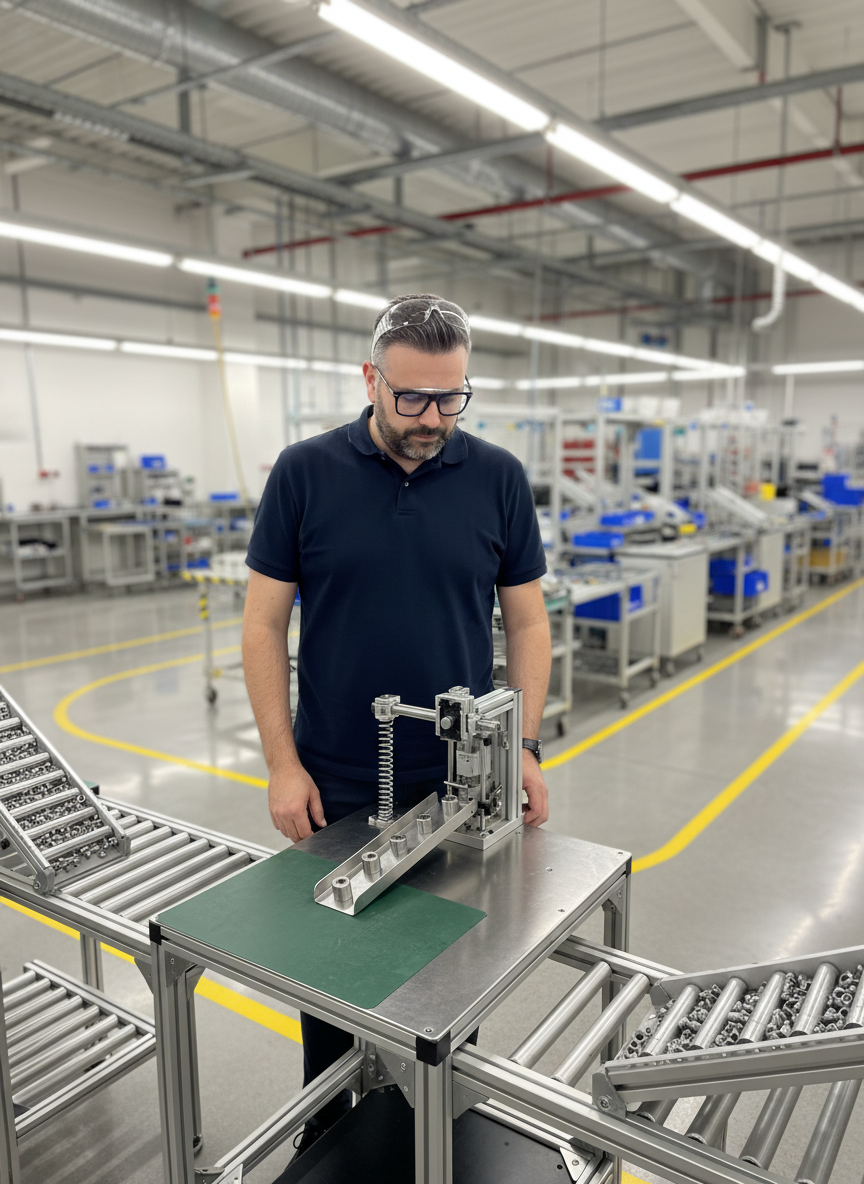
I was standing at the end of an assembly cell in a Tier 1 automotive plant when I noticed a failure mode that the PFMEA completely missed. The cell was beautiful on paper: six stations, U-shaped, one-piece flow, and a 42-second takt time. The engineering team had spent months designing it. The simulation showed near-perfect efficiency.
But three months after launch, the cell was chronically missing its targets. At Station 4, the operator finished her work, picked up the completed subassembly, turned around, walked three steps to Station 5, set it down, walked back, and repositioned herself for the next part. That manual handoff consumed up to nine seconds of a 42-second takt time.
Every station had a similar transfer penalty. The cell designed for 86 units per hour was averaging 61. The tooling was correct. The cycle times were validated. But the unautomated ejection and presentation of parts was quietly destroying the cell's OEE and injecting variation into the process.
The root cause was the absence of Hanedashi. It is a Japanese term for auto-ejection: a mechanism built into a machine or workstation that automatically ejects a finished part and presents the next one without human intervention. It is the most overlooked prerequisite for one-piece flow in modern manufacturing.
The Mathematics of the Missing Transfer Time
Most organizations refuse to measure part transfer because it feels incidental. Consider a five-station cell with a designed cycle time of 40 seconds per station. Takt time is 40 seconds, yielding a theoretical output of 90 units per hour.
Add manual transfer to the equation. Each operator spends roughly five seconds physically moving the part and repositioning. That adds 25 seconds of non-value-added time to the total cell cycle. Effective cycle time climbs to 65 seconds.
The penalty compounds because transfer time is inconsistent. It varies based on operator fatigue, part weight, and ergonomic constraints. In my experience auditing these cells, a nominal five-second transfer averages over seven seconds with a high standard deviation. Actual output drops to roughly 52 units per hour. The plant loses 42% of its theoretical capacity to a process step that engineering never modelled.
The Cost of Manual Part Transfer
The Quality Impact of Manual Handling
Hanedashi is not just a productivity issue; it is a severe quality liability. Every manual part transfer introduces a risk of handling damage. I have audited cells where the downstream scrap rate was noticeably higher than upstream purely because operators were dropping or scratching finished components during transit. The process produced good parts, and the transfer destroyed them.

Manual transfer also guarantees inconsistent part orientation. When a subassembly arrives at the next station rotated slightly or misaligned, the receiving operator must reposition it before starting. When they fail to seat it correctly, the resulting defect is falsely attributed to operator error at the station of discovery, not the transfer itself. The true root cause evades your 8D analysis.
Cycle time variation destroys statistical process control. When manual transfer causes the cycle to fluctuate wildly, adhesive cure times compress and tool wear accelerates unpredictably. Your control charts will flag special cause variation, but your root cause analysis will struggle to link it back to the fact that the operator took six seconds to move the part instead of four. Furthermore, task switching degrades cognitive focus. The operator rushing to transfer a part is not fully focused on their incoming quality check.
Three Levels of Auto-Ejection Maturity
Hanedashi is not binary. I categorize implementation into three distinct levels, each requiring incrementally more engineering effort but delivering compounding returns in both quality and cycle time stability.
Level 1 is Mechanical Auto-Ejection. The fixture automatically ejects the part when the cycle completes. The operator's hands never touch the part during transfer. A spring-loaded mechanism might cost a few hundred dollars in materials and a few hours of toolmaker time. This alone recovers the majority of the transfer loss.
Level 2 is Oriented Transfer. The part is delivered to the next station in the exact orientation required for the next operation. This eliminates repositioning time and orientation-related defects. Level 3 is Synchronized Flow, where parts move between stations in a timed sequence matching takt time. This is what one-piece flow was meant to be: material moving like water through a pipe.
Hanedashi Implementation Hierarchy
- Level 3: Synchronized FlowParts move automatically between stations in a timed sequence matching takt time.
- Level 2: Oriented TransferPart is ejected and delivered in the exact orientation required for the next operation.
- Level 1: Mechanical Auto-EjectionSpring, chute, or pneumatic pusher removes the finished part with zero human handling.
- Level 0: Manual TransferOperator picks up, carries, sets down, and repositions for every single cycle.
Resisting the Urge to Automate the Problem
I worked with a medical device manufacturer assembling critical insulin pump housings. The seven-station cell required 100% visual inspection, but first-pass yield was stuck at 91.3%. Operators manually carried delicate housings in plastic trays between stations, and handling damage accounted for roughly 40% of all scrap.
The engineering team proposed a solution: fully automate the cell with industrial robots. The proposal required $2.4 million in capital expenditure and a 14-month implementation timeline. I told them to shelve the robotics and look at the mechanics of the transfer itself.
Over four weeks, the team installed simple ejection mechanisms, soft-surface gravity chutes, and locator features. The investment was $18,000 in materials and fabrication time. Throughput rose from 240 to 341 units per shift. First-pass yield climbed to 97.8%. Handling damage dropped significantly. The $2.4 million robot proposal was quietly abandoned.
Why Engineers Resist Simple Mechanisms
If Hanedashi is cheap and effective, why does it remain ignored? During cell design, transfer mechanisms are routinely deferred to a Phase 2 improvement list. Phase 2 never arrives. Once the cell is running, manual transfer becomes the accepted standard. Operators adapt, supervisors normalize the output loss, and engineers move on.
Engineers would rather propose a $50,000 robotic transfer system than a $500 gravity chute, because complexity feels like real engineering.
The most insidious barrier is the assumption that operators can handle it. Because skilled operators successfully compensate for missing mechanical design through daily effort, the waste remains invisible. The problem does not trigger an andon call. It simply caps your facility's maximum capability while artificially inflating your labour costs.
Quality professionals must treat this as a systemic design failure. When I build a greenfield QA or QC department, the first mandate is to eliminate reliance on operator compensations. If a human is doing something repetitive, predictable, and non-judgmental, engineer it out.
Implementing Hanedashi on the Shop Floor
Implementing Hanedashi requires rigorous observation. Stand at each station for thirty cycles. Measure the time from work completion to part presentation at the next station. Measure the time from part receipt to the start of work. Add them together to quantify your Hanedashi gap.
Identify your highest-impact stations using this data. Prioritize areas where parts are heaviest, most delicate, or require precise orientation. Design the simplest possible solution. Gravity chutes and spring ejectors are ideal because they possess zero moving parts and require no maintenance.
Before fabricating anything in steel, prototype the mechanism in cardboard and tape. Test it with real parts. You will learn more in thirty minutes of physical iteration than in weeks of CAD design. Listen to the operators and iterate the design to standard work.
Hanedashi Deployment Sequence
- 01Measure the GapTime 30 cycles per station to quantify manual transfer and repositioning losses.
- 02Prioritize by RiskTarget heavy, delicate, or precision-oriented parts first to drive quality gains.
- 03Prototype PassivelyBuild the simplest mechanism in cardboard to validate flow and operator ergonomics.
- 04Standardize in PFMEAFabricate final design, integrate into TPM, and list it as an engineering requirement.
Engineering Out the Invisible Tax
Hanedashi teaches us to hunt for the invisible work embedded in daily operations. Every process suffers from a variation of the missing ejector. The quality inspector who walks forty meters to a terminal. The technician searching for a calibrated torque wrench. The supervisor transcribing paper forms into a spreadsheet because systems remain disconnected.
These hidden friction points will never trigger a customer complaint, but they impose a massive tax on your plant's OEE and first-pass yield. Locating and eliminating them with the simplest mechanism possible is the core of lean quality engineering.
Your operators already know where the friction hides. Go to the gemba, observe the handoffs, and build the mechanism that allows the part to move without a single human thought. That is how you achieve genuine one-piece flow.