Quality and the Bathtub Curve: When Your Organization Discovers That Most Failures Don’t Happen Randomly — They Happen at the Beginning and at the End, and the Middle Is Where Your Quality System Goes to Sleep

Uncategorized

Quality and the Bathtub Curve: When Your Organization Discovers That Most Failures Don’t Happen Randomly — They Happen at the Beginning and at the End, and the Middle Is Where Your Quality System Goes to Sleep

The Shape That Explains Everything

There is a curve that every reliability engineer knows by heart. It looks like a bathtub. And if you’ve ever wondered why some products fail the day you buy them, others run flawlessly for a decade, and then suddenly everything breaks at once — that curve is the answer.

The bathtub curve isn’t a theory. It’s a pattern so consistent across products, industries, and decades of manufacturing data that it might as well be a law of physics. It describes three distinct phases of a product’s life: infant mortality, useful life, and wear-out. Each phase has its own failure mechanisms, its own warning signs, and its own quality strategy.

And here’s what makes it dangerous: most quality systems treat all three phases the same way. They don’t. They never did. And the organizations that understand the difference are the ones that stop playing whack-a-mole with defects and start designing failure out of their products entirely.

This is the story of that curve — and what happens when your quality system finally learns to read it.


Act One: Infant Mortality — The Failures That Should Never Leave Your Building

The left side of the bathtub curve is steep. Failure rates are high at the beginning of a product’s life, then they drop sharply. This is infant mortality — the phase where manufacturing defects, assembly errors, and weak components reveal themselves quickly, sometimes within hours or days of first use.

In the automotive world, this is the phase that creates warranty claims in the first 12 months. In electronics, it’s the dead-on-arrival units. In medical devices, it’s the ones that fail during the first procedure. The causes are almost always the same: latent defects that escaped your inspection process, assembly mistakes that your quality system didn’t catch, or components that were marginal from the start and couldn’t survive even minimal stress.

The brutal truth about infant mortality is that most of these failures were preventable. They didn’t happen because of bad luck. They happened because something in your manufacturing process allowed a defect to pass through — and your outgoing quality inspection wasn’t designed to catch it.

The Burn-In Strategy

The most effective organizations don’t just accept infant mortality as a fact of life. They force the curve to reveal itself before the product leaves their control. This is burn-in testing — running products under accelerated stress conditions to weed out the weak ones before they reach the customer.

In semiconductor manufacturing, burn-in is standard practice. Every chip gets subjected to elevated temperature and voltage for hours or days before it ships. The ones that were going to fail early? They fail during burn-in, in the factory, where the cost of failure is a scrap part — not a returned product, an angry customer, and a damaged reputation.

In automotive, the equivalent is the end-of-line test that every vehicle undergoes before it leaves the plant. But here’s the difference: a ten-minute roll test won’t catch a bearing that’s going to fail at 5,000 kilometers. That requires either a longer test, a more severe test, or a better understanding of what makes that bearing vulnerable in the first place.

This is where HALT — Highly Accelerated Life Testing — enters the picture. HALT doesn’t simulate normal use. It abuses the product. It pushes temperature, vibration, and electrical stress far beyond specification limits. The goal isn’t to prove the product works. The goal is to find out where it breaks — and then fix the weakness so it never breaks in the field.

Organizations that master burn-in and HALT don’t just reduce infant mortality. They practically eliminate it. Their customers never see the left side of the bathtub curve because the curve got flattened before the product ever shipped.


Act Two: Useful Life — The Dangerous Quiet

The bottom of the bathtub curve is flat and low. Failure rates during useful life are relatively constant and — here’s the critical point — essentially random. These aren’t manufacturing defects anymore. These are random failures caused by unexpected stress events, rare material anomalies, or statistical outliers in component quality.

This is the phase where most quality systems get complacent. The phone calls from angry customers have stopped. The warranty claims have tapered off. The defect rate is low and stable. Everything looks fine.

But “looks fine” and “is fine” are not the same thing.

The useful life period is where your quality system needs to be watching for the wrong things. You’re not looking for patterns anymore — you’re looking for deviations from the expected random failure rate. And that requires a fundamentally different approach than what most organizations use.

The Weibull Window

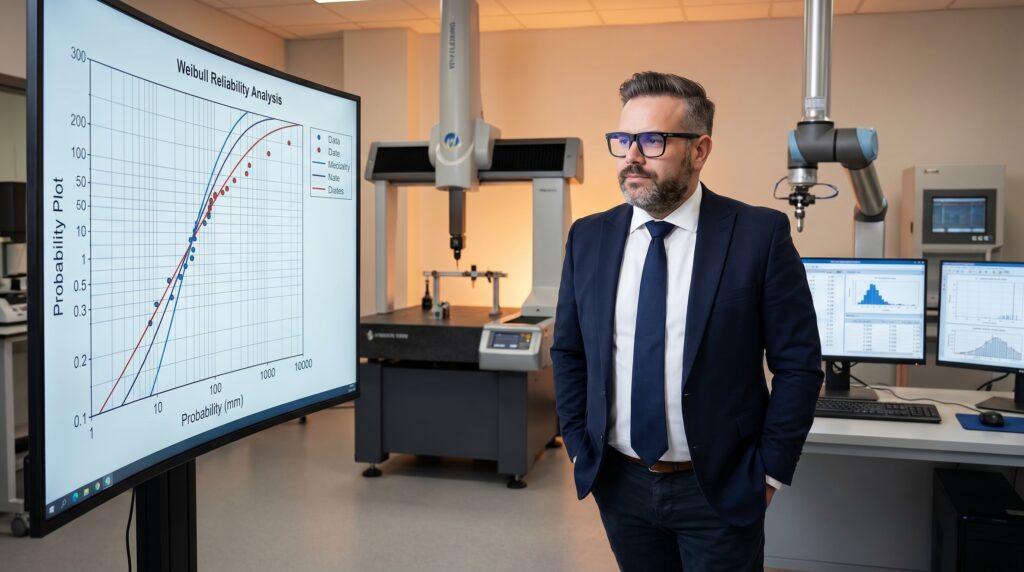
This is where Weibull analysis becomes your most powerful tool. The Weibull distribution can model failure data across all three phases of the bathtub curve, and its shape parameter — beta — tells you exactly which phase you’re in.

When beta is less than 1, failures are decreasing over time. You’re in infant mortality. Something in your process is producing weak units that fail early.

When beta equals 1, failures are random and constant. You’re in useful life. There’s no pattern to chase — only a rate to monitor.

When beta is greater than 1, failures are increasing over time. You’re entering wear-out. The clock is ticking, and everything is starting to degrade.

Most organizations never calculate beta. They track failure rates as averages over arbitrary time periods, mix all three phases together, and wonder why their data doesn’t tell them anything useful. It’s like mixing three different recipes into one bowl and then being surprised that the cake tastes confused.

The organizations that understand Weibull don’t just track failures — they classify them. They know exactly which failures belong to which phase of the curve, and they apply the right strategy to each one. Infant mortality gets process improvement. Useful life gets monitoring. Wear-out gets preventive replacement.


Act Three: Wear-Out — The Failure Everyone Saw Coming and Nobody Prevented

The right side of the bathtub curve rises. Failure rates increase as products approach the end of their design life. Materials degrade. Moving parts wear down. Seals harden and leak. Coatings corrode. Batteries lose capacity. Everything that was designed to last a certain amount of time… lasts exactly that amount of time, and then stops.

Wear-out is the most predictable type of failure. It’s not random. It’s not a surprise. It’s the engineering equivalent of death and taxes. And yet, organizations are shocked by it every single time.

Here’s why: most organizations don’t track their products long enough to see the right side of the curve. They track warranty periods — typically one to three years. But many products enter wear-out at five, seven, or ten years. By the time the failures start rolling in, the product has been out of production for years, the engineering team has moved on to the next generation, and the field failure data goes to a department that doesn’t have the authority or the budget to do anything about it.

The Predictive Maintenance Revolution

The most forward-thinking organizations have turned wear-out from a crisis into a planned event. Predictive maintenance uses sensor data, usage patterns, and degradation models to predict exactly when a component will fail — and replaces it just before it does.

In manufacturing equipment, this is now standard practice in world-class plants. Vibration sensors on bearings. Thermal imaging on electrical connections. Oil analysis on gearboxes. Each data point feeds a model that knows the bathtub curve for every critical component and can predict its position on that curve in real time.

But here’s the gap: most organizations apply predictive maintenance to their equipment but not to their products. They know when their CNC machine’s spindle is going to fail, but they have no idea when their customer’s product is going to fail. The same data, the same models, the same bathtub curve — but applied only inward, never outward.

The organizations that bridge this gap — that apply the same rigor to predicting their product’s wear-out as they do to their equipment’s wear-out — are the ones that turn reliability from a cost center into a competitive advantage. They don’t just sell products. They sell predictable performance. And customers pay a premium for that.


Why Your Quality System Keeps Missing the Curve

Understanding the bathtub curve is one thing. Building a quality system that acts on it is another. Most organizations fail at this for three reasons:

First, they aggregate their failure data. They take infant mortality failures, useful life failures, and wear-out failures, dump them all into one database, and calculate an overall failure rate. That number is meaningless. It’s like averaging the temperature of your oven and your freezer and concluding that your kitchen is room temperature.

Second, they use the wrong tools for the wrong phase. They apply Statistical Process Control to wear-out failures — but SPC detects shifts in a stable process, and wear-out isn’t a shift, it’s an expected trend. They apply root cause analysis to useful life failures — but random failures don’t have a single root cause. They launch corrective action projects for infant mortality — but the corrective action should have been a process change, not an investigation.

Third, they stop watching too early. Most quality systems focus on the first 90 days. Some extend to the warranty period. Almost none track products through their entire useful life and into wear-out. It’s like watching a baseball game through the third inning and then leaving — you saw the starting lineup, but you missed the entire story.


Building a Bathtub-Aware Quality System

The organizations that get this right don’t just understand the curve — they organize their entire quality strategy around it. Here’s what that looks like in practice:

For Infant Mortality: Prevention and Screening

  • Design for Manufacturing (DFM) reviews that catch design features likely to cause assembly errors
  • Process FMEAs focused specifically on failure modes that escape to the customer
  • Burn-in and environmental stress screening for high-risk components
  • HALT during development to find and eliminate weaknesses before production
  • First-article inspection protocols that validate process capability, not just dimensional conformance

For Useful Life: Monitoring and Readiness

  • Field failure tracking with Weibull analysis to confirm you’re in the flat part of the curve
  • Constant failure rate monitoring with statistical alarms for unexpected increases
  • Spare parts logistics optimized for random failure patterns
  • Customer feedback systems designed to capture early signals of unexpected failure modes
  • Cross-reference analysis between field data and manufacturing records to catch correlations

For Wear-Out: Prediction and Planning

  • Accelerated life testing (ALT) during development to characterize the wear-out curve
  • Design life specifications that are explicit, documented, and communicated to customers
  • Preventive maintenance schedules for products where maintenance is possible
  • End-of-life planning for products where maintenance isn’t practical — including recycling and disposal
  • Next-generation design inputs derived from wear-out data on the current generation

The Cost of Ignoring the Curve

Let’s talk about money. Because the bathtub curve doesn’t just describe failure patterns — it describes cost patterns.

Infant mortality failures are expensive per unit but limited in scope. You’re replacing individual products, handling individual complaints, and managing individual warranty claims. Painful, but containable.

Wear-out failures are expensive in aggregate but predictable in timing. You can budget for them, plan for them, and in many cases, prevent them through maintenance or replacement. Costly, but manageable.

But the failures that kill organizations — the ones that destroy brands, trigger recalls, and generate class-action lawsuits — are the ones that sit at the transitions between phases. The infant mortality failure that was supposed to be caught but escaped into the field. The useful life failure that wasn’t random but looked random because nobody was analyzing the data correctly. The wear-out failure that started earlier than expected because a supplier quietly changed a material specification.

These transition failures are where the bathtub curve hides its sharpest edges. And they’re the ones that separate organizations that manage reliability from organizations that are managed by it.


The Cultural Dimension

Here’s something the textbooks won’t tell you: understanding the bathtub curve is a technical capability, but acting on it is a cultural one.

In organizations with a reactive quality culture, the bathtub curve is just a graph in a reliability report that nobody reads. Infant mortality is blamed on the customer. Useful life failures are called “random” and dismissed. Wear-out is “expected” and accepted. The curve is visible, but invisible.

In organizations with a proactive quality culture, the bathtub curve is a living document. It’s updated with every field failure. It’s analyzed at every design review. It’s the framework that connects development, manufacturing, and field performance into a single narrative. The curve isn’t just understood — it’s respected.

The difference isn’t knowledge. It’s discipline. Every reliability engineer knows the bathtub curve. Not every organization has the discipline to build its quality system around it.


A Practical Starting Point

If your organization doesn’t currently use the bathtub curve as a quality framework, here’s where to start:

  1. Segment your field failure data by time-in-service. Break your warranty and field return data into buckets: 0-3 months, 3-12 months, 1-3 years, 3-5 years, 5+ years. Plot the failure rate for each bucket. You’ll see the curve.

  2. Run a Weibull analysis on your top five failure modes. Calculate the beta parameter for each. This will tell you immediately whether you’re dealing with infant mortality, random failures, or wear-out — and whether your current corrective actions are targeting the right phase.

  3. Audit your burn-in and screening processes. Are you actually catching the failures you’re trying to catch? Or are your test conditions too mild to trigger the defects you’re looking for? Compare your burn-in failure rate to your early field failure rate. If they don’t correlate, your burn-in isn’t working.

  4. Check your design life specifications. Do your products have an explicit, documented design life? Does your warranty policy align with it? Does your field service team know when products are approaching wear-out? If the answer to any of these is no, you’re flying blind on the right side of the curve.

  5. Bring reliability engineering into your design reviews. Not as an afterthought or a compliance checkbox, but as a core voice in every design decision. The bathtub curve is shaped during design. By the time you’re in production, you’re just living with the shape you created.


The Curve Remembers

The bathtub curve doesn’t care about your quality policy. It doesn’t read your ISO certificate. It doesn’t attend your management reviews. It simply exists — a mathematical description of how products fail, as reliable as gravity, as patient as time.

Organizations that learn to read the curve gain something their competitors don’t have: the ability to see the future. Not in a crystal ball sense, but in a data-driven, statistically validated, engineering-grounded sense. They know when failures will happen, why they’ll happen, and what to do about it before they happen.

Everyone else is just reacting. Chasing failures. Fighting fires. Writing corrective action reports for problems that were predictable from the day the product was designed.

The bathtub curve is always there. The only question is whether your quality system is shaped around it — or whether it’s shaped around the comfortable fiction that failures are surprises.

They’re not. They never were. The curve knows. And now, so do you.


Peter Stasko is a Quality Architect with over 25 years of experience in automotive and manufacturing quality systems, reliability engineering, and continuous improvement. He has helped organizations across Europe and North America transform their quality cultures from reactive firefighting to proactive excellence.

Scroll top