In 2012 I visited Toyota City as a quality engineer, not a tourist. I spent two weeks on the production lines observing a system that fundamentally contradicted standard Western manufacturing doctrine. When I asked the plant manager where the press shop schedulers were, the answer was direct: there were none. They used Kanban.
When I asked about quality control inspectors, the response was equally blunt. Every operator had the authority to stop the line the moment something was wrong. There was no separate inspection department hunting for defects after the fact. Quality was built into the process, not bolted on at the end.
That visit clarified a distinction I had been missing. The Toyota Production System is not a toolkit you install. It is an operating philosophy built on making problems visible and respecting the people who do the actual work. The challenge was whether I could translate that philosophy into a European automotive supply chain operating under IATF 16949 constraints.
TPS Structure Beyond the Buzzwords
TPS is built on two foundational pillars: Just-in-Time and Jidoka. Just-in-Time means producing exactly what the customer pulls, when they need it, in the quantity required. Jidoka means automation with a human touch — stopping the process the instant an abnormality appears, so defects cannot travel downstream.
Supporting these pillars are the mechanisms most engineers recognise: Kanban for visual material flow, Poka-Yoke for error-proofing, Standard Work for process consistency, and Kaizen for continuous improvement. But these tools are inert without the operational discipline to enforce them. A Kanban board without WIP limits is decoration.
What TPS explicitly rejects is the assumption that efficiency comes from maximising machine utilisation or pushing material to keep people busy. It targets the elimination of muda — waste in all its forms: overproduction, excess inventory, unnecessary motion, waiting, defects, and transport. The objective is value, defined strictly from the customer's perspective.

Diagnosing a Push-Based Supply Chain
When I returned from Japan, I applied these principles to a 150-person automotive supplier plant running three production lines. The operation suffered from a binary inventory pathology: material was either abundant or absent. Stock levels oscillated violently, expedited freight costs were bleeding the margin, and deliveries to OEM customers were consistently late.
I asked the production planner when they triggered the next order for critical components. The answer: when we run out. I asked how they knew when that would happen. They did not. Material planning was reactive, driven by emergency shortages rather than systematic replenishment logic. The plant was running on adrenaline, not flow.
The root cause was a push system. Schedulers were releasing work orders based on forecasted demand, forcing material onto the floor regardless of actual consumption. This inflated WIP, extended lead times, and buried defects under layers of unfinished product. Little's Law applies: reduce WIP to reduce lead time. It is mathematical certainty, not management opinion.
Push Scheduling vs Pull Replenishment
Push system (before)
- Orders released from ERP forecast regardless of floor status
- WIP accumulates unpredictably between operations
- Shortages discovered at assembly, triggering expedited freight
- High inventory carrying cost masking frequent stockouts
Pull system (after)
- Upstream production triggered only by Kanban signal from downstream
- WIP capped by strict card count per part number
- Consumption visibility replaces forecast guessing
- Material shortages surface immediately, forcing root-cause fixes
Building the Kanban Infrastructure
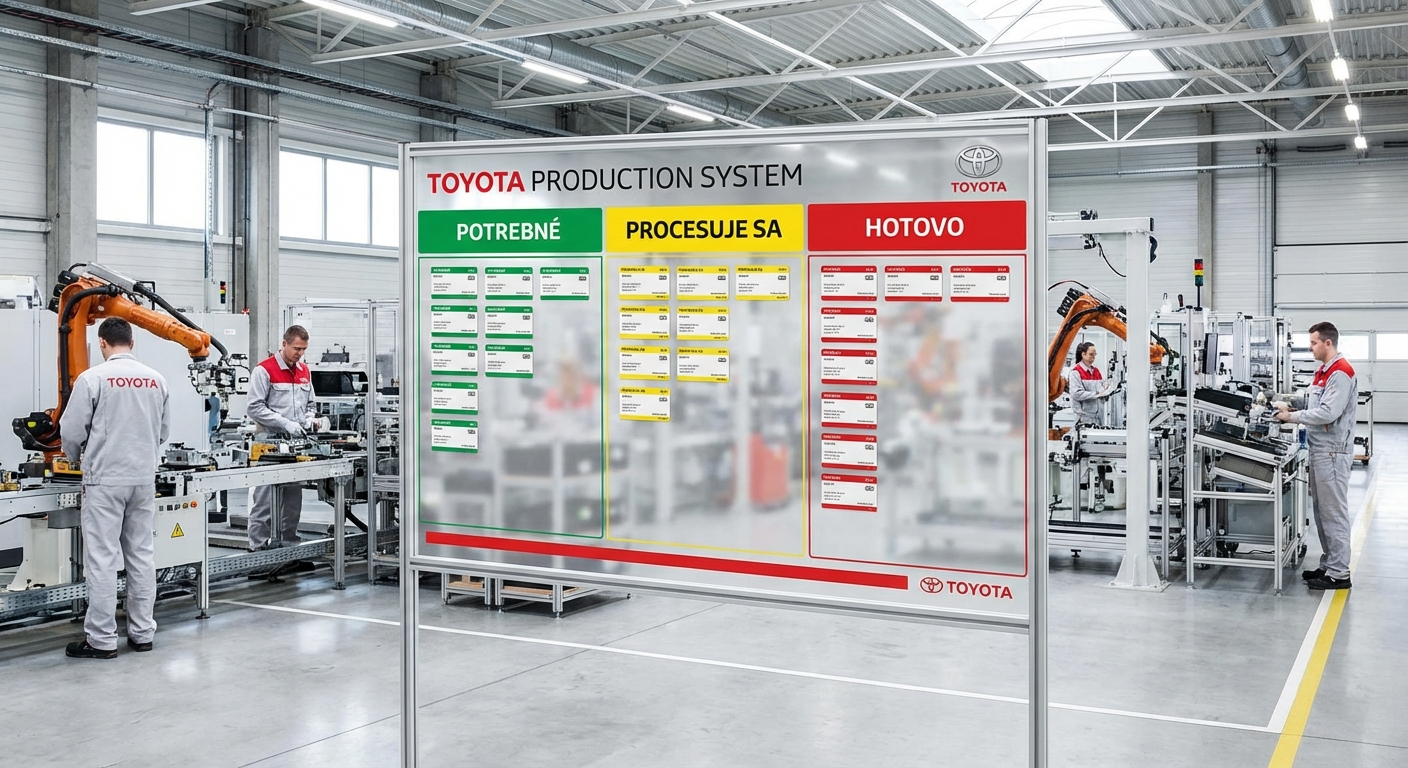
The first implementation step was physical visualisation. Every part number received a Kanban card carrying specific data: part number, description, WIP quantity, minimum threshold, and reorder point. These were not digital entries buried in an MRP module. They were magnetic cards placed on boards at each line, visible to anyone walking the floor.
Each line operated a three-column board: Required, In Process, and Complete. A card moved forward only when the physical work moved. This exposed the actual state of production in real time. Red denoted critical shortage, green signalled healthy stock, and yellow warned of excess WIP. The colour system made abnormality impossible to ignore.
The critical rule was the WIP limit. I set a maximum of two Kanban cards in process for any given part family. This was the mechanism that converted the board from a tracking tool into a flow-control system. By capping work in progress, we forced bottlenecks to surface. Stations could no longer mask problems by overproducing.
Inventory dropped by 40% within the first quarter of operation. More importantly, the stability of the schedule improved. When material replenishment is tied to actual consumption rather than forecast guesswork, the entire chain stops oscillating. The team stopped fighting fires and started managing the process.
Installing Jidoka and Poka-Yoke on the Line
Flow control solves the inventory problem. Quality at the source solves the defect problem. TPS demands that quality is verified at the point of manufacture, not at a final inspection station. I installed andon systems and verification checkpoints at the end of each critical operation, backed by CMM measurement where tolerances demanded it.
The system was configured to block downstream transfer automatically when a parameter drifted out of specification. This is Poka-Yoke applied to process logic: the operation simply cannot proceed with a defective part. Defects were caught at the machine, not discovered in an audit. Rework volume dropped by 65% in the first three months.
Stopping the line is not a production loss. It is the cheapest quality inspection you will ever run, because it prevents the defect from multiplying.
The hardest cultural shift was convincing management that line stops were necessary. Operators were given the authority to halt production without asking permission. The protocol was rigid: operator stops the line, a quality engineer arrives within five minutes, and if the issue is non-trivial, the team runs an immediate root-cause analysis on the floor.
Line stops spiked to seven in the first week. Management was alarmed. By the second week there were three. By the fourth week, zero. The problems had always existed — they had simply been buried under inventory and passed downstream. Once exposed and fixed at the source, overall equipment effectiveness rose by 35% within the month.
Standardising Work to Enable Flexibility
Uncontrolled variation between operators is a hidden source of scrap and cycle-time instability. Before standardisation, each operator on the line had developed their own sequence, tool preference, and inspection rhythm. The result was inconsistent takt time and unpredictable output. We eliminated this by creating Standard Work Sheets for every station.
Each sheet documented the exact sequence: five-step photo documentation with cycle times, specified torque and measurement values, safety checkpoints, and required tooling. The standard was not a suggestion — it was the baseline. Any improvement to the process had to be formally reviewed and incorporated into the sheet. This is how standard work enables Kaizen rather than blocking it.
The operational impact was immediate. New operator training time dropped from two weeks to three days. Cycle-time variability fell by half. And critically, the standard baseline made deviations instantly recognisable. When every operator follows the same sequence, any anomaly stands out. Standardisation creates the conditions for visual management to function.
Six-Month Performance Shift After TPS Implementation
Why TPS Implementations Fail in Supplier Plants
Most TPS implementations in the automotive supply chain fail because managers treat the tools as ends rather than mechanisms. They install Kanban boards, hold a Kaizen event, and declare victory. The boards become stale within a month, the discipline collapses, and the system reverts to push scheduling under production pressure.
The failure mode is cultural, not technical. Operators resist when they perceive Kanban cards as bureaucratic paperwork imposed on top of their existing workload. Middle managers resist because WIP limits expose bottlenecks they are judged on hiding. Senior managers resist because line stops look like lost output on the daily OEE report.
What works is involvement. Operators must help design the visual system and set the card thresholds. Management must walk the gemba daily and reinforce that stopping the line is expected behaviour, not a failure. And the WIP limits must be enforced absolutely — no exceptions for customer pressure, no temporary overrides when the schedule tightens.
Tier suppliers face realities Toyota does not: smaller batch sizes, higher product variability, volatile OEM schedules, and less leverage over upstream material suppliers. The adaptation is electronic Kanban integrated with ERP, dynamic reorder points calculated from actual demand variability, and Vendor Managed Inventory agreements for critical components. The principle holds; the mechanics adjust.