Organizations fail at continuous improvement because they attempt to install the visible artifacts of lean manufacturing without grasping the underlying behavioural routines. They invest heavily in andon cords, kanban scheduling, and 5S audits, only to watch their internal PPM and scrap rates stagnate over the following quarters. The assumption is that operational excellence is a matter of deploying the correct quality engineering tools.
This assumption is categorically false. Having audited and transitioned quality management systems across automotive and aerospace manufacturing, I have seen pristine ISO 9001 and IATF 16949 systems fail to prevent systemic escapes because the operators lacked a structured problem-solving routine. Toyota's sustained competitive advantage was never its tools. The advantage lies entirely in a deliberately practiced daily routine that develops scientific thinking across the entire workforce.
In Japanese martial arts, a kata is a structured routine practiced relentlessly until the fundamental movements become automatic. Applied to quality management, it operates as the operating system for your existing compliance frameworks. Mike Rother documented this behaviour in his research on Toyota's management system. He proved that systematic, daily experimentation navigating from a current condition toward a target condition yields compounding quality improvements that traditional kaizen events cannot sustain.
The Improvement Kata: Four Steps to Replace Assumptions
The Improvement Kata is a rigid, four-step routine that any quality team can learn and apply directly on the shop floor. It looks deceptively simple on paper, but executing it requires a fundamental shift away from the traditional plan-then-execute project management mindset. The sequence forces engineers and operators to confront reality before proposing countermeasures.
First, you must establish a clear, measurable target condition that aligns with your strategic direction. This is not a vague aspiration like improving compliance or reducing scrap. A functional target condition dictates specific process parameters, such as reducing dimensional variation to within 0.15mm across all measurement points and sustaining it for thirty consecutive production days.
Second, you must rigorously grasp the actual current condition by going directly to the gemba. Relying on aggregated dashboards or monthly Cpk reports hides the true process behaviour. I once spent two full days observing an automotive assembly station only to discover that post-changeover defects were caused by a subtle fixture misalignment hidden entirely within an acceptable setup sheet tolerance.
Third, you establish the next target condition as a short-term milestone, usually achievable within one to four weeks. Fourth, you systematically experiment toward that target condition using rapid PDCA cycles. You form a hypothesis, design a small test that can fail safely, run it, measure the result, and extract data. You might run twenty distinct experiments before hitting the target, but each iteration reveals critical process mechanics.
The Improvement Kata Routine
- 011. Understand DirectionDefine a specific, measurable vision that aligns with strategic quality goals (e.g. zero escapes, automated SPC data).
- 022. Grasp Current ConditionGo to the shop floor, map the real process flow, and measure actual deviation using live data, not historical summaries.
- 033. Establish Target ConditionSet a specific, short-term, achievable milestone (1-4 weeks) that moves the process measurably closer to the direction.
- 044. Experiment RapidlyForm a hypothesis, execute a small test, measure the result, and iterate continuously until the target is achieved.
Why the Coaching Kata Sustains the Routine
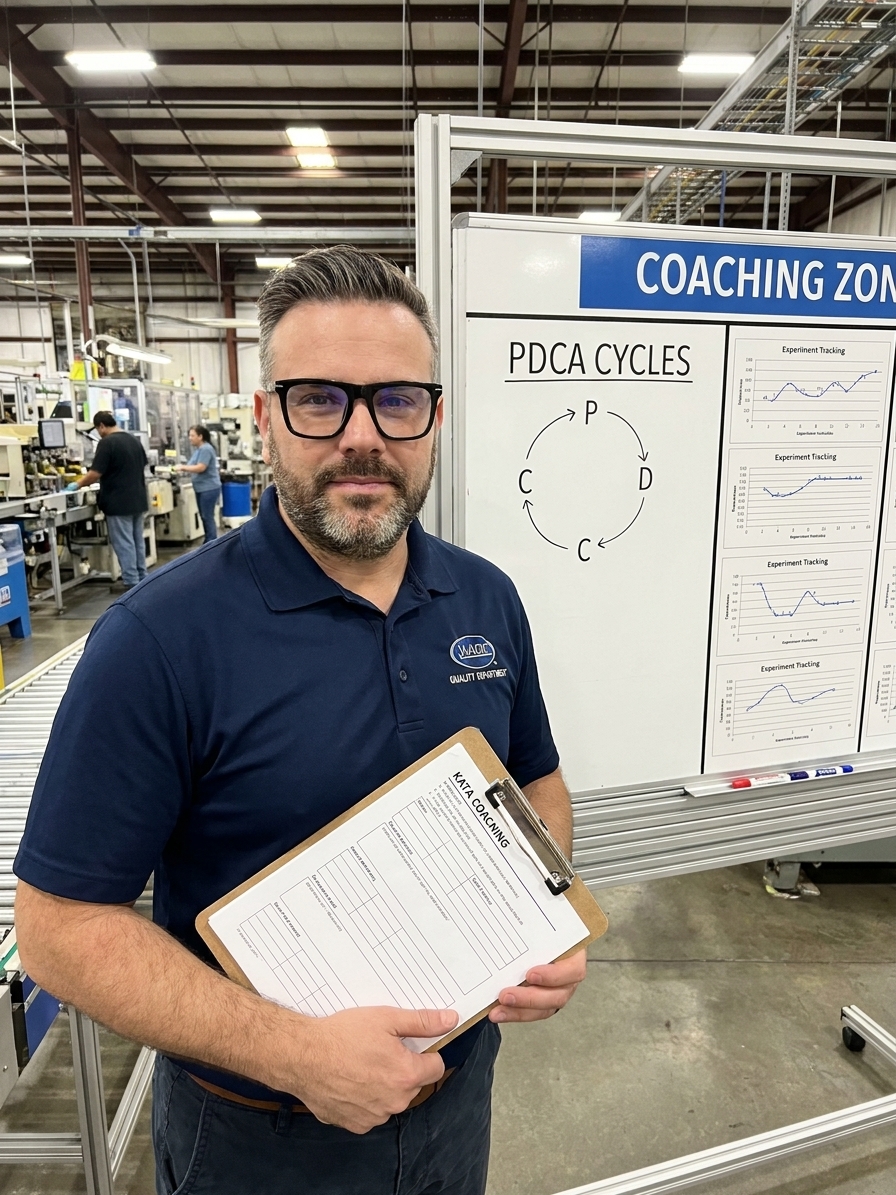
The Improvement Kata will die within weeks if left unsupported by management. The traditional habits of assigning and executing tasks are deeply ingrained in manufacturing leadership. Scientific experimentation feels slow and inefficient to managers evaluated on immediate output. The Coaching Kata is the structured daily routine that a leader uses to force the improvement pattern into the team's permanent behavioural repertoire.
The coach does not provide answers or authorize technical solutions. Their sole function is to ask five specific questions in a strict order, every single day, directly at the point of execution. This forces the learner to articulate their target, ground their analysis in measured reality, identify the actual obstacle, and commit to their next experiment. Coaching from an office completely invalidates the routine.
When a manager solves the problem for the team, organizational learning stops. The Coaching Kata shifts leadership behaviour from problem-solving to problem-solver development. If a black belt runs the statistical analysis and implements the fix, the team watches passively. When the team runs the experiments guided by the coach's questions, they build the neurological pathways required to permanently sustain the quality gains.
The coach doesn't solve the problem. The coach develops the problem-solver through disciplined, daily questioning at the gemba.
Executing Kata in Stamping and Assembly Operations
Consider a tier-one automotive supplier struggling with dimensional variation on a critical body panel. Their defect rate had stagnated at roughly 2,200 PPM for eighteen months. They had launched three separate Six Sigma projects. Two yielded no sustained improvement, and the third saw a brief reduction that rebounded entirely within six weeks of the closure review.
The quality director replaced the project framework with the kata routine. The team defined their target condition: dimensional variation within 0.15mm across all measurement points, sustained for thirty consecutive days. Live data from the previous two weeks showed actual variation ranging randomly from 0.12mm to 0.41mm. Their first obstacle was a total lack of process parameter visibility, as they were only measuring the final part.
The team's first experiment was simply measuring die temperature, material batch, and press tonnage at the start of each run to find correlations. Over six weeks, they ran twenty-three rapid experiments. They discovered that die temperature swings exceeding 15°C between the first and fiftieth part directly correlated with 80% of their variation spikes. They also found a specific supplier's batch required an undocumented tonnage adjustment.
By week twelve, dimensional variation had tightened to within 0.18mm. By week twenty, the target condition was met and sustained, dropping the defect rate below 400 PPM. The team did not just solve one isolated manufacturing issue; they developed a thinking routine that they immediately applied to the next bottleneck. The capability of the process scaled with the capability of the people.
Stamping Line Kata Results
Integrating Kata with QMS Requirements
Quality professionals frequently ask how kata integrates with formal compliance requirements like IATF 16949 or AS9100. The framework is not a replacement for your QMS; it is the behavioural engine that drives it. Your quality management system dictates the standards and documentation required for compliance, while the kata routine builds the daily discipline needed to actually hit those standards on the floor.
Your PFMEA identifies what could go wrong and prioritizes risk, but the routine is how you systematically experiment to close those specific risk gaps. Your SPC charts tell you exactly when a process is drifting out of statistical control, but the routine is how operators investigate the root cause and correct the drift before it results in a nonconforming product. The tools provide the data; the routine drives the action.
Consider the 8D corrective action process required by automotive standards. Teams often treat 8D as a paperwork exercise to satisfy customer quality demands after an escape. When a team practices scientific thinking daily, their 8D responses become inherently more rigorous. Because they are already accustomed to forming hypotheses and running controlled experiments on the floor, their containment and root cause analysis are based on proven physical tests rather than theoretical assumptions.
The most critical intersection occurs during internal audits. A standard ISO 9001 audit checks for adherence to documented procedures. An organization practicing kata has operators who actively experiment to improve those procedures daily. The audit shifts from a reactive scramble to prove compliance into a standard review of a continuously improving, highly disciplined operational system. Compliance becomes a natural byproduct of good practice.
Common Implementation Failures
The most frequent error is treating kata as a top-down corporate program to be rolled out across an entire facility simultaneously. Structured scientific thinking cannot be mandated via a PowerPoint presentation. It must start with a single team, a single coach, and a single process, expanding organically only after the initial routine takes hold and demonstrates measurable success.
Another critical failure is abandoning the routine immediately after the first major success. The hardest phase of implementation begins precisely when a team achieves their target condition. If they do not immediately apply the routine to the next challenge, old habits of plan-then-execute will instantly return. Leadership must enforce the daily coaching cycles relentlessly to prevent regression to traditional firefighting behaviour.
Managers frequently skip the deep investigation of the current condition because the temptation to jump straight to solutions is overwhelming. Teams that bypass this step almost always solve the wrong problem. Without a quantified, measured baseline of exactly what is happening at the gemba right now, every subsequent hypothesis is built on assumption rather than fact, rendering the experimentation cycle useless and wasteful.
Finally, leaders confuse coaching with problem-solving. If you are providing technical answers to your team during a coaching cycle, you might be a skilled engineer, but you are failing as a kata coach. The mandate is strictly to ask the five questions, push the learner to define their next step, and walk away. The cognitive struggle of designing the experiment belongs entirely to the operator.
Establishing the First Thirty Days
Begin implementation by selecting one specific team, one coach, and one narrowly defined process during the first week. Do not choose the plant's largest systemic issue. Choose a contained problem where the team can safely learn the routine without the pressure of executive oversight. The priority in this initial phase is behavioural repetition, not immediate defect reduction.
During week two, the coach must begin daily cycles at the gemba. This requires ten to fifteen minutes of direct floor time asking the five structured questions without exception. The coach must consciously resist providing any solutions, focusing entirely on verifying that the learner understands their current condition and has formulated a valid, testable hypothesis for their next step.
By week three, the team should be executing their first rapid experiments and documenting the results. The parameters must be small enough to fail safely. If an experiment risks scrapping a high-value aerospace component or halting the line, the scope is too broad. The goal is fast data generation that proves or disproves a specific variable's effect on the process output.
At the thirty-day mark, evaluate the team's operational dynamics rather than just their metrics. If the daily conversation has shifted from assigning blame for defects to actively discussing the next parameter test, the routine is taking hold. Almost every early failure in this phase traces back to managers who provided answers instead of asking questions, or coaches who skipped days and failed to build the neural pathways.