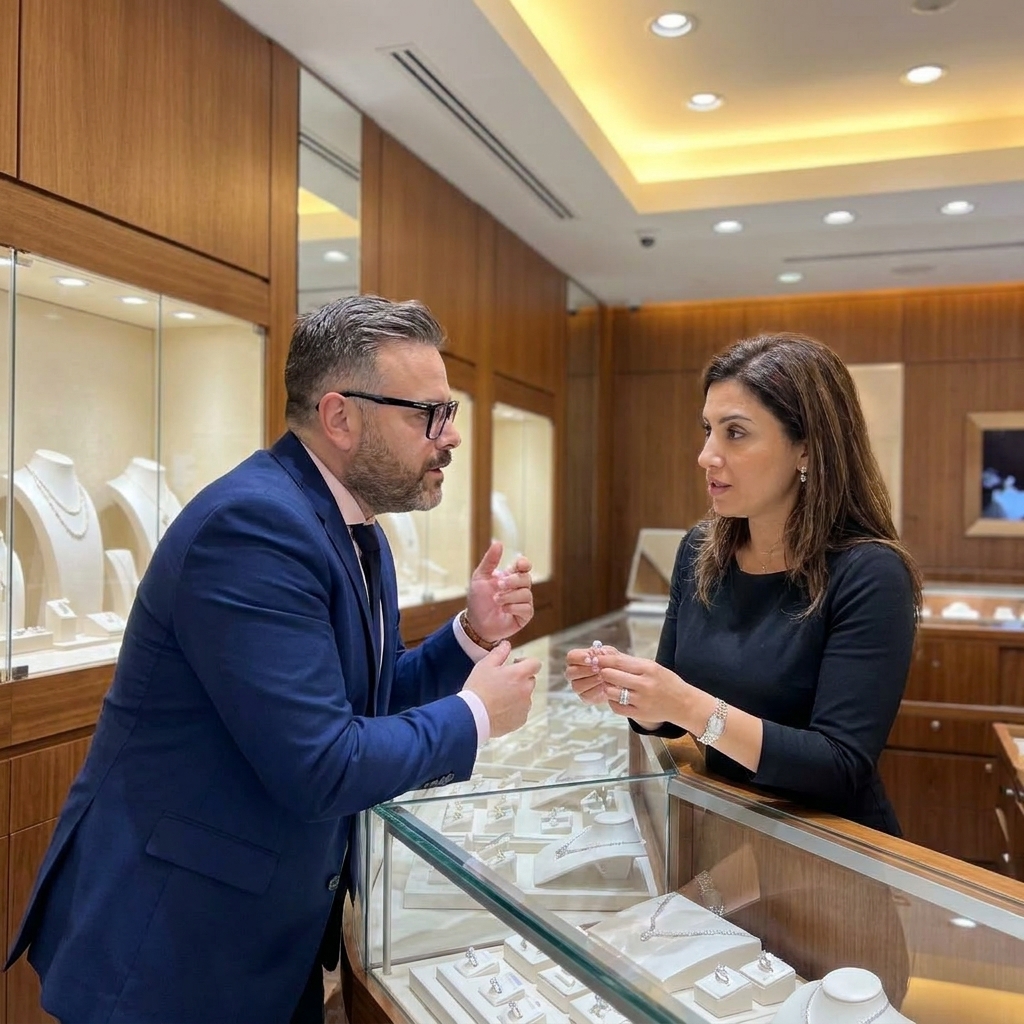
When a high-end retail operation suffers from volatile revenue and low conversion, management typically treats it as a marketing problem. They buy more advertising or redesign the storefront. In my experience auditing and restructuring operations across automotive and aerospace, low conversion is almost always a process problem. The organisation has failed to define its critical parameters, standardise its workflows, or measure its actual performance.
The principles we use in IATF 16949 and AS9100 environments apply directly to high-ticket retail. A luxury boutique selling high-value goods faces the same fundamental risks as a manufacturing plant: uncontrolled variation, undocumented processes, and a workforce that relies on individual heroism rather than systematic competence. When you treat the customer journey as a production process, you can apply Statistical Process Control (SPC), Standard Operating Procedures, and Plan-Do-Check-Act (PDCA) methodologies to stabilise and grow revenue.
I have implemented these quality management systems at manufacturing facilities with 900+ employees, and the structural requirements are identical. You must define the Critical Customer Experience (CCE) just as you define Critical-to-Quality (CTQ) characteristics in manufacturing. If you do not map and control the process, your output—whether it is an aerospace component or a completed retail sale—will remain unpredictable.
Defining the Critical Customer Experience
In precision engineering, we identify critical characteristics using tools like PFMEA (Process Failure Mode and Effects Analysis) to determine where a process is most likely to fail. In high-ticket retail, the equivalent is mapping the Critical Customer Experience. This involves breaking the customer journey down into discrete, measurable touchpoints and establishing acceptable tolerances for each one. Without this definition, staff improvise, and the customer experience varies wildly.
A typical failure point in luxury retail occurs within the first minute. If a customer is not acknowledged according to a defined standard, the probability of a meaningful sales conversation drops significantly. By implementing a standard greeting protocol—essentially a Standard Operating Procedure for initial contact—we can shift the first-conversation rate from roughly 40% to over 85% in a matter of weeks. This is not about scripting personalities; it is about controlling the process inputs to guarantee a reliable output.
Once the critical touchpoints are defined, they must be documented and controlled. In a manufacturing audit, if an operator cannot show the procedure for their station, it is a major non-conformity. The same standard must apply to retail staff. Every team member must know the exact parameters for product presentation, needs discovery, objection handling, and closing. This documentation transforms individual talent into institutional knowledge that survives staff turnover.

Standardising the Sales Process
A Standardized Sales Process (SSP) functions exactly like a manufacturing routing. It defines the sequence of operations, the time allocated, and the quality checks required at each stage. In a jewellery boutique, this means establishing clear procedures for greeting, needs discovery, product selection, closing, and post-purchase follow-up. When a process is standardised, deviations become immediately visible, allowing management to correct them before they impact revenue.
In manufacturing, we use Control Plans to specify how each operation must be performed and monitored. The retail equivalent is a documented SSP that specifies the exact criteria for moving a customer from one stage of the sales process to the next. For example, the needs-discovery phase requires specific open-ended questions to identify the occasion and budget range. If a salesperson skips this step, the subsequent product presentation is based on guesswork rather than data.
The implementation of an SSP also drastically reduces onboarding time. In my experience transitioning ISO 9001 systems, the most significant cost of staff turnover is the loss of undocumented tacit knowledge. When a standardised process is in place, new hires become productive in two weeks instead of two months. They follow the procedure, they are measured against the established metrics, and they achieve the expected output with significantly less variance.
The Retail Standardised Sales Process (SSP)
- 01Greeting & WelcomeInitial 30 seconds: Acknowledge presence warmly and assess browsing versus buying intent.
- 02Needs DiscoveryNext 2 minutes: Ask open-ended questions to identify the occasion and precise requirements.
- 03Product PresentationPresent 2-3 matched options, highlight craftsmanship, and invite product trial.
- 04Closing & Follow-UpResolve objections, process payment seamlessly, and execute 24-hour post-purchase follow-up.
Applying Statistical Process Control to Sales
If you do not measure your process, you cannot control it. This is a fundamental rule in both SPC and quality management. Retail operations typically track lagging indicators like monthly revenue, which tells you what happened but not why. To control a retail operation, you must track leading indicators: foot traffic, first-conversation rate, product demonstration rate, and conversion rate. These are the process variables that drive the final output.
We implement daily logging systems using a simple CRM to capture these variables. Each salesperson records their inputs: the number of customers engaged, the number of needs-discovery conversations completed, and the number of demonstrations performed. By plotting this data on control charts, we can identify special-cause variation immediately. If a salesperson's conversion rate drops below the lower control limit on a given day, we investigate the root cause using 8D methodology.
The result of this measurement discipline is predictable revenue. Instead of fluctuating wildly from month to month, the operation begins to forecast within a tight tolerance. In manufacturing, we aim for a Cpk of 1.33 to ensure process capability. In retail, we apply the same logic to sales metrics. When conversion rates and average transaction values stabilise, forecasting accuracy improves dramatically, allowing for better inventory management and resource planning.
Key Retail Performance Indicators
Executing PDCA for Continuous Improvement
Plan-Do-Check-Act (PDCA) is the engine of ISO 9001 and IATF 16949. It is not an annual review; it is a continuous cycle of process refinement. In a retail operation, this means structured weekly quality meetings where management reviews the leading indicators on the control charts. The team identifies deviations from the standard, assigns root-cause corrective actions, and verifies implementation. This is the exact same management review process required by clause 9.3 of ISO 9001.
Quarterly Kaizen events provide the platform for deeper process optimisation. During these focused sessions, the team conducts a deep dive into one specific area—such as the display layout, the consultation booking process, or the high-value client journey. We map the current state, identify constraints and waste, design a future state, and implement the changes. The performance of the new process is then measured against the baseline data.
Standardising the process does not eliminate the craft; it isolates the variables that actually drive value.
Continuous improvement relies on data, not opinions. If a team believes that moving a product display will increase sales, that hypothesis must be tested against the measurement system. We implement the change, track the conversion rate and average transaction value, and compare the results to the previous baseline. If the data confirms an improvement, the new layout becomes the standard. If it does not, we revert to the old standard.
Building a Quality Culture in Retail
A quality management system will fail without cultural adoption. In manufacturing, I have seen plants with flawless documentation produce defective products because the operators did not follow the procedures. The same happens in retail. If the sales team views the SSP as bureaucratic interference rather than a tool for their success, they will bypass it. Building a quality culture requires leadership to model the behaviour, enforce the standards, and reward compliance.
Management must follow the same procedures they enforce. If the owner or manager deviates from the standardised process, the team will immediately recognise the lack of commitment. Leadership also means measuring quality metrics alongside revenue numbers. A salesperson who hits their revenue target but ignores the CRM logging requirements and bypasses the follow-up protocol has not delivered quality. Recognition must be tied to adherence to the system, not just financial output.
Empowerment is the final piece. In a mature quality system, operators have the authority to stop the line if they detect a defect. In retail, staff must have the authority to resolve customer issues immediately, without escalating every decision to management. This requires clear boundaries, comprehensive training, and a culture that views mistakes as process failures to be solved, not individual failures to be punished. When this environment is achieved, staff turnover drops significantly.
The Measurable Impact of Process Control
The application of these quality principles produces measurable, verifiable results. In one specific implementation at a high-end retail boutique, the systematic application of process definition, standardisation, and SPC transformed the operation within twelve months. The most critical indicator—conversion rate—increased from 3% to 18%. This was not achieved through better marketing, but by controlling the inputs: ensuring that 85% of visitors received a structured needs-discovery conversation.
Operational efficiency improved in tandem. Average transaction value increased from €2,200 to €5,100 because the standardised process forced staff to present higher-value options matched to properly identified customer needs. Staff turnover dropped from 45% to 12% because the documented processes reduced onboarding time from two months to two weeks, and the clear expectations reduced workplace friction. Inventory turnover improved from 2.5x to 4.2x per year due to predictable sales patterns.
These outcomes are the direct result of applying rigorous manufacturing quality principles to a retail environment. By defining critical characteristics, implementing standard operating procedures, applying statistical process control, and executing continuous improvement cycles, the operation achieved predictable, sustainable growth. The same methodologies that ensure zero-defect manufacturing in aerospace can engineer consistent excellence in customer experience.