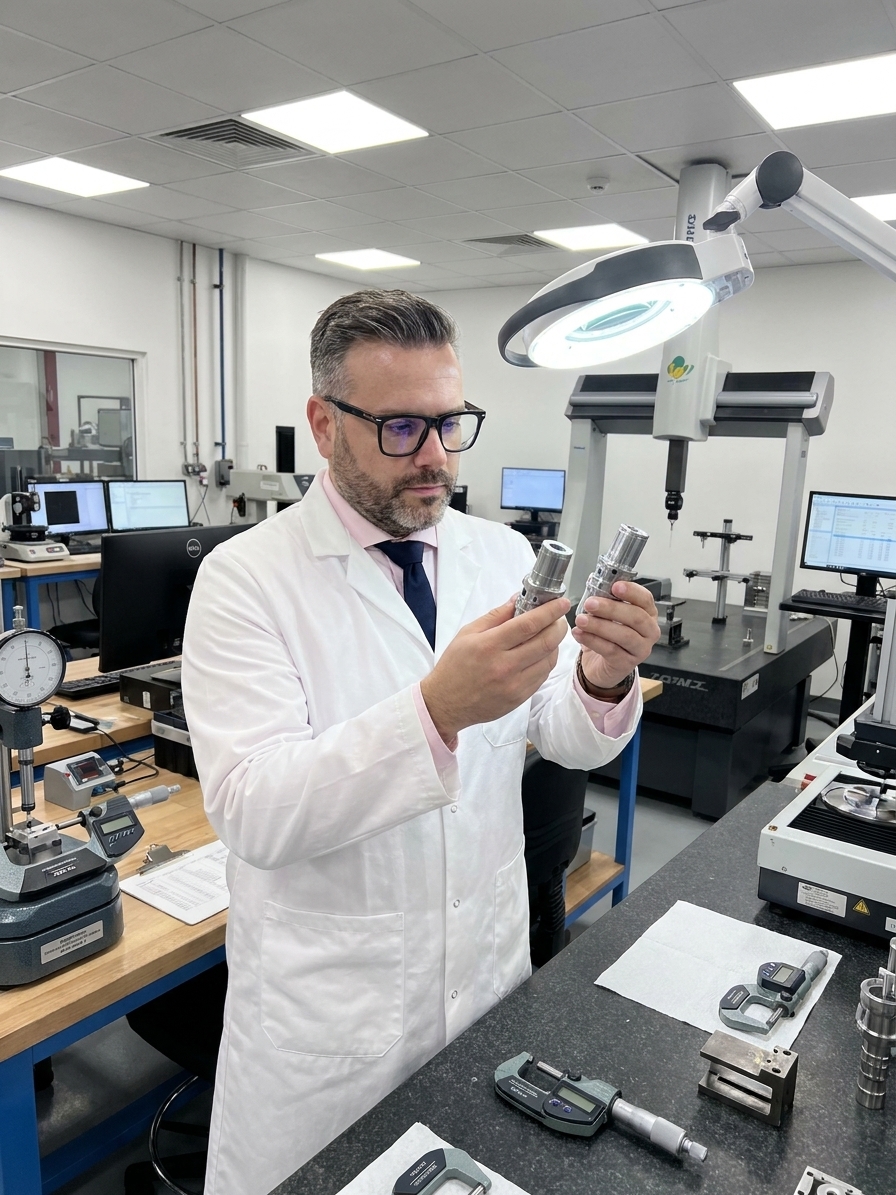
Three parts come through the line. The first carries visible tool marks, a burr, and a finish that is clearly out of spec. The second is slightly better but remains defective. Judged against the first, however, it looks acceptable. The third is marginally worse than the second. The inspector passes all three.
When the customer later rejects the batch, you pull the parts and measure them against the specification. All three fail. The inspector had the gauges, the training, and the spec sheet. What they lacked was immunity to the Contrast Effect: the cognitive bias that makes human judgment relentlessly relative rather than absolute.
The human perceptual system evolved to detect changes, not absolutes. Retinal cells report differences in light, not raw levels. The auditory system measures changes in pressure. The brain is a difference engine, and in quality inspection, that neurological architecture is a measurable liability.
I have audited plants where highly experienced operators approved systematically defective parts because their internal baseline had shifted over a four-hour shift. The specification never changed. The operator's perception did. The cost of this inspection drift is cumulative, invisible, and entirely avoidable through engineering controls.
The Mechanics of Inspection Drift
An inspector evaluating hundreds of parts in sequence is supposed to measure each against an absolute, unchanging standard. Instead, the brain evaluates each part in the context of the experience that occurred five seconds prior. After thirty borderline parts, the internal baseline shifts.
What looked marginal at 8:00 AM looks acceptable by 10:00 AM. This adaptation has a name in quality management: inspection drift. It is a repeatable phenomenon documented across automotive, aerospace, electronics, and pharmaceutical visual inspection. It occurs regardless of inspector diligence.
Consider an inspector evaluating surface finish on machined components with a maximum roughness of Ra 1.6. Part 1 measures Ra 1.4 and is approved. Part 2 measures Ra 1.55, borderline but conforming. The inspector approves, but their internal baseline shifts slightly upward.
Part 3 measures Ra 1.65, technically out of spec. Judged against Part 2, the difference is imperceptible, and it passes. Part 4 measures Ra 1.78, but judged against the shifted baseline, it remains in the neighbourhood. Part 5 measures Ra 1.95, grossly defective. The cumulative drift hides the decline.
Cumulative Perceptual Drift Sequence
- 01Baseline AnchorInspector begins the shift anchored to the specification limit of Ra 1.6.
- 02Borderline ExposureExposure to borderline parts at Ra 1.55 shifts the internal reference upward.
- 03Threshold BlurA part at Ra 1.65 is judged against the previous part, not the spec, and passes.
- 04Gross Failure AcceptanceBy Ra 1.78, the cumulative baseline shift makes gross defects appear conforming.

Where Sequential Bias Destroys Quality
The Contrast Effect does not limit itself to visual inspection of surface finish or cosmetic defects. It shows up wherever human judgment meets sequential evaluation. Dimensional judgment using dial gauges is vulnerable when inspectors must interpret whether the needle sits clearly within the green zone or on the line.
Internal and external audits are equally susceptible. After reviewing a department with serious nonconformities, an auditor evaluates the next department against a lower baseline. After a high-performing department, expectations rise, and minor variations get flagged. Audit consistency becomes contaminated by sequence effects.
Supplier evaluation creates identical distortion. A mediocre supplier looks competent when evaluated immediately after a terrible one. A good supplier looks inadequate when evaluated right after an outstanding one. Professional audit firms address this by scheduling breaks, rotating auditors, and using standardised scoring systems that force comparison against defined criteria.
Even calibration technicians fall prey to this bias. When setting reference standards, the sequence of adjustments can be influenced by the contrast between the current reading and the previous one, introducing systematic error into the calibration results.
Why Training Cannot Solve a Perceptual Problem
The standard response to inspection errors is retraining. Remind the inspector of the specification. Show examples of conforming and nonconforming parts. Send them to a workshop. Training is necessary, but it is insufficient against the Contrast Effect.
You cannot train away a fundamental property of human neurology any more than you can train someone to see ultraviolet light. The problem is not a lack of knowledge. It is a perceptual limitation. The inspector sincerely believes they are judging against the specification. They are judging against the last part.
Expertise actually amplifies the risk. Experienced inspectors develop rapid pattern recognition. They process parts faster, which means they process more parts in sequence, accumulating more contrast adaptation per shift. The fifteen-year veteran is not immune. They are efficient, and efficiency without countermeasures accelerates drift.
A new inspector, uncertain and cautious, checks every part against the specification. They have not seen enough parts to build a shifted baseline. Their judgment is slow, but it is anchored to the standard. The confident veteran processes parts in rapid flow and has not looked at the spec sheet in weeks. If the process is drifting, their internal standard drifts with it.
Expertise doesn’t eliminate the Contrast Effect. It creates the conditions for it to do its worst work — quickly, confidently, without self-doubt.
Engineering Countermeasures for Human Perception
If you cannot eliminate the Contrast Effect, you must engineer systems that minimise its impact. This is where quality engineering meets human factors. The goal is to break the sequential chain and force periodic recalibration against absolute references.
Reference reset protocols are the primary defence. Between batches or at fixed intervals within a batch, require the inspector to re-examine a known golden sample representing the boundary between conforming and nonconforming. The military has used this approach for decades in munitions inspection, requiring comparison against a reference standard every twentieth round.
Randomised sequencing breaks the sequential chain. If parts are always inspected in production sequence, any systematic trend will be masked by contrast adaptation. Automated inspection systems can feed parts from a buffer rather than directly from the line, and manual inspection can implement creative logistics to achieve the same disruption.
Blind comparison standards provide both measurement and reset. Periodically insert known nonconforming parts into the inspection stream without the inspector's knowledge. This measures actual detection rates in real conditions and forces a perceptual reset when the planted defect is caught. The awareness that any part could be a test specimen maintains attentional engagement.
Training vs. Engineering Controls
What teams do
- Retrain the inspector on the specification limits after defects escape.
- Assume experience provides immunity from perceptual bias.
- Inspect parts in the exact sequence they arrive from production.
- Rely on the inspector remembering what the standard looks like.
What works
- Engineer reference resets using physical golden samples at fixed intervals.
- Implement blind testing to measure actual detection rates.
- Randomise inspection order to break the sequential contrast chain.
- Route borderline cases to automated measurement anchored to a number.
Systemic Contamination in Audits and Management Review
The Contrast Effect walks directly into your audit program. Internal auditors who review the same processes repeatedly develop contrast baselines just like inspectors. A process that would horrify a fresh auditor looks normal to the one who has seen it deteriorate gradually over three years.
The nonconformity that would be flagged in isolation gets normalised by the sequence of previous audits that documented the same issue without requiring corrective action. This is why auditor rotation is not merely good practice. It is a perceptual necessity. Fresh eyes see the process as it is, not as it compares to what it was.
Management reviews suffer the same distortion. When senior leaders review quality performance monthly, each month's data is evaluated against last month's data. A quality metric that has been declining for two years gets accepted because the month-over-month change looks small. The Contrast Effect, applied to trend analysis, hides systemic decline.
The countermeasure is identical: periodic reset against an absolute reference. Compare current performance to the best month, not last month. Compare the process to what it should be, not to what it was. Supplier audits require the same discipline. The auditor who just came from your worst supplier is not the one who should evaluate your next one.
Building a Contrast-Aware Quality System
Most organisations manage quality in relative terms without realising it. They compare this quarter's defect rate to last quarter's. They compare their production lines and suppliers to each other. All of these are relative comparisons, and all are vulnerable to contrast drift.
At the inspection station, implement reference resets and measure detection rates, not just throughput. An inspector who catches 98% of defects at a slower pace is more valuable than one who catches 85% at a faster pace. Build forced-pace inspection with deliberate pauses to let the perceptual system partially reset.
At the design level, build robustness into the process. If a dimension sits so close to the specification limit that conformance depends on inspector perceptual accuracy, the process is not capable. A Cpk of 1.33 is the minimum, but a robust process pushes capability higher so the inspector's judgment is not the deciding factor.
World-class quality organisations maintain absolute references: customer specifications, zero-defect targets, and best-in-class benchmarks. They do not ask whether they are better than yesterday. They ask whether they are where they need to be. The first question is relative. The second is absolute, and it is the only one that matters to the customer receiving the part.