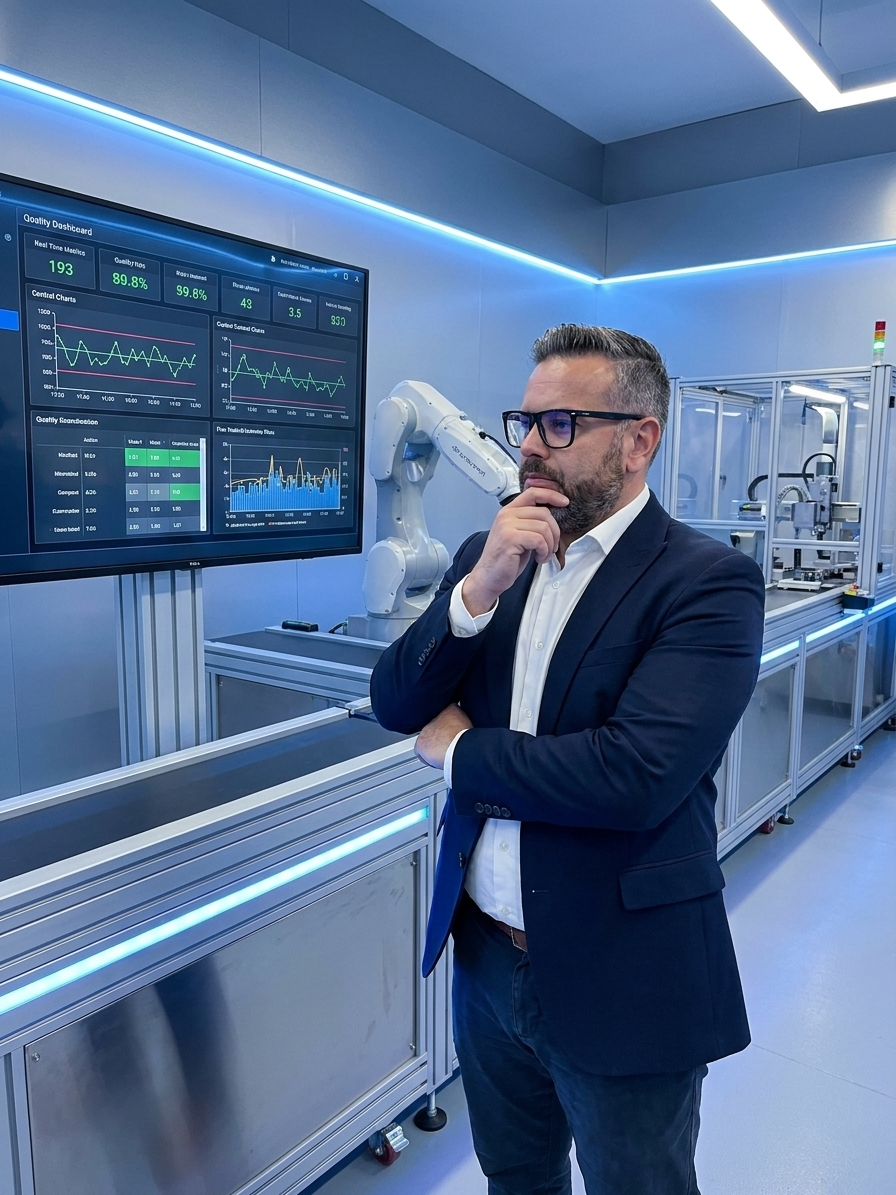
Adding a second inspection station to catch defects seems like sound engineering logic. If one inspector misses a fault, the second acts as a safety net. The investment is typically modest—a used coordinate measuring machine and a technician reassigned from production. The immediate results usually justify the decision. Defect rates drop, quality managers present hockey-stick graphs at monthly reviews, and the problem appears solved.
Six months later, the customer rejects an entire shipment. The defect is not subtle or difficult to detect. The parts are missing a hole specified on the drawing for over a decade—an operation every operator has performed thousands of times. Both the original inspector and the newly added second inspector signed off on the batch.
During the 8D investigation, the root cause becomes clear. The first inspector, knowing a second inspector follows, gradually relaxed his acceptance criteria. The second inspector, aware that the first already approved the parts, never fully engaged with the process. Together, they created an inspection system less effective than a single inspector working without a net. This is risk compensation, and it actively undermines layered process audits and inspection systems.
The Economics of Risk Compensation
In 1975, economist Sam Peltzman published a study on automotive safety mandates. The conventional assumption was that mandatory seatbelts, padded dashboards, and collapsible steering columns would reduce traffic fatalities. The reality proved more complex. While the severity of injuries in any given accident decreased, the total number of accidents increased.
Drivers protected by seatbelts drove faster, followed more closely, and braked later. The safety equipment did not eliminate risk; it relocated it. Some of the risk drivers shed through safer vehicles was absorbed by pedestrians, cyclists, and the drivers themselves through increased accident frequency. The human brain unconsciously maintains a target level of risk. When an activity feels safer, people push the boundaries until perceived risk returns to their comfort zone.
This psychological mechanism applies directly to AS9100 and IATF 16949 environments. If operators perceive that automated vision systems, poka-yoke devices, and layered approvals are protecting the process, they allocate less of their own attention to the task. The relaxation happens below the level of conscious awareness. Nobody decides to be careless; they simply calibrate their effort to the perceived risk.
How Safeguards Dilute Operator Responsibility
Quality systems are built on safeguards. Dual inspections, automated checks, SPC charts, and layered process audits each address a genuine failure mode. Each makes sense in isolation. But the Peltzman Effect operates in the spaces between these safeguards. It exploits human cognition: when we perceive a system is protecting us, we reduce our vigilance.
I have audited plants where operators stopped measuring every critical dimension after a vision system was installed. Instead, they checked every third part, confident the machine was watching. Inspectors abbreviated twelve-step protocols when poka-yoke devices were added to the line. Supervisors stopped reviewing first article inspections thoroughly once SPC charts showed twelve months of stability. Each adjustment was rational, small, and entirely invisible.
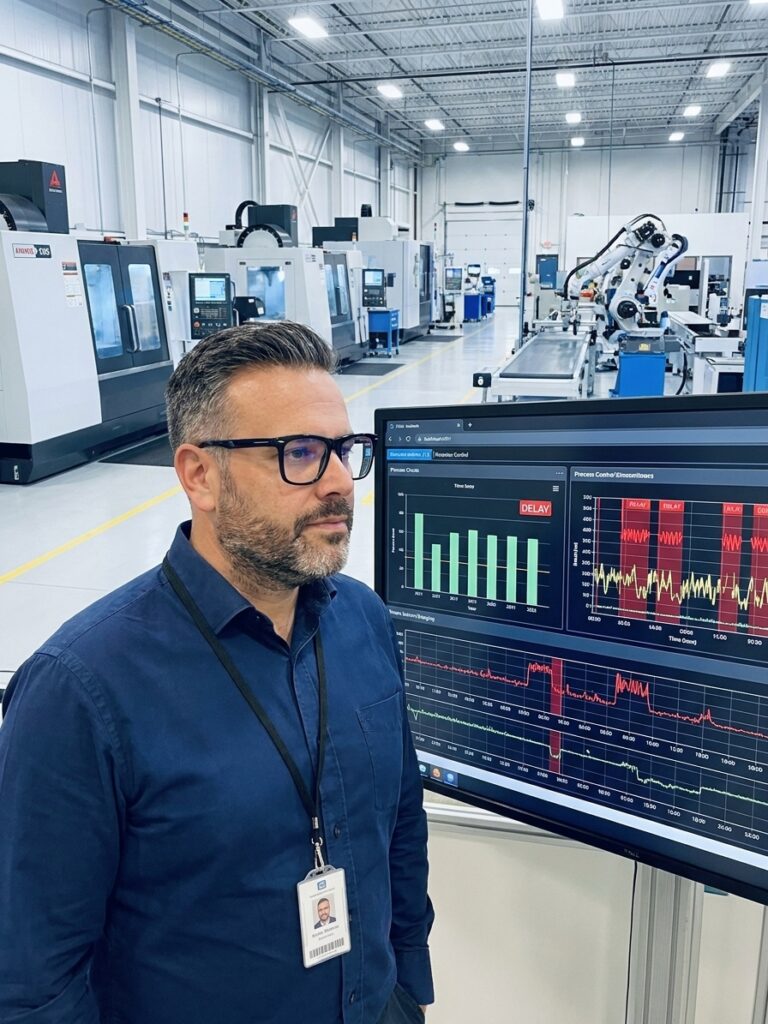
The failure occurs when the vision system’s camera gets coated with cutting fluid and nobody notices, because the operator stopped looking months ago. The poka-yoke sensor fails in the pass position, and the inspector’s abbreviated protocol lacks the check that would have caught it. The safeguards did not fail mechanically. They changed the behavior of the humans around them, and the changed behavior created the defect.
The Hierarchy of Risk Compensation
Not all safeguards trigger risk compensation equally. Through two decades implementing ISO 9001 systems across automotive and aerospace, I have observed a clear hierarchy of behavioral relaxation. The intensity of the Peltzman Effect correlates directly with the visibility of the safeguard and its perceived comprehensiveness.
At the top are highly visible, comprehensive systems. A fully automated inspection cell with reject bins and alarm lights shifts the operator’s mental model. Quality becomes something the machine does, rather than something the operator produces. The psychological distance between the operator and the outcome increases. If the machine is responsible for catching defects, the operator unconsciously stops owning the quality of the output.
In the middle are layered systems—multiple checks performed by different people. These trigger a subtler but equally dangerous dynamic: the diffusion of responsibility. When three people are responsible for catching a defect, each unconsciously reduces their effort because they expect the others to compensate. Social psychologists call this the bystander effect. In quality systems, it means three inspectors can be collectively less effective than one inspector working alone.
Hierarchy of Risk Compensation Intensity
- High Risk: Comprehensive AutomationAutomated cells with alarm lights shift ownership from the operator to the machine.
- Medium Risk: Layered InspectionsMultiple human checks trigger the bystander effect and diffuse responsibility.
- Low Risk: Augmentation ToolsGo/no-go gauges extend operator capability without altering their perceived responsibility.
At the bottom are safeguards that augment human capability without replacing human judgment. Go/no-go gauges and torque wrenches do not typically trigger significant risk compensation. The operator still decides whether to use the tool, still interprets the result, and still owns the outcome. The tool extends their capability without altering their responsibility for the process.
Why Conventional Metrics Miss the Drift
The Peltzman Effect is invisible to conventional quality metrics because it does not create new failure modes. It activates existing ones. When an operator stops measuring every part and starts measuring every third part, the daily quality metrics do not immediately change. The vision system is still catching defects. The SPC charts show statistical control. The customer receives acceptable parts. Everything looks stable, often for months or years.
What is actually happening is that the system’s margin of safety is being consumed. The defense-in-depth you designed is being quietly dismantled from the inside. Not by sabotage, but by the natural human tendency to calibrate effort to perceived risk. Each individual adjustment is invisible to Cpk tracking and OEE dashboards. The cumulative effect is catastrophic.
Three inspectors can be collectively less effective than one inspector working without a safety net.
Failures caused by risk compensation are always shocking because they involve obvious defects. A missing hole. An incorrect torque value. An unfinished surface. They reveal that multiple PFMEA safeguards failed simultaneously—not because the safeguards broke, but because the humans around them had calibrated their behavior to assume the safeguards would compensate for their reduced vigilance. The 8D post-mortem concludes with human error, and it misses the systemic root cause entirely.
The Cost of Automating Away Responsibility
I worked with a tier-one automotive supplier that invested heavily in a state-of-the-art automated inspection system for their machining line. The system used multiple cameras, laser measurement, and AI-based defect recognition. For the first year, the technology worked beautifully. Then the OEM reported a field failure rate ten times higher than the previous year, before the automated system was installed.
The investigation revealed a cascade of risk compensation. Before automation, the line relied on three manual inspection points. Operators at these stations were attentive because they knew defective parts would reach the customer. After the automated system was installed, management reduced manual inspections from three to one. The remaining inspector, knowing the automated system checked every part, shifted from thorough inspection to a confirmatory glance.
Production operators began running machines at higher speeds, pushing tooling beyond recommended change intervals, and skipping in-process checks. The automated system itself was operating at high detection efficiency. But the manual oversight that had previously contributed detection capability was neutralized by risk compensation. The combined system was less effective than the purely manual process it replaced.
Tracking Behavioral Disengagement
Designing Defenses Against the Peltzman Effect
You cannot eliminate risk compensation; it is a feature of human cognition, not a defect. But you can design quality systems that account for it. The first principle is preserving psychological ownership. Every person in the value chain must feel personally responsible for the output. Design safeguards that make human judgment more important, not less. Instead of an automated system that replaces inspection, implement one that flags borderline cases for mandatory human review.
The second principle is to measure the health of the measurement system, not just the product. Standard quality metrics—defect rates, scrap rates, customer PPM—are lagging indicators. You need leading indicators that track whether humans are still engaged. Is the automated system rejection rate changing? How many borderline decisions is each inspector making per shift? Are manual override rates consistent? If operators never override the automated system, they have mentally checked out.
The third principle is periodically stress-testing your safeguards. Every six months, temporarily disable one layer of your quality system—with appropriate risk mitigation in place. If defect rates remain stable, your remaining layers are robust. If defect rates spike, you have discovered that one of your other layers was compromised by risk compensation. You found the vulnerability before it caused a customer-facing failure.
The final principle is the discipline of subtraction. When a quality failure occurs, the first question should not be what new safeguard to add. The first question should be: what existing safeguard changed the behavior that led to this failure? If the root cause was behavioral disengagement caused by existing layers, adding another layer worsens the problem. You are treating the symptom of the treatment.