AQL
— Acceptable Quality Limit: When You Stop Inspecting Every Piece and Start
Assessing Risk Intelligently
There once was a quality manager who believed that 100% inspection
of every single piece was the only path to certainty. His name was Milan,
and he worked at an automotive supplier plant in eastern Slovakia. Every
morning he arrived at the factory, looked at the production plans, and
knew that once again his team of inspectors would spend hours hunched over
every single part. Their heads spun, their eyes grew tired — and despite
it all, defects still slipped through.
Milan wasn’t a bad manager. He was convinced he was doing the best
he could. But it took him three years and one particularly painful
customer complaint before he understood what many quality professionals
realize too late: 100% inspection is not 100% certainty.
It’s an illusion that costs money, time, and — paradoxically — quality.
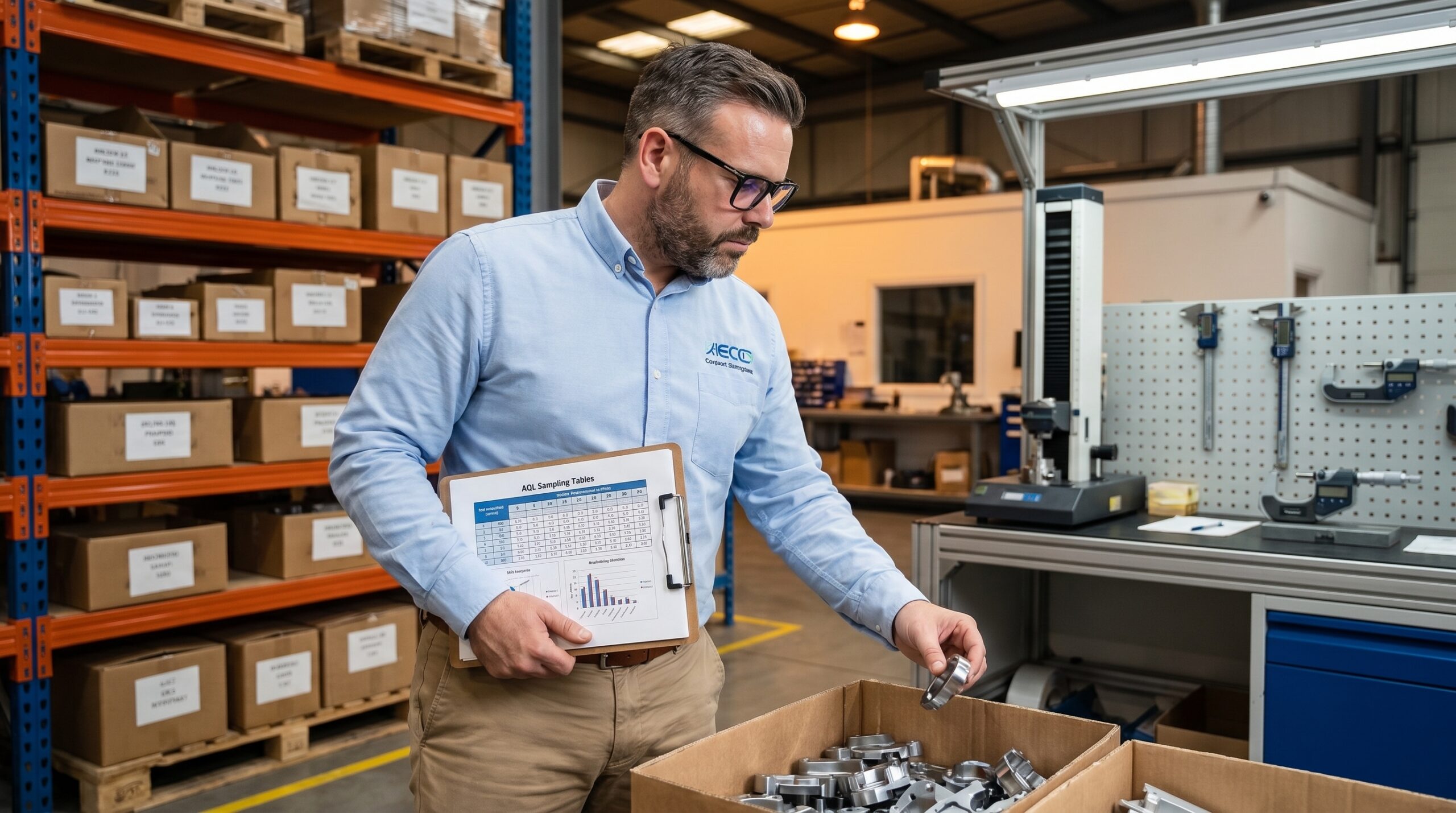
Today we sit in his office, three years after he introduced AQL
sampling plans. On the wall hangs a board with sample plans, histograms,
and an incoming inspection flowchart. Milan smiles: “You know what’s most
interesting? Since we started inspecting fewer pieces, our complaint costs
have gone down. The bottleneck wasn’t the quantity of inspection. It was
its quality.”
What Is AQL and Why It Exists
AQL, or Acceptable Quality Limit (historically Acceptable Quality
Level), is a fundamental concept of statistical quality control that
defines the highest acceptable percentage of defects in
a batch or shipment. It is not a quality target — it is the boundary that
separates an acceptable shipment from an unacceptable one.
The concept emerged during World War II, when the U.S. military
needed to quickly and reliably accept or reject massive shipments of
ammunition and materiel. They couldn’t test every single round — that
would destroy the entire shipment. But they also couldn’t let everything
through unchecked. They needed a system that would tell them, with high
probability: “This batch is fine” or “This batch is problematic, we’re
rejecting it.”
The result was the MIL-STD-105 standards, which later became the
foundation for ISO 2859 — a set of standards for acceptance sampling by
attributes. Today, AQL is used in virtually every industry: from
electronics to automotive, textiles, and pharmaceuticals.
How AQL Works — The Story
of One Shipment
Imagine you’re Milan and a shipment of 5,000 plastic covers from a
new supplier in Turkey just arrived. You can’t inspect all of them — that
would take two days. You also can’t just check 10 pieces “to have
something to show.” You need a system.
AQL gives you a three-step procedure:
1. Determining the Sample Size
Based on the batch size (5,000 pieces) and the chosen inspection
level (typically General Level II), you look up the sample size in the
ISO 2859-1 tables. In this case, it would be approximately 200 pieces.
Not just any 200 — but randomly selected 200 from the
entire batch. That’s a critical distinction that is often
overlooked.
2. Defining AQL Levels
Here comes the most important decision: what level of defects are
you willing to tolerate? The standard breakdown uses three categories:
- Critical Defects (AQL 0.0) — No critical defects are
permitted. If you find even one, the batch is rejected. This includes
defects that compromise safety or product function. - Major Defects (AQL 1.0 or 1.5) — Defects that
significantly reduce the product’s usability. At AQL 1.0 with a sample
of 200 pieces, the acceptance number is typically 5 — if you find 5 or
fewer major defects, the shipment passes. - Minor Defects (AQL 2.5 or 4.0) — Cosmetic defects
that don’t affect function. At AQL 2.5, the acceptance number might be 10
for a sample of 200 pieces.
Milan remembers when he first saw these numbers. “Five defects is
acceptable? Am I crazy?” he asked himself. The answer was: No,
you’re not crazy. You’re being rational. AQL is not consent to
poor quality — it’s a transparent agreement about what is acceptable and
what isn’t, backed by mathematics, not emotions.
3. The Accept or Reject Decision
After inspecting the sample, you simply compare the number of
defects found with the acceptance number. If the number of defects is
equal to or less than Ac — the batch passes. If it’s higher — the batch
is rejected. No “well, it was close.” No compromises. A binary decision
backed by statistical certainty.
Why AQL Works Better Than
100% Inspection
Milan once showed me a graph that changed his thinking. It was a
simple XY chart: on the X-axis was sample size, on the Y-axis was the
probability of detecting a batch with a 5% defect rate.
“Look,” he said, “with a sample of 200 out of 5,000 pieces, I have
more than a 95% probability of catching a batch with 5% defects. If I
only inspected 50 pieces, that drops to 70%. But if I inspected 1,000?
I gain only a few extra percentage points — for five times the time.”
This phenomenon is called diminishing marginal utility of
inspection. Each additional inspected piece adds less
information than the previous one. And with 100% inspection, another
enemy appears: inspector fatigue.
Studies show that an inspector’s effectiveness during 100%
inspection drops to 70–80% after just 20–30 minutes. After two hours, the
defect detection rate can fall to just 50%. So you’re inspecting
everything — but seeing only half. AQL solves this by having inspectors
check a smaller number of pieces, but with full attention. Less is more —
literally, this time.
AQL in Practice — Three
Levels of Protection
One of the most common mistakes in AQL implementation is using a
single level for everything. Truly effective organizations work with
three levels:
Normal Inspection
The standard level for routine production and established suppliers.
It represents a balanced trade-off between risk and inspection
costs.
Tightened Inspection
An escalated level that activates when a supplier is having problems
— for example, when two out of five consecutive batches fail normal
inspection. The sample size increases, the acceptance number decreases.
It’s a signal: “Improve, or you’ll lose us.”
Reduced Inspection
Conversely, if a supplier consistently delivers quality batches (for
example, 10 consecutive batches without a single AQL exceedance), you can
switch to reduced inspection. Smaller sample, lower costs — a reward for
reliability.
This dynamic system creates natural pressure for continuous
improvement. Suppliers know that good quality means less inspection and
faster acceptance — which is an economic advantage for them.
Switching Rules — When to
Switch
Transitioning between levels is not an ad hoc decision. ISO 2859-1
defines precise rules:
- Normal → Tightened: When 2 out of 5 consecutive
batches fail acceptance inspection. - Tightened → Normal: When 5 consecutive batches pass
tightened inspection. - Normal → Reduced: When 10 consecutive batches pass
normal inspection, overall production is in a stable process, and the
supplier has a functioning QMS. - Reduced → Normal: Immediately, if one batch fails,
or if the supplier’s process becomes unstable.
Milan showed me his tracking spreadsheet. “We have 47 active
suppliers. Twelve of them are on reduced inspection. Four are on
tightened. The rest are normal. We reassess every quarter. It’s like a
league system — it keeps them on their toes.”
Mistakes People Make with
AQL
Over the years, I’ve seen every possible AQL implementation — from
excellent to disastrous. Here are the most common mistakes:
1. Random Selection
Is Not “From the Top Pieces”
The most frequent mistake: an inspector picks pieces from the top of
the pallet, from the first box, from the most accessible spot. That’s not
random selection — that’s convenience sampling. Truly random selection
requires that every piece in the batch has an equal probability of being
chosen. Use random number generators, stratify your selection across
layers in the shipment.
2. AQL Is Not a Quality Target
AQL 1.0 doesn’t mean it’s acceptable to have 1% defects. It means
you’ll accept a batch with a 1% defect rate with high probability. Your
quality target should always be PPM (parts per million) or zero defects —
AQL is an acceptance tool, not an improvement methodology.
3. Ignoring Producer’s
Risk and Consumer’s Risk
Every sampling plan has two risks: – Producer’s Risk
(α): The probability of rejecting a good batch. Typically 5%.
– Consumer’s Risk (β): The probability of accepting
a bad batch. Typically 10%.
If you set AQL too strictly, you’ll reject good batches and burn
relationships with suppliers. If you’re too lenient, you accept poor
quality. Balance is key.
4. Nonexistent Defect
Classification
Without a clear definition of what constitutes a critical, major, and
minor defect, AQL is meaningless. This classification must be agreed upon
between you and the supplier before the first shipment — ideally as part
of the PPAP process or a quality agreement.
AQL and Sampling
Plans — How to Choose the Right One
There are three basic types of sampling plans:
Single Sampling Plan — The simplest. You take one
sample, inspect it, decide. The advantage is simplicity; the disadvantage
is that for borderline batches, a single decision can be too drastic.
Double Sampling Plan — Two chances. If the first
sample doesn’t give a clear result, you take a second one. The advantage
is a smaller average number of inspected pieces for good batches. The
disadvantage is complexity and longer time for borderline cases.
Multiple Sampling Plan — Three or more rounds. The
most efficient in terms of the number of inspected pieces, but the most
demanding administratively. Rarely used, typically for very high
volumes.
Milan uses exclusively single sampling. “For our inspectors, it’s
the clearest approach. Two tables — sample size and acceptance number. No
complicated decisions about a second sample. One measurement, one
decision.”
From AQL to Proactive Quality
Here’s the insight Milan didn’t discover until several years in:
AQL is a tool for acceptance, not for improvement. It’s a
gate that protects your plant from defective inputs. But if AQL becomes
your only supplier control tool, you’re operating in passive mode.
Truly world-class organizations use AQL as one element in a
comprehensive system:
- AQL for incoming inspection — as the gate.
- PPAP/APQP during development — to prevent defects
before series production even begins. - SPC at the supplier — for real-time monitoring of
their process. - Regular audits — to verify that their QMS is
functioning. - Joint improvement projects — once a supplier is
validated, you help them get better.
Milan now spends 60% of his time at suppliers — not as an inspector,
but as a partner. “AQL is my indicator. If it tells me something’s wrong,
I go to the supplier and help them find the root cause. If it tells me
everything’s OK, I move them to reduced inspection and focus on those who
need it.”
AQL in the Digital Age
With the rise of Industry 4.0 and automated inspection systems, a
question emerges: Does AQL still make sense when we can automatically
inspect 100%?
The answer is more nuanced than it seems:
- With automated inspection (vision systems, CT
scanners, coordinate measuring machines), 100% inspection can be
economically feasible — but it still has a false positive/negative rate
that must be accounted for. - With destructive testing (strength, durability,
environmental tests), AQL remains the only rational choice — you can’t
destroy an entire batch just to verify its quality. - With combined approaches, you can have 100%
automated inspection for critical parameters and AQL sampling for
destructive or time-intensive tests.
Milan is experimenting with a hybrid model: “We have a vision system
on the covers that inspects 100% of visual defects. But dimensional
inspection and strength testing we do on AQL. It’s the optimal
combination — technology handles the routine, human inspection focuses on
what requires expertise.”
A Practical Guide to
Implementation
If you want to implement AQL in your organization, here’s a proven
approach:
Step 1: Classify defects. Define what is critical,
major, and minor. Write it down. Agree on it with your suppliers.
Step 2: Set AQL levels. For critical: 0.0, for
major: 1.0–1.5, for minor: 2.5–4.0. Adjust based on risk and product
type.
Step 3: Choose the inspection level. General Level II
is the standard. Level I for less critical shipments, Level III for
high-risk ones.
Step 4: Build a switching rules system. Track the
results of every batch. Automatically switch levels according to the
rules.
Step 5: Train your inspectors. Random selection,
proper measurement technique, objective defect evaluation. Without these,
even the best tables are worthless.
Step 6: Review and calibrate. Every 6 months, verify
that your AQL levels and defect classifications still match reality.
Conclusion — The Wisdom
of Smaller Numbers
Milan sits in his office today, looking at a dashboard with supplier
results from the past month. Green, green, green, yellow, green. One
supplier on tightened inspection — and they’re already working on
corrective action.
“You know what AQL taught me?” he asks. “It taught me that more isn’t
always better. It taught me to trust mathematics over instinct. And above
all — it taught me that quality isn’t about how many pieces you inspect.
It’s about whether your system can tell the good from the bad.”
AQL isn’t a flashy concept. It’s not artificial intelligence or a
digital twin. It’s a quiet, disciplined system that does one thing — and
does it well: it protects your factory from poor quality without
bankrupting you on inspection costs.
In a world where every minute of production time costs money and every
defective shipment costs customer trust, AQL is the compass that tells
you: “Inspect less — but know more.”
And that’s the kind of wisdom that can’t be bought. It can only be
learned — ideally before one painful customer complaint forces you to.
Peter Stasko is a Quality Architect with 25+ years of experience
in automotive, manufacturing, and quality management. He helps
organizations build systems that don’t just work on paper — but in real
production, with real people, and real results.