Quality and the Cynefin Framework: When Your Organization Applies the Wrong Problem-Solving Method to the Wrong Type of Problem — and the Structured Approach Everyone Trusted Became the Reason the Complex Problem Got Worse

Uncategorized

Quality
and the Cynefin Framework: When Your Organization Applies the Wrong
Problem-Solving Method to the Wrong Type of Problem — and the Structured
Approach Everyone Trusted Became the Reason the Complex Problem Got
Worse

You have a defect. Your team assembles in the conference room, opens
the 8D template, and begins the disciplined march through the
problem-solving process. Define the problem. Contain it. Identify the
root cause. Implement corrective action. Verify effectiveness.

It works beautifully — sometimes. The bearing failure on Line 7 gets
traced to a contaminated lubricant batch, the corrective action is
implemented, and the defect rate drops to zero. The team celebrates. The
8D gets filed. Everyone feels the warm glow of systematic
problem-solving.

Then a different problem shows up. Customer complaints about
“inconsistent quality” start arriving from three different markets
simultaneously. Your internal data looks fine. The complaints don’t
match any pattern you can identify. Your team opens another 8D, follows
the same disciplined process, and six weeks later, you have a
beautifully documented investigation that concluded with “root cause
undetermined” and a corrective action that says “continue
monitoring.”

What went wrong?

You used a wrench to drive a nail. The tool wasn’t wrong — the
application was. And the reason your organization keeps doing this is
that it doesn’t know there are different types of problems,
each requiring a fundamentally different approach.

This is where the Cynefin Framework changes everything.

What Is the Cynefin
Framework?

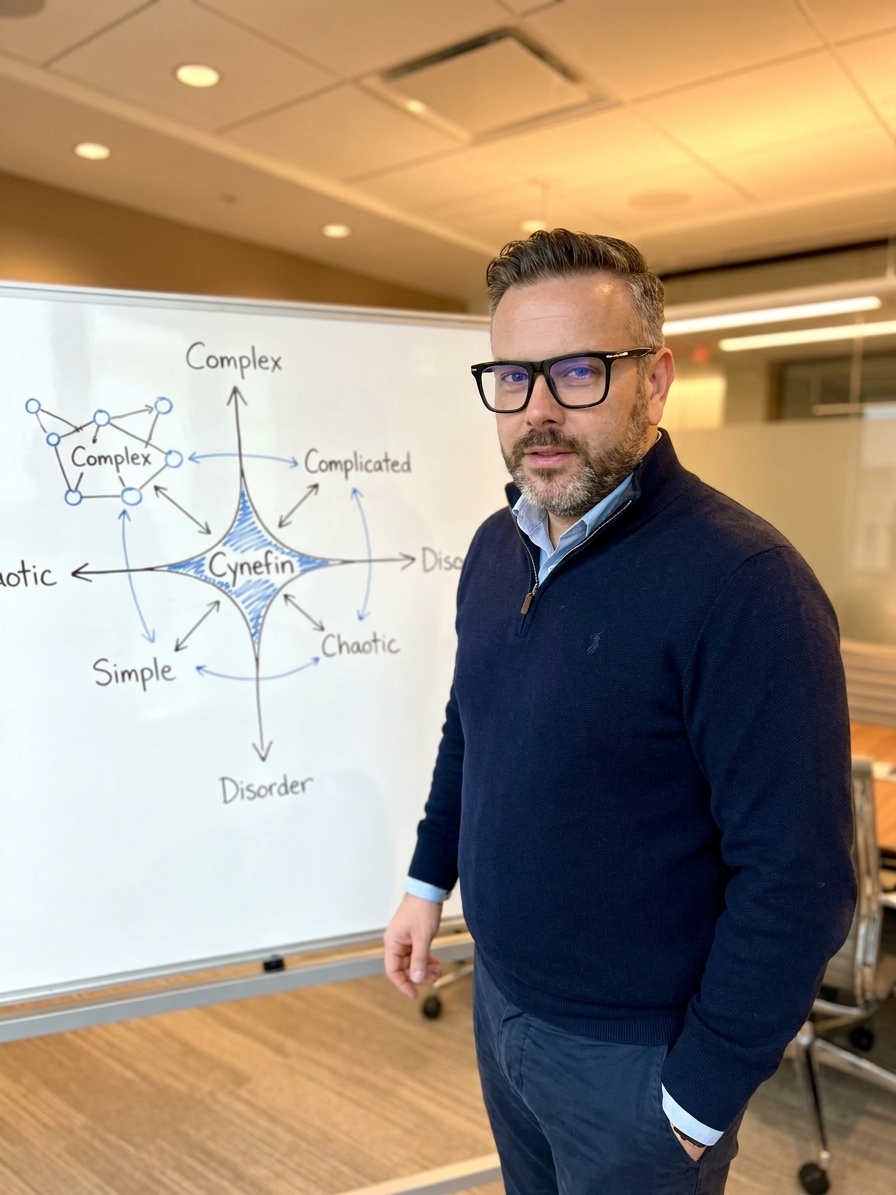
Developed by Dave Snowden in 1999, the Cynefin Framework (pronounced
“kuh-NEV-in,” from the Welsh word for “habitat”) is a sense-making model
that helps leaders understand that not all problems are created equal.
It divides situations into five domains, each with its own
characteristics and — critically — its own appropriate response
strategy.

The five domains are:

Clear (formerly “Simple”): Cause and effect are
obvious. Best practices exist. The right approach is to sense the
situation, categorize it, and respond with the known solution.

Complicated: Cause and effect exist but are not
obvious. Expert analysis is needed. The right approach is to sense the
situation, analyze it with expertise, and respond based on that
analysis.

Complex: Cause and effect can only be understood in
retrospect. There are no right answers — only emerging patterns. The
right approach is to probe (experiment), sense what happens, and respond
based on what emerges.

Chaotic: Cause and effect are impossible to
determine. The situation is turbulent and unstable. The right approach
is to act to establish stability, sense what’s happening, and respond to
move the situation toward a manageable domain.

Confusion (Disorder): You don’t know which domain
you’re in. The priority is to gather enough information to move into one
of the other four.

If this sounds academic, bear with me. Because what it means for
quality organizations is profound — and most quality systems are
designed as if every problem lives in the Clear or Complicated domain,
when in reality, some of your most important problems live in Complex or
Chaotic territory.

The
Clear Domain: Where Your Quality System Works Beautifully

A turned shaft comes in at 47.82 mm instead of the specified 48.00
±0.05 mm. The operator measures it, flags it as non-conforming, and the
disposition process kicks in. Root cause: tool wear on the lathe.
Corrective action: adjust the tool change interval. Problem solved.

This is the Clear domain. The relationship between cause and effect
is transparent. The problem is well-defined, the cause is identifiable,
and the solution is known. Your quality system — your FMEAs, your
control plans, your SPC charts, your 8D process — was built for exactly
these situations.

And here’s the thing: for Clear problems, these tools are
exceptional. SPC tells you when a process has drifted before you’ve
produced defects. FMEA helps you anticipate known failure modes.
Standard work ensures consistent execution. CAPA closes the loop on
identified problems.

The trap in the Clear domain is complacency — assuming that because
the solutions are known, no thinking is required. But the domain itself
is well-served by existing quality tools.

Most organizations are comfortable here. This is where six sigma
projects live. This is where DMAIC excels. This is where your quality
engineers feel confident and your managers feel in control.

The trouble starts when a problem shows up that doesn’t belong here,
and you treat it as if it does.

The
Complicated Domain: Where Expertise Saves You

A pcb assembly has an intermittent failure that shows up in 0.3% of
units but only after 200+ hours of field operation. Your SPC charts show
nothing. Your FMEA didn’t predict this. The failure mode doesn’t match
any known pattern.

This is the Complicated domain. There IS a cause-and-effect
relationship, but it’s not obvious. It requires expert analysis — deep
technical knowledge, sophisticated diagnostic tools, and patient
investigation. An electrical engineer traces the failure to a specific
via that develops a micro-crack under thermal cycling, caused by a
subtle change in the board manufacturer’s lamination process that was
within specification but changed the stress profile of the assembly.

The Complicated domain is where your best quality engineers earn
their keep. It’s where DOE (Design of Experiments) is invaluable —
because you need to systematically test multiple variables to find the
ones that matter. It’s where advanced root cause analysis techniques
like fault tree analysis or Kepner-Tregoe shine.

The key characteristic: there IS a right answer. You just need
expertise to find it. Given enough time and the right experts, the
problem can be fully understood and permanently solved.

Most organizations are reasonably comfortable here too, as long as
they have access to the right expertise. The problems that break them
are the ones in the next domain.

The
Complex Domain: Where Your Quality System Falls Apart

Here’s where things get uncomfortable.

A Tier 1 automotive supplier implements a new quality management
system. They train everyone. They document every process. They pass
their IATF 16949 audit with zero nonconformities. And over the next
eighteen months, their customer complaint rate doubles.

Root cause analysis reveals… nothing definitive. The operators
followed the procedures. The inspections were performed. The
documentation was complete. The quality system, by every measurable
standard, was working as designed. But something about the way people
interacted with the new system — the subtle shifts in ownership, the
slight delay in escalation when someone noticed something unusual, the
way the new documentation requirements changed the rhythm of
communication between shifts — created gaps that didn’t exist
before.

This is the Complex domain. There is no single root cause. There is
no linear cause-and-effect relationship. The problem emerged from the
interaction of multiple factors — human, technical, organizational,
cultural — in ways that could not have been predicted in advance.

And here’s the critical insight: the tools that work in Clear
and Complicated domains make Complex problems worse.

When you apply root cause analysis to a complex problem, you force a
linear narrative onto a non-linear reality. You identify a “root cause”
that makes everyone feel better but addresses only one thread of a
tangled web. You implement a “corrective action” that shifts the problem
somewhere else rather than resolving it.

When you apply DMAIC to a complex problem, the Define phase creates a
boundary that excludes the very interactions causing the issue. The
Measure phase quantifies things that are measurable while missing the
emergent properties that are significant. The Improve phase optimizes a
subsystem while degrading the system.

This is not a criticism of these tools. It’s a recognition that they
were designed for a different type of problem.

What Works in the Complex
Domain

In the Complex domain, the appropriate strategy is
probe-sense-respond. You run safe-to-fail experiments.
You try small interventions and observe what happens. You amplify what
works and dampen what doesn’t. You accept that understanding emerges
from action rather than preceding it.

What does this look like in quality practice?

Instead of launching a massive root cause investigation into why
customer satisfaction scores are declining, you run multiple small
probes: change the communication frequency with one customer segment,
adjust the inspection protocol on one product line, test a different
escalation pathway for one type of complaint. You watch what happens.
You learn from the patterns that emerge.

Instead of redesigning your entire quality system to address a
systemic issue, you create “safe-to-fail” experiments — small,
reversible changes that test hypotheses about what might improve the
situation. Some will work. Some won’t. The ones that work become the
foundation for broader changes.

This is fundamentally different from the plan-execute-verify approach
that dominates quality management. It requires a different mindset,
different leadership behaviors, and different success metrics.

The Toyota Production System understood this intuitively. The
emphasis on small, incremental experiments (kaizen), on going to the
gemba to observe actual conditions, on empowering workers to make local
improvements — these are probe-sense-respond behaviors. Toyota didn’t
solve complex problems through analysis. It solved them through
iterative experimentation.

The
Chaotic Domain: Where Speed Matters More Than Analysis

A manufacturing plant discovers that a critical safety component has
been produced with a material substitution for the past three weeks. The
parts are already in the field. The failure mode is potentially
catastrophic. Nobody has a playbook for this exact scenario.

This is the Chaotic domain. There’s no time for analysis. There’s no
opportunity for experimentation. The priority is to act — immediately —
to establish stability and prevent harm.

The quality response in this domain is fundamentally different from
the other three. The first priority is containment: stop the bleeding.
Recall the parts, quarantine the inventory, notify the customers, halt
the production line. Don’t try to understand the problem yet — just stop
it from getting worse.

Once stability is established, you can begin the process of moving
the situation into a domain where more sophisticated responses are
possible. The investigation can begin. The root cause analysis can
start. But those activities come AFTER the crisis has been
contained.

Many quality organizations struggle here because their processes are
designed for thoroughness, not speed. A CAPA system that requires
multiple levels of approval before action can be taken is dangerous in a
chaotic situation. An escalation process that routes decisions through
three layers of management is too slow when the problem is actively
harming customers.

The best quality organizations build crisis-response pathways that
bypass normal governance. They define in advance who has the authority
to stop a line, quarantine a product, or notify a customer without
seeking approval. They practice these responses through simulations so
that when chaos arrives, the response is automatic rather than
bureaucratic.

After the immediate crisis is contained and the situation is
stabilized, the organization can — and should — apply more sophisticated
problem-solving approaches. But the initial response to chaos must be
fast, decisive, and unencumbered by process designed for calmer
domains.

The
Most Dangerous Mistake: Applying Clear-Domain Solutions to Complex
Problems

Here’s why understanding Cynefin matters for quality professionals:
the most common and most damaging mistake in quality management is
applying Clear-domain responses to Complex-domain problems.

An organization has a culture problem — people don’t escalate
concerns, defects get hidden, and quality data is unreliable. The
leadership team, trained in six sigma and accustomed to structured
problem-solving, responds by creating a new escalation procedure, adding
more documentation requirements, and implementing a quality metrics
dashboard.

The problem gets worse. The new procedures add burden without
addressing the underlying trust issue. The additional documentation
creates more opportunities for people to appear compliant without
actually being transparent. The dashboard measures things that are easy
to measure while missing the human dynamics that drive the real
problem.

This is not a failure of the tools. It’s a failure of diagnosis. The
organization treated a Complex problem as if it were Clear, and the
result was a solution that looked rigorous but was fundamentally
mismatched to the nature of the problem.

I’ve seen this pattern repeat across dozens of organizations. A
complex supply chain quality issue gets treated with tighter
specifications on individual components — which doesn’t address the
interaction effects between components that are causing the actual
problem. A complex organizational change gets treated with more training
— which doesn’t address the incentive structures that are driving the
wrong behaviors. A complex customer satisfaction issue gets treated with
more frequent inspection — which doesn’t address the design decisions
that created the dissatisfaction in the first place.

How to
Apply the Cynefin Framework in Quality Management

The first step is diagnostic: before you open your 8D template or
launch your DMAIC project, ask which domain you’re operating in.

Ask yourself:

  • Is the cause obvious or easily identifiable? → Clear domain. Apply
    best practices.
  • Is there a cause, but it requires expert analysis to find? →
    Complicated domain. Bring in the experts and apply good practices.
  • Is the problem emerging from multiple interacting factors with no
    clear linear cause? → Complex domain. Run experiments and iterate.
  • Is the situation a crisis requiring immediate action? → Chaotic
    domain. Contain first, analyze later.
  • Are you unsure which of these applies? → Confusion. Gather more
    information before committing to an approach.

The second step is matching your tools and approaches to the
domain:

Clear: Checklists, standard work, SPC, FMEA, control
plans. These are your reliable workhorses. Use them with confidence.

Complicated: DOE, advanced RCA techniques, expert
consultation, fault tree analysis, Kepner-Tregoe. Invest in expertise.
Take the time to analyze thoroughly.

Complex: Probe-sense-respond. Run safe-to-fail
experiments. Use narrative methods to understand what’s happening.
Embrace emergence. Look for patterns rather than root causes.

Chaotic: Act immediately to contain. Establish
stability. Practice crisis response in advance. Build authority pathways
that work at speed.

The third step is the hardest: recognizing when a problem has shifted
domains. A problem that starts in the Chaotic domain (a crisis) often
shifts to Complex as you begin to understand it, then to Complicated as
patterns emerge, and eventually to Clear as solutions become
standardized. Your approach needs to evolve with it.

Many organizations get stuck because they apply a Chaotic-domain
response (command and control) to what has become a Complex problem, or
they apply a Clear-domain response (standard operating procedure) to
what is actually a Complicated problem requiring fresh analysis.

The Pattern Language
of Quality Problems

One practical approach I’ve found valuable is developing a “pattern
language” for quality problems — a shared vocabulary that helps teams
quickly identify which domain they’re operating in.

When a team member says “We’ve seen this before,” they’re identifying
a Clear-domain problem. The response should be to apply the known
solution.

When they say “I’m not sure what’s causing this, but I have some
hypotheses,” they’re in the Complicated domain. The response should be
to investigate systematically.

When they say “Something’s not right, but I can’t put my finger on it
— the pieces don’t add up,” they’re sensing a Complex-domain problem.
The response should be to probe and experiment rather than to analyze
and solve.

When they say “Everything is going wrong at once,” they’re in the
Chaotic domain. The response should be to contain and stabilize.

This shared language doesn’t replace technical expertise. It
supplements it by ensuring that the type of thinking applied to
a problem matches the nature of the problem.

What This Means for Quality
Leaders

If you’re a quality leader, the Cynefin Framework has several
practical implications:

First, diversify your toolkit. Most quality
organizations are heavily invested in Clear and Complicated domain
tools. Invest equally in capabilities for the Complex domain:
experimentation frameworks, narrative sense-making methods,
cross-functional collaboration skills, and the ability to design and run
safe-to-fail probes.

Second, train your people in diagnosis before
solution.
Before teaching people how to solve problems, teach
them how to identify what type of problem they’re facing. A brilliant 8D
investigation applied to a Complex problem is wasted effort. A
well-designed experiment applied to a Clear problem is unnecessary
complexity.

Third, build organizational adaptability. The
organizations that excel at quality are not the ones with the most
rigorous processes — they’re the ones that can shift their approach
based on the nature of the problem they’re facing. This requires
flexibility in governance, speed in decision-making, and a culture that
values diagnosis as much as solution.

Fourth, resist the urge to force every problem into a
familiar domain.
It’s comforting to believe that every quality
problem has a root cause that can be found through disciplined
investigation. Some problems don’t. Some problems emerge from the
complexity of your systems, your people, your supply chain, and your
markets. Forcing these problems into a linear framework doesn’t solve
them — it just makes you feel better about not solving them.

Fifth, develop your ability to tolerate ambiguity.
In the Complex domain, you won’t have a clear answer before you act.
You’ll need to experiment, observe, and iterate. This requires a
different kind of confidence — not the confidence of knowing the answer,
but the confidence of knowing how to find the answer through disciplined
exploration.

The Bigger Picture

The quality profession has been built on a foundation of reductionism
— the belief that complex systems can be understood by breaking them
into parts and optimizing each part. This approach has delivered
extraordinary results: six sigma processes, zero-defect manufacturing,
ISO management systems that ensure consistency across global
operations.

But the problems that remain — the ones that keep quality leaders
awake at night — are the ones that don’t yield to reductionist thinking.
They’re the problems that emerge from complexity: culture, trust,
adaptation, emergence, systemic interaction. These problems don’t have
root causes. They have patterns. They don’t have solutions. They have
trajectories.

The Cynefin Framework doesn’t replace your existing quality tools. It
gives you the wisdom to know when to use them — and when to reach for
something different.

Your organization doesn’t need better root cause analysis. It needs
better problem diagnosis. It doesn’t need more rigorous corrective
action procedures. It needs the ability to match its approach to the
nature of the problem it’s facing.

The next time your team opens an 8D template, pause. Ask: what type
of problem are we dealing with? Is the cause obvious? Is it hidden but
findable? Is it emergent and non-linear? Or is the house on fire?

The answer to that question determines everything that follows.


Peter Stasko is a Quality Architect with 25+ years of experience
transforming organizations across automotive, aerospace, and
pharmaceutical industries. He has led quality transformations across
three continents and believes that the most important quality tool is
the one that matches the problem you’re actually facing — not the one
you’re most comfortable using.

Scroll top