The
Metric Everyone Knows and Almost Nobody Uses Correctly
Overall Equipment Effectiveness — OEE — is simultaneously the most
widely adopted manufacturing metric of the last twenty years and the
most consistently misused. Walk into any factory on the planet and ask
the plant manager what their OEE is. They will give you a number. Ask
them how they calculated it. Watch the conversation shift from
confidence to vagueness in under thirty seconds.
That shift is the entire problem.
OEE was conceived by Seiichi Nakajima in the 1960s as the central
diagnostic pillar of Total Productive Maintenance. The formula is
elegant in its simplicity: Availability multiplied by Performance
multiplied by Quality. Three ratios, each capturing a distinct dimension
of equipment effectiveness, multiplied together to produce a single
percentage that tells you how well a machine is being used compared to
its theoretical maximum. When Nakajima proposed a world-class benchmark
of 85%, he was describing an aspirational target that most organizations
would spend decades chasing.
The formula itself is not the problem. The formula is mathematically
sound. The problem is what happens when a metric this powerful becomes a
reporting obligation rather than a diagnostic instrument. Organizations
do not fail at OEE because the math is hard. They fail because every
human being involved in the calculation has an incentive to inflate,
smooth, or manipulate one of the three components — and over time, the
manipulation becomes so embedded in the process that nobody remembers
what the real number was supposed to be.
The Three
Components and Where Each One Goes Wrong
Let us walk through each component carefully, because this is where
the fine differences live.
Availability is the ratio of actual run time to
planned production time. You take the scheduled time, subtract downtime
(unplanned stops, planned stops that ran over, changeovers), and divide
by the scheduled time. Simple. Except that nobody agrees on what counts
as planned downtime, what counts as a changeover, whether preventive
maintenance windows should be included, whether lunch breaks count
against the machine, and whether the fifteen minutes the operator spent
looking for a fixture is a downtime event or just normal production
reality.
In practice, Availability is the most manipulated of the three
components because it is the most visible. Plant managers are judged on
machine uptime. When the number looks bad, the response is rarely “let
us investigate the root causes of downtime.” The response is usually to
reclassify what counts as downtime. The thirty-minute meeting the team
held next to the machine? That was a quality discussion, not downtime.
The two hours waiting for raw materials? That was a supply chain issue,
not an equipment issue. The four hours the machine sat idle because the
previous shift did not leave it ready? That is a shift-handover problem,
not an availability problem. Each reclassification makes the number look
better and the underlying problem harder to find.
Performance is the ratio of actual cycle time to
ideal cycle time. In principle, this measures whether the machine is
running at its designed speed. In practice, ideal cycle time is one of
the most contested numbers in any factory. Engineering says the machine
should run at 120 parts per minute based on the OEM specification. The
operator runs it at 95 parts per minute because at 120 the machine jams
and they have to stop and clear it, which hurts Availability. The
production manager knows the nameplate speed is theoretical and has
informally agreed with the operators to run at 100. Nobody documents
this agreement. The OEE calculation uses 120 as the ideal because that
is what the spec sheet says, and Performance looks fine.
The deeper problem with Performance is that it rewards running a
machine faster than the process can sustainably handle. If you push
cycle times to maximize the Performance ratio, you may produce more
scrap, which hurts the Quality ratio. Or you may increase wear on
tooling, which increases unplanned downtime next week, hurting
Availability. The three components are not independent variables. They
are coupled in ways that the multiplication obscures, and optimizing one
in isolation almost always degrades another.
Quality is the ratio of good parts to total parts
produced. This is theoretically the easiest to measure because you are
counting physical things. In practice, Quality is distorted by what you
count as a reject. Does a part that fails first-pass inspection but is
reworked count as good, bad, or a separate category? Does a part
scrapped during setup count against the machine’s Quality ratio or is it
excluded as startup scrap? Does a part that the customer returns six
months later get retroactively applied to the OEE calculation from the
month it was produced? These are not academic questions. They are the
questions that determine whether your OEE is 65% or 82%, and the answers
vary by facility, by shift, and by who is asking.
The
Multiplication Problem: Why the Final Number Hides More Than It
Reveals
Here is a mathematical truth that most OEE practitioners do not
internalize: when you multiply three percentages together, the result is
always lower than the lowest individual component. An Availability of
90%, Performance of 95%, and Quality of 98% — all respectable numbers
individually — produce an OEE of 83.8%. This is not a bug. It is the
point. Nakajima designed it this way because he wanted a single number
that would refuse to let organizations hide behind one good
dimension.
But the multiplication creates a perverse incentive structure.
Because the final number is dominated by the weakest component,
improving your worst area produces the largest OEE gain. This should
drive organizations to focus on their biggest loss. Instead, it drives
them to argue about which component is artificially low and whether the
calculation methodology needs to be revised.
You will hear conversations like this: “Our Availability is only 72%
because we are counting changeover time against it. If we excluded
changeovers, Availability would be 89% and our OEE would jump from 62%
to 76%.” This is not wrong in a technical sense — changeover
classification is genuinely a methodological choice. But the intent
behind the argument reveals everything. The goal is not to reduce
changeover time. The goal is to produce a number that looks better
without changing anything on the shop floor.
The
Six Big Losses: The Framework That Makes OEE Actually Useful
Nakajima did not propose OEE as a standalone number. He proposed it
as the entry point to the Six Big Losses framework — a structured
taxonomy of the specific reasons equipment effectiveness degrades. The
Six Big Losses are:
- Equipment failure (breakdowns) — Unplanned stops
due to mechanical, electrical, or software failures. Addressed by
autonomous maintenance and preventive maintenance. - Setup and adjustments — Time lost to changeovers,
tool changes, and machine warm-up. Addressed by SMED methodology. - Idling and minor stoppages — Brief interruptions
(under five minutes) that are too small to warrant a maintenance call
but cumulatively destroy throughput. Addressed by identifying and
eliminating recurring micro-causes. - Reduced speed — The gap between ideal cycle time
and actual cycle time. Addressed by understanding why operators
deliberately run below nameplate speed and fixing the underlying
constraints. - Process defects (scrap) — Parts that cannot be
used. Addressed by root cause analysis and process capability
improvement. - Reduced yield (startup losses) — Parts lost during
the period between machine startup and stable production. Addressed by
standardizing startup procedures and reducing warm-up cycles.
The genius of this framework is that each loss maps to a specific
component of OEE. Losses 1 and 2 reduce Availability. Losses 3 and 4
reduce Performance. Losses 5 and 6 reduce Quality. If you measure OEE
but do not track and attack the Six Big Losses, you have a score without
a game. You know the number is bad, but you have no systematic way to
improve it.
This is where most organizations fail. They implement OEE as a
dashboard metric — a number displayed on a screen in the production
office that goes up or down each month. They do not connect the number
to the loss taxonomy. They do not assign owners to each loss category.
They do not set reduction targets for specific losses. They just watch
the number and hope it improves, and when it does not, they adjust the
calculation.
The
Automation Trap: When Software Replaces Understanding
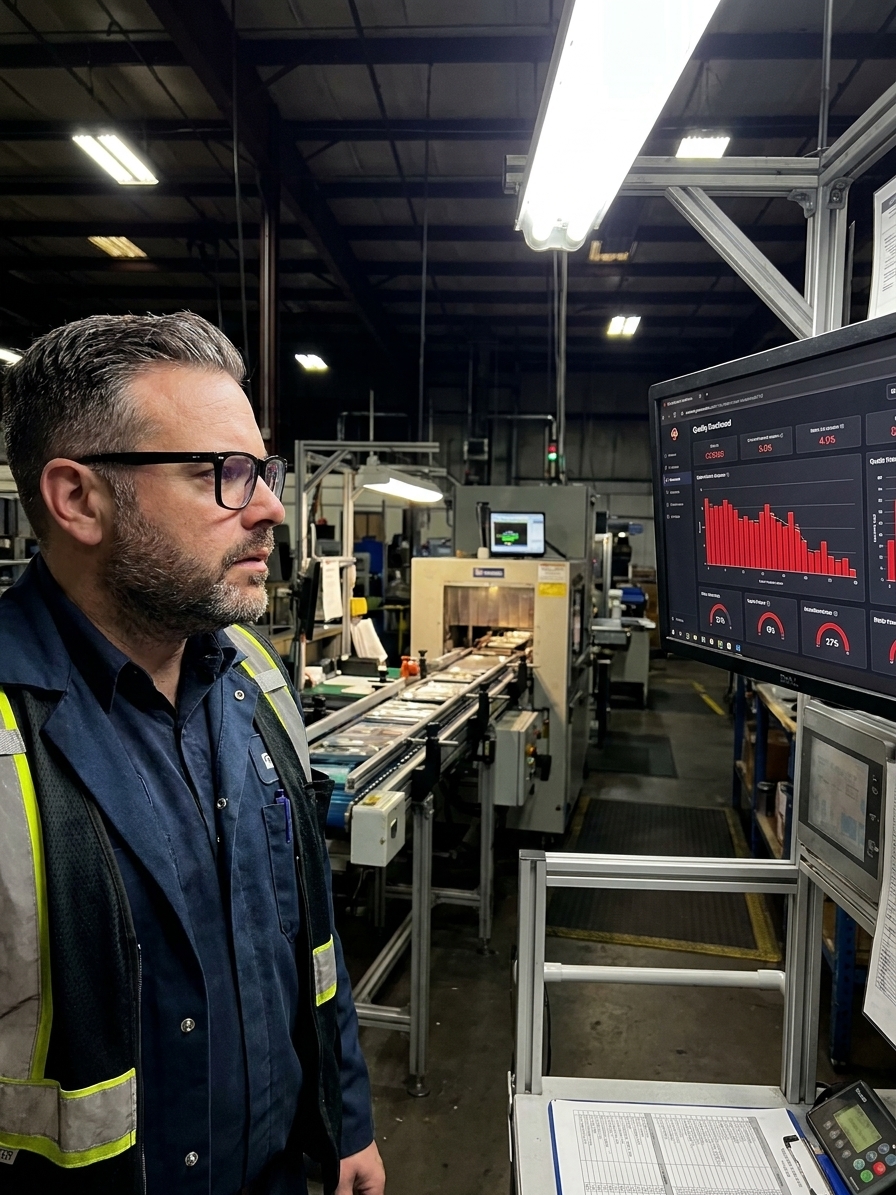
The OEE software market is substantial. Vendors sell systems that
automatically collect machine data, calculate OEE in real time, and
display dashboards on screens throughout the factory. These systems are
marketed as the solution to manual data collection — and they can be,
when implemented correctly.
But automation introduces its own failure mode. When operators
manually recorded downtime reasons on paper logs, they had to think
about each stoppage, categorize it, and write it down. The process was
tedious and inaccurate, but it forced engagement with the loss. When a
machine is connected to an IoT gateway that automatically records
downtime based on PLC signals, nobody needs to think about anything. The
system generates data. The data generates dashboards. The dashboards
generate meetings. The meetings generate questions about the data. The
questions generate requests for the IT team to adjust the classification
rules. And the improvement cycle never starts because everyone is busy
debating the accuracy of the measurement instead of addressing the
losses the measurement was supposed to reveal.
The most effective OEE implementations use a hybrid approach:
automated data collection for the raw numbers (run time, cycle counts,
scrap counts) combined with human input for downtime reason codes. The
human input is what drives improvement because it forces the team to
diagnose each loss event. A machine that stopped for twenty minutes is
data. A machine that stopped for twenty minutes because the feed
mechanism jammed on a specific raw material lot because the supplier
changed the surface finish without notification is knowledge. The first
goes on a dashboard. The second drives a supplier corrective action
request.
OEE
Targets: The 85% Myth and the Danger of Benchmarks
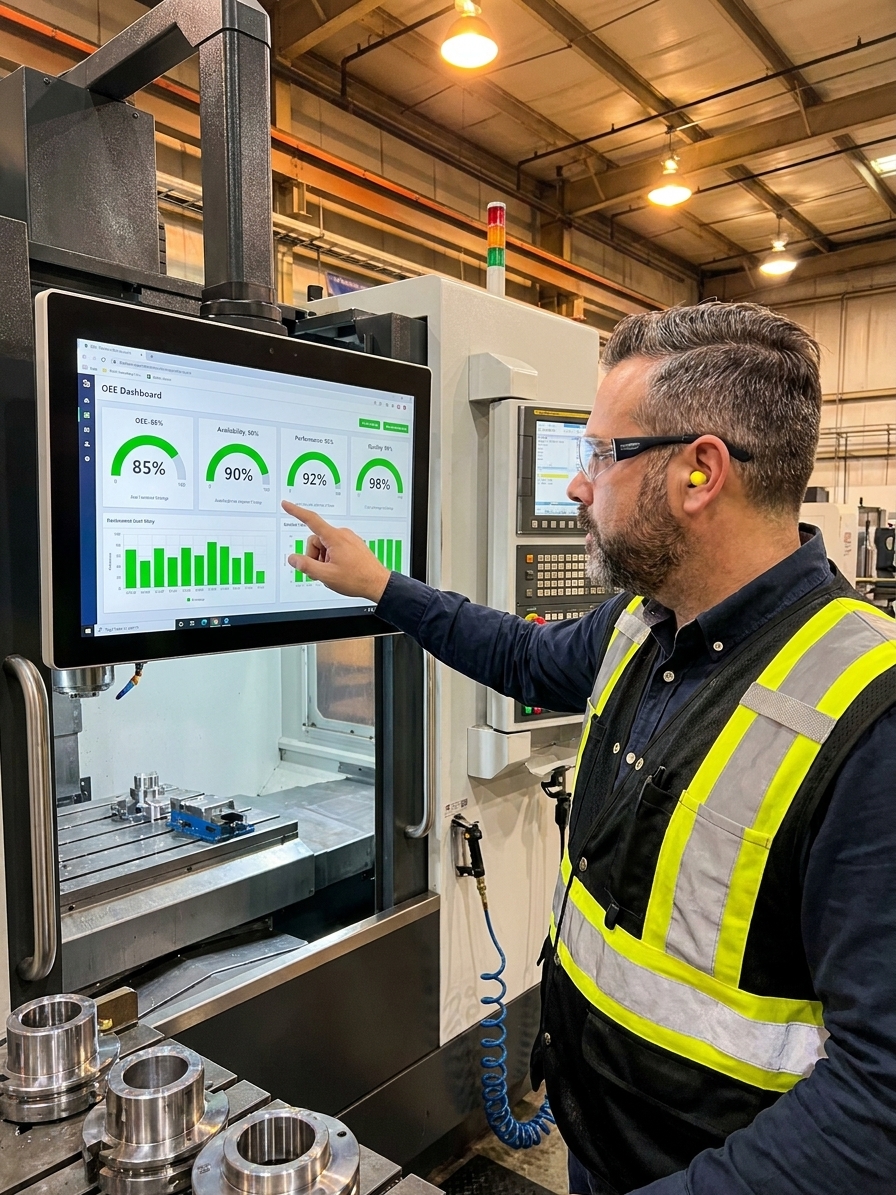
Nakajima’s 85% benchmark (90% Availability, 95% Performance, 99%
Quality) was proposed as a world-class standard. It has become, through
decades of repetition, the default target that organizations set for
themselves regardless of their starting point, their industry, their
equipment age, or their product mix.
This is destructive in two directions. For organizations starting at
45-55% OEE — which is typical for a factory that has never
systematically measured equipment effectiveness — the 85% target is so
distant that it feels unattainable, which means nobody takes it
seriously as a near-term goal. For organizations that have been
measuring for years and are stuck at 68-72%, the 85% target creates
pressure to manipulate the calculation rather than acknowledge that some
equipment may never reach world-class performance due to age,
complexity, or product requirements.
The honest approach is to set targets based on the current baseline
and the rate of improvement, not on a benchmark derived from a different
industry in a different era four decades ago. A factory that moves from
52% to 61% OEE in twelve months has achieved something significant. A
factory that claims 86% OEE because it reclassified half its downtime is
lying to itself. The first factory will keep improving. The second
factory has destroyed the diagnostic value of the metric to hit a
number, and it will never know where its real losses are.
OEE in Batch vs.
Continuous Manufacturing
The original OEE framework was developed for discrete manufacturing —
stamping presses, machining centers, assembly lines where parts are
counted individually. The methodology gets progressively more contested
as you move toward batch and continuous processes.
In a chemical plant, what is a part? In a paper mill, how do you
define a cycle? In a pharmaceutical tablet press, is a tablet a part or
is a batch a part? These are not trivial questions because the
Performance component depends entirely on how you define the unit of
production. Batch manufacturers have developed modified OEE frameworks
that weight by mass or volume rather than count, but these introduce
their own ambiguities around yield, moisture content, and density
variations.
The core principle — measure how effectively equipment is being used,
decompose the losses, attack them systematically — applies to any
process. But the mechanical application of the original OEE formula to
non-discrete manufacturing without thoughtful adaptation produces
numbers that are technically precise and practically meaningless.
The
Cultural Dimension: What OEE Reveals About Your Organization
If you want to understand an organization’s quality culture, ask to
see their OEE data and then ask what they did with it. The answer will
tell you everything.
Organizations with a genuine improvement culture use OEE as a
flashlight. They do not hide bad numbers. They do not adjust
calculations to make the trend look favorable. They publish the raw
data, decompose it into the Six Big Losses, assign cross-functional
teams to attack the largest loss, and measure the result. Their OEE
numbers may not be world-class, but they are improving, and everyone in
the organization understands why.
Organizations with a compliance culture use OEE as a report. The
number is generated because headquarters requires it. It is reviewed in
a monthly meeting where nobody asks a substantive question. It trends
slightly upward over time because the calculation methodology is quietly
revised each year. And the actual equipment losses — the jams, the setup
overruns, the startup scrap, the deliberate slow running — continue
unaddressed on the shop floor while the dashboard glows green in the
conference room.
The difference between these two organizations is not the formula. It
is not the software. It is not the target. It is whether the
organization treats the number as a starting point for investigation or
as an endpoint for reporting. That choice, more than any methodology or
tool, determines whether OEE delivers value or just consumes the time
and attention of everyone involved.
Practical
Implementation: Doing It Right
If you are implementing OEE for the first time, or rescuing an
implementation that has degraded into reporting theater, the path
forward is the same:
Start with one line, not the whole plant. Pick your
most critical production line. Measure it manually for the first month.
Have operators log every stoppage with a reason code. This builds
understanding of the loss structure before you invest in automated
systems that will obscure it.
Define your terms before you collect data. Write
down what counts as planned downtime, what ideal cycle time means for
each product, and how scrap is classified. Get the production,
engineering, and quality teams to agree on these definitions in writing.
Every future argument about the number will trace back to an ambiguity
you failed to resolve here.
Decompose into the Six Big Losses from day one. Do
not report a single OEE number. Report Availability, Performance, and
Quality separately, and beneath each, show the loss categories. The
number is not the insight. The loss structure is the insight.
Set improvement targets on specific losses, not on
OEE. “Reduce changeover time on Line 3 from 47 minutes to 25
minutes by Q4” is an actionable target. “Improve OEE from 64% to 70%” is
a wish.
Review the data on the shop floor with the people who operate
the equipment. The operators know why the machine jams at 120
parts per minute. They know which raw material lots cause startup scrap.
They know the changeover steps that are unnecessary. If your OEE review
happens in a conference room without operators, you have access to 20%
of the knowledge available. If it happens on the shop floor with the
people who run the machine, you have access to 100%.
Never adjust the calculation to improve the number.
The moment you do, the metric dies. It may take years for the corpse to
stop moving, but it is dead. Every future number will be suspect. Every
trend will be debatable. The trust between the shop floor and the
management office — already fragile in most organizations — will be
broken in a way that takes years to rebuild.
The Real Measure of OEE
Success
The ultimate test of whether your OEE implementation is working is
not the number itself. It is whether the operators on the floor can tell
you, without looking at a dashboard, what their biggest loss category is
and what they are doing about it. If they can, OEE is working as a
diagnostic tool. If they cannot, OEE is working as a reporting
obligation — and no amount of software, dashboards, or methodology
refinement will fix that. Only leadership can.
Nakajima gave the manufacturing world a formula. The formula is fine.
What the manufacturing world did with it — that is the story worth
examining. And in most factories, it is a story of a powerful diagnostic
instrument reduced to a compliance metric, of potential insight traded
for political comfort, and of a number that was supposed to drive
improvement becoming the reason improvement never happens.
The organizations that reverse this pattern — that use OEE as a
flashlight instead of a scorecard — are the ones that achieve the gains
the framework was designed to deliver. The ones that do not will keep
adjusting the calculation, keep reporting the number, and keep wondering
why their equipment effectiveness never actually improves.
Peter Stasko is a Quality Architect with over 25 years of
experience in manufacturing quality management, process improvement, and
production system design. He has implemented OEE and Total Productive
Maintenance programs across discrete, batch, and continuous
manufacturing environments in automotive, electronics, and consumer
goods industries.