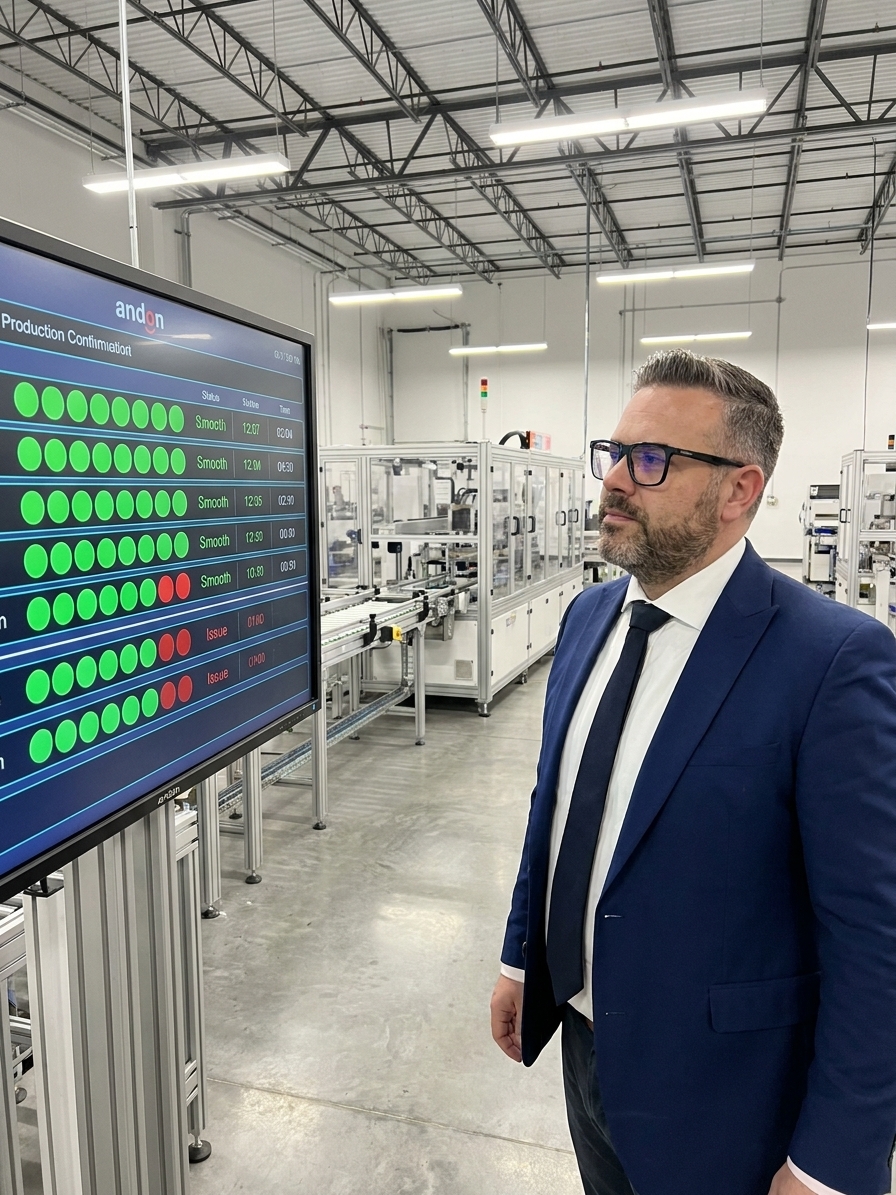
An operator notices a process drift or a surface finish defect. In that instant, a critical decision is made: stop the line, or keep running to maintain the shift target. In most manufacturing environments, the operator keeps running. The system implicitly teaches that schedule adherence matters more than immediate containment.
This behaviour guarantees that defects propagate downstream. By the time final inspection catches the nonconformance, the root cause has continued producing defective parts for minutes or hours. The resulting corrective action requires sorting, rework, and extensive root cause investigation that disrupts the next shift.
Organisations that master quality intervene differently. They use an Andon system to make abnormalities visible instantly. Derived from the Toyota Production System, Andon is a visual or auditory signal that empowers any operator to halt production. Stopping the line to fix a problem is treated as the highest standard of process discipline, not a disruption.
The containment mathematics of stopping early
Consider a production line running at 60 parts per hour. A tool insert begins to wear at Station 4. Without Andon, the operator works around the drift. The defect flows through Stations 5, 6, and 7. It reaches final inspection 27 minutes later. By that point, 27 additional defective parts have been produced.
Quality engineers must now quarantine the batch. They spend hours tracing the defect back to Station 4. Corrective action requires a tool change, but the organisation must also scrap or rework the 28 affected parts. The hidden cost of a 27-minute delay balloons into a day of non-productive administrative and quality work.
With an active Andon system, the mathematics shifts. The operator identifies the drift at Station 4 and pulls the cord. The line stops. The team leader arrives within 30 seconds. They diagnose the worn insert, replace it, and restart the line. Total downtime is three minutes. Defective parts produced: one.
The Andon Cost-Benefit Ratio
The organisation trades a small, visible cost for a large, hidden one. This is the Andon bargain. It requires a willingness to absorb immediate output losses to protect the customer and stabilise the overall process.
Installing hardware versus building a response system
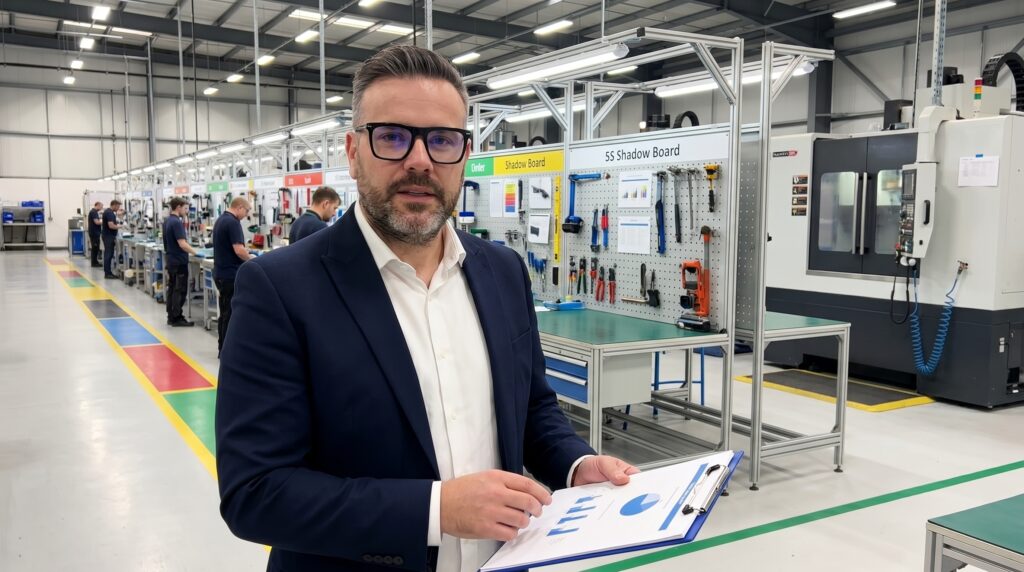
A genuine Andon system requires three operational pillars: psychological safety, response discipline, and documented closure. Without these elements, the system is mere theatre. Installing cords and digital boards changes nothing if the underlying management system penalises intervention.
Psychological safety means operators must know that pulling the cord will not result in punishment. This mandate starts with the plant manager. When an operator stops production, leadership must treat it as a successful defect catch, not a schedule failure. Tolerance is insufficient; the action must be actively celebrated.
Response discipline is the immediate reaction to the signal. When the cord is pulled, a team leader must arrive within seconds. If management fails to respond instantly, the operator learns that the signal is irrelevant. Once operators realise their escalations are ignored, they revert to working around the problem.
Closure requires linking the escalation to permanent corrective action. Every activation must end with a documented root cause analysis, typically using the 8D methodology. The operator must see that their signal resulted in a process improvement, transforming a single act of courage into a sustainable quality habit.
Three levels of organisational Andon maturity
I have audited plants that spent heavily on Andon hardware but recorded zero activations per month. Their culture silently punished delays. Operators knew that stopping the line brought immediate pressure from supervisors managing shift targets, so the expensive systems sat dormant while defects continued downstream.
Andon Maturity Model
- Level 3: Automated preventionSensors and SPC limits trigger alerts automatically before defects occur. Requires total cultural discipline.
- Level 2: Active human responseOperators pull the cord, leaders respond instantly, and root causes are permanently fixed.
- Level 1: Installed but dormantHardware exists, but culture discourages stopping. The system is ignored to protect output metrics.
Level 1 maturity is defined by expensive hardware with zero activation. Management writes the Andon procedure into standard work but fails to address the supervisor behaviours that discourage its use. The defect rate remains unchanged because the system never actually stops the process.
Level 2 maturity is where real transformation occurs. Operators pull the cord, the line halts, and supervisors respond with support. Defect rates drop, and productivity paradoxically increases because the line spends less time producing scrap that requires rework or sorting downstream.
Automating Andon without losing the human element
At Level 3 maturity, Andon becomes predictive. Sensors monitor process parameters in real time. Statistical process control (SPC) limits trigger automatic line holds before a nonconforming part is even produced. Machine learning algorithms identify patterns that precede equipment failures.
Level 3 only functions if Level 2 is already solid. Automating Andon without first building human response discipline results in a sophisticated system of ignored alerts. Technology amplifies an existing quality culture; it cannot create one from scratch.
Plants that achieve Level 3 are those that spent years building muscle memory for root cause analysis. They established absolute trust between operators and engineering. When the automated technology arrives, it simply makes their existing problem-solving cycles faster and more precise.
Digital Andon systems now extend beyond the factory floor. Cross-functional alerts notify supply chain teams of incoming material nonconformances before they reach production. Mobile alerts route the correct engineering expert to the station regardless of their location, minimising diagnostic downtime.
Technology without culture is just expensive hardware. The most sophisticated system is worthless if the culture still punishes exposure.
Building trust as a systemic quality metric
The most significant outcome of a functioning Andon system is not defect reduction. It is trust. By implementing a reliable escalation process, the organisation explicitly states that it trusts the operator's judgment over the production schedule. This inverts the traditional power dynamic of manufacturing.
Most plants operate on the assumption that operators must be closely monitored to ensure compliance. Andon shifts this paradigm. It acknowledges that the person closest to the process has the most accurate real-time data, and the organisation's role is to provide a channel for that data to drive action.
This trust propagates across the entire quality management system. Operators who feel their input is valued take active ownership of their stations. They begin initiating continuous improvements and coaching new hires on process standards, reducing long-term variation.
When an organisation proves it will respond to problems without blame, escalation rates naturally peak and then decline. The initial surge of Andon activations represents the surfacing of hidden factory issues. As permanent corrective actions eliminate these root causes, the daily activation rate drops.
Assessing your current escalation culture
To determine if your facility has a functional Andon system or expensive theatre, examine the immediate aftermath of a line stop. Assess whether the responding supervisor arrived with diagnostic support or visible frustration over the missed output target.
The Line-Stop Reaction Audit
What fails the audit
- Supervisor arrives frustrated about the schedule.
- Operator feels anxious about causing a delay.
- Incident is ignored in the morning production meeting.
- Issue is temporarily worked around to resume output.
What passes the audit
- Supervisor arrives with tools and immediate support.
- Operator is recognised for catching the defect.
- Stoppage is reviewed in the morning meeting for learning.
- Issue requires a documented 8D corrective action.
Check if the activation was documented in the morning production meeting as a learning opportunity. Review whether the operator who triggered the stop felt pride in protecting the customer, or anxiety about facing their team leader. This behavioural signal reveals more about your quality culture than any external audit.
Andon is a promise the organisation makes to its workforce: the company prefers to stop and fix rather than run and hide. Organisations that maintain this discipline consistently achieve process capability that competitors cannot match. The hardware is simple to install; the cultural discipline is the actual deliverable.