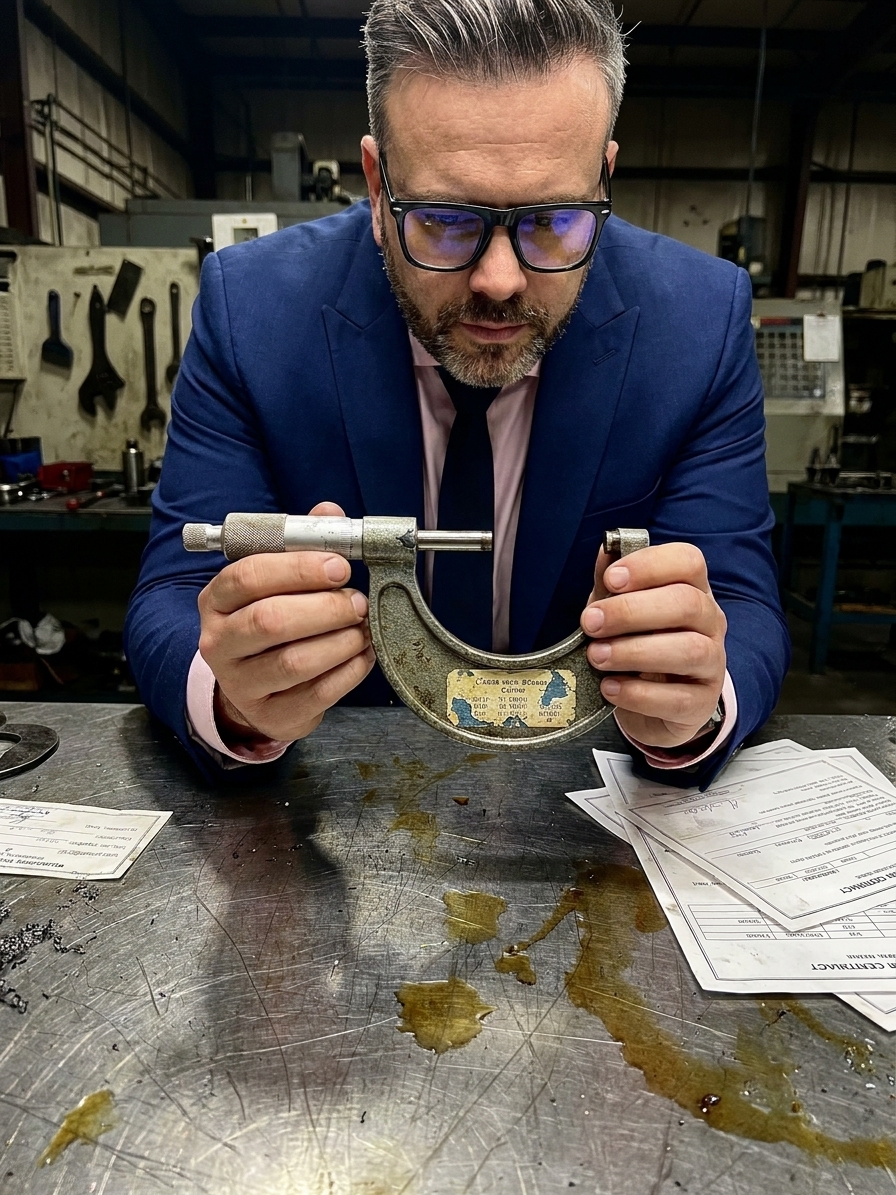
Walk into any manufacturing plant and you will find them: calibration stickers on every gauge, torque wrench, CMM, and scale. Green stickers, yellow stickers, dates, initials. They are supposed to certify that someone, at some point, verified the instrument was measuring correctly. For a brief moment after calibration, perhaps it was.
What those stickers do not tell you is how the instrument was treated between calibrations. They do not reveal whether the torque wrench was dropped on concrete three days after certification, or whether the CMM probe crashed into a fixture last Tuesday and was quietly returned to service. They do not tell you whether the calibration lab was competent, or whether it calibrated your micrometer against a standard that was itself overdue.
The sticker tells you one thing: someone performed a procedure and documented it. Whether that procedure means your measurements are accurate right now, on your production floor, at this temperature, with this operator, is a different question. It is the question almost nobody asks. I have audited plants where the calibration paperwork was immaculate and the measurement data was practically worthless, and the management could not tell the difference.
Calibration Is Not Accuracy
Calibration and accuracy are treated as synonyms in most manufacturing organisations. They are not. Calibration compares your instrument to a reference standard under controlled laboratory conditions, at a specific temperature, with a specific technician, using a defined method. It confirms the instrument read within specification at that moment, under those conditions.
Then you take that instrument to the production floor, where temperature swings twelve degrees between shifts, where the operator applies force inconsistently, where the part is oily, and where the fixture introduces error absent from the calibration lab. You use it to make a pass-fail decision on a two-micrometre tolerance. The calibration certificate covers none of this.
Your organisation acts as though it does. You treat the calibration sticker as a guarantee of measurement accuracy at the point of use, but that guarantee was never made by anyone. It was inferred by people who did not understand the difference between laboratory conformance and shop-floor reality, and it has been perpetuated by audit systems that reward documentation over measurement integrity.
Intervals Chosen by Calendar, Not Data
Ask how your organisation decided that torque wrenches need calibration every six months, or that calipers need it annually. In most plants, someone looked at what seemed reasonable, copied another plant's schedule, or defaulted to the manufacturer's recommendation without analysing how the instrument performs in its specific application. This is not calibration interval management. It is calendar management.
Proper interval analysis requires historical calibration results showing drift over time, usage frequency and severity, environmental conditions at point of use, and the consequences of measurement error for each application. With this data, you can statistically determine optimal intervals that balance the risk of error against the cost of calibration. Almost no plant does this. They pick intervals that feel right and shorten them slightly when an instrument fails.
The result is predictable: stable instruments calibrated too often, wasting resources, while drifting instruments calibrated too rarely corrupt measurement data. Nobody knows which is which because nobody collected the data to distinguish them. The entire interval system runs on assumption rather than evidence, and the cost is invisible until a major nonconformance exposes it.
Calendar-Driven vs Data-Driven Calibration
Calendar-driven
- Fixed intervals copied from templates or manufacturer defaults
- Stable instruments over-calibrated, wasting budget and downtime
- Drifting instruments under-calibrated, allowing silent error
- No statistical basis for the interval chosen
Data-driven
- Intervals adjusted using historical drift and usage severity data
- Resources concentrated on instruments that actually drift
- Risk of measurement error quantified and balanced against cost
- Interval optimisation reviewed annually as data accumulates
The Phantom Recall Problem
An instrument returns from calibration out of tolerance. The lab flags it. The quality engineer receives the report. The correct response is straightforward: every measurement made since the last satisfactory calibration is suspect. Every part accepted or rejected with that instrument must be evaluated. If the out-of-tolerance condition could have affected acceptance decisions, parts may need recall, re-inspection, or quarantine. The customer may need notification.
What actually happens in most plants? The instrument gets adjusted or replaced. The out-of-tolerance condition is documented in a report that gets filed. The parts are already shipped, already in the field. The possibility that they were accepted incorrectly is acknowledged in theory and ignored in practice. Everyone knows a recall should happen. Nobody wants to initiate it.
The paperwork gets done, the sticker gets updated, and the implications disappear into the filing cabinet. Your calibration programme just told you your measurement data was unreliable for six months, and your organisation's response was to update the sticker and carry on. This is the phantom recall: the investigation that should happen but never does, because the consequences of conducting it are perceived as worse than the consequences of ignoring it.
Your calibration programme told you your data was unreliable for six months, and your response was to update the sticker and carry on.
Calibration Labs of Questionable Competence
Not all calibration labs are equal. Everyone nods when you say it, and then nobody checks. ISO 17025 accreditation is the gold standard for calibration laboratories. It means the lab has been assessed for technical competence, its measurement uncertainties are validated, its standards are traceable, and its processes are audited. Many calibration labs hold this accreditation. Many do not, and their customers never ask.
In manufacturing plants, the calibration function is often performed by an internal lab or by a technician whose primary qualification was availability. The internal calibration may use reference standards that are themselves overdue. The technician may not understand measurement uncertainty or the difference between accuracy and precision. Procedures may be outdated, the environment uncontrolled, and the records incomplete.
The sticker goes on regardless. The date gets written. The record enters the system. When the auditor asks whether instruments are calibrated, you say yes, because technically someone performed a procedure and documented it. The quality of that procedure, the competence of the person, and the traceability of the standards are questions asked only when something goes badly wrong. At that point, the answers are usually unacceptable.
Calibration Competence Hierarchy
- Level 1: Documented procedureSomeone performs calibration and records it. Standards traceability is assumed, not verified.
- Level 2: Internal lab with controlled environmentTemperature and humidity monitored. Reference standards calibrated externally. Uncertainty budgets absent.
- Level 3: Uncertainty budgets definedMeasurement uncertainty quantified for each instrument type. Results include uncertainty statements.
- Level 4: ISO 17025 accreditedFull technical competence assessed. Traceability chain documented and audited. Processes validated.
Ignoring the Measurement System
Calibration addresses the instrument. Measurement is performed by a system. That system includes the instrument, the fixture, the part, the environment, the method, and the operator. Calibration verifies one component under controlled conditions. It says nothing about the system as a whole, and the system as a whole is what actually generates the number you use to accept or reject product.
This is why Measurement System Analysis exists. A proper MSA study, whether a formal Gage R&R or similar analysis, evaluates the entire system: instrument, operators, parts, method, and their interactions. It quantifies how much observed variation is real part variation and how much is measurement noise. Many plants with rigorous calibration programmes have never performed one. They calibrate the gauge religiously and never check whether the gauge, as used by their operators on their parts in their environment, can distinguish good product from bad.
This is like calibrating a scale to exact specification and then weighing parts on a vibrating factory floor with an operator who places each part differently. The scale is accurate. The measurements are meaningless. Your calibration programme will never catch this because it was never designed to. MSA is the tool designed for exactly this problem, and it is the tool most plants have never properly used.
What a Real Measurement Programme Looks Like
A programme that protects measurement integrity looks fundamentally different from what most plants have. Calibration intervals are based on analysed drift data, not guesswork. Every instrument has a calibration history that is reviewed to determine optimal intervals. Instruments that drift get shorter intervals. Stable instruments get longer ones. The analysis is ongoing, and intervals adjust as data accumulates.
MSA becomes routine practice, not a one-time PPAP submission. Every critical measurement system is analysed with formal studies. Results drive decisions about instrument selection, operator training, fixture design, and measurement method. Calibration feeds into MSA; it never substitutes for it. Out-of-tolerance findings trigger real investigations: parts measured since last satisfactory calibration are identified, acceptance decisions are reviewed, customers are notified if warranted.
Critical instruments get point-of-use verification between formal calibrations. A five-minute check against a reference standard before each shift confirms the instrument is still reading correctly in its actual operating environment. For measurements driving critical acceptance decisions, uncertainty budgets are quantified and documented, covering instrument, environment, method, operator, and fixture. The acceptance decision is made with full knowledge of measurement uncertainty, not with the false precision of an instrument that displays four decimal places but is only accurate to two.
Most plants do not need a better calibration programme. They need a measurement programme that includes calibration as one component. Calibration tells you the instrument was correct at a point in time. A measurement programme tells you whether you can trust the data you are using to make decisions right now, on your floor, with your people, on your parts. Your calibration programme is probably fine. Your measurement programme is probably broken. The first step toward fixing it is admitting those are not the same thing.